


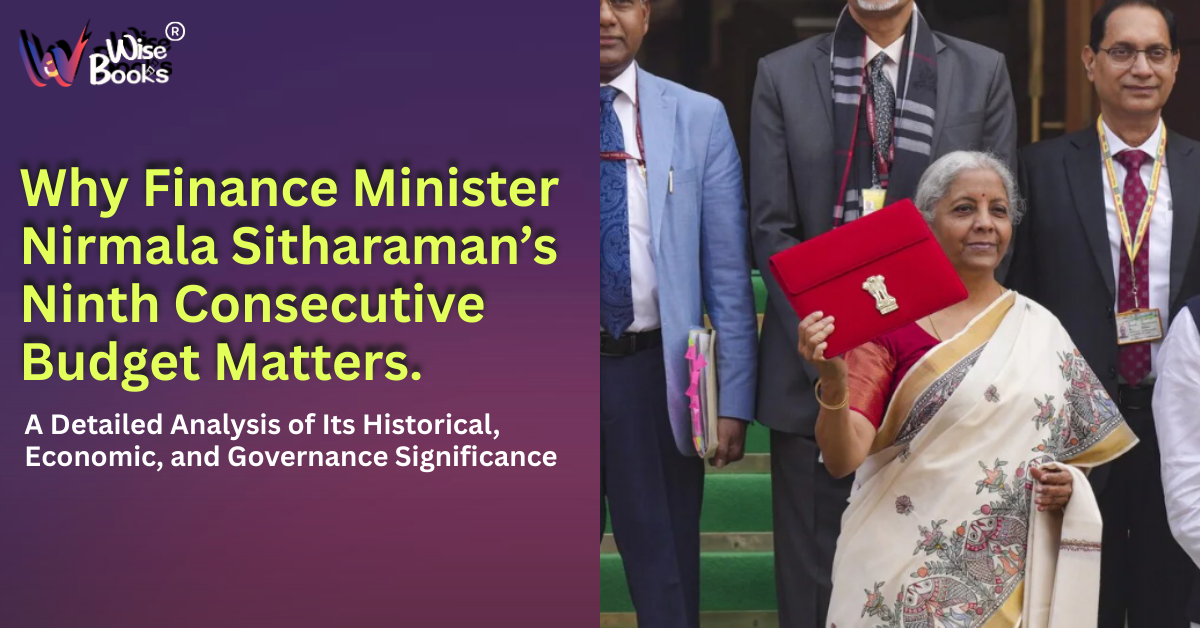
Why Finance Minister Nirmala Sitharaman’s Ninth Consecutive Budget Matters
A Detailed Analysis of Its Historical, Economic, and Governance Significance
Why This News Is Important
The announcement that Finance Minister Nirmala Sitharaman is set to present her ninth consecutive Union Budget marks a rare and significant moment in India’s economic and political history. This achievement goes far beyond numbers or records. it represents policy continuity, administrative stability, and sustained confidence in her leadership at a time when both global and domestic economies are facing constant uncertainty.
In India’s parliamentary system, finance ministers often change due to elections, cabinet reshuffles, or political transitions. Against this backdrop, delivering nine consecutive budgets signals long-term ownership of fiscal policy, enabling the government to pursue reforms with consistency rather than short-term political considerations. It also allows the finance minister to design and implement multi-year economic strategies, ensuring that reforms are gradual, predictable, and sustainable for businesses and taxpayers alike.
Historical Significance of the 9th Consecutive Budget
Pre-Pandemic Economic Reforms
Before the COVID-19 pandemic, the government focused on strengthening India’s economic foundations through structural reforms. These included GST stabilisation, corporate tax rationalisation, and initiatives to improve the ease of doing business. Such measures helped formalise the economy, encouraged compliance, and brought more businesses into the organised tax framework, creating a stronger base for future growth.
COVID-19 Crisis Management
The pandemic forced a dramatic shift in fiscal priorities from growth-driven policies to economic survival. During this period, the finance ministry rolled out emergency relief packages, liquidity support for MSMEs, tax deadline extensions, and enhanced welfare spending. Managing public finances in this phase required a delicate balance between fiscal discipline and urgent humanitarian needs, making it one of the most challenging periods of economic governance.
Post-Pandemic Recovery Phase
As the economy emerged from the pandemic, the focus shifted toward reviving demand, restoring employment, and rebuilding business confidence. The government increased capital expenditure, supported domestic manufacturing, and introduced targeted incentives to stimulate economic activity. At the same time, emergency measures were gradually withdrawn to restore fiscal normalcy.
Inflationary Pressures
Rising global inflation driven largely by energy prices and supply constraints—posed significant challenges. The government had to carefully align fiscal policy with monetary measures to control inflation without restricting economic growth. This required targeted subsidies, calibrated taxation, and prudent expenditure management to protect consumers from rising costs.
Global Interest Rate Tightening
As major global central banks raised interest rates, borrowing costs and capital flows became more volatile. India’s fiscal strategy during this period focused on maintaining investor confidence, managing government borrowing efficiently, and ensuring that domestic interest rates remained stable to support growth.
Supply Chain Disruptions
Global trade disruptions and geopolitical tensions exposed vulnerabilities in international supply chains. In response, budget policies increasingly emphasised domestic manufacturing, logistics improvement, and reduced import dependence through initiatives such as Make in India and production-linked incentives (PLI).
Rising Geopolitical Uncertainty
Ongoing global conflicts and economic fragmentation created uncertainty around trade, energy supplies, and investment flows. Budget planning under such conditions required cautious forecasting and flexible fiscal strategies to absorb external shocks while safeguarding economic stability.
The Budget-Making Team: Veterans and Fresh Faces
The article highlights that the upcoming budget is being shaped by a balanced mix of experienced bureaucrats and younger officers, ensuring both stability and innovation in policy formulation.
a) Role of Experienced Officials (Veterans)
Senior officials bring a deep understanding of fiscal deficit management, helping ensure that government revenues, expenditures, and borrowing remain within sustainable limits. Their familiarity with legacy tax structures and long-standing compliance challenges enables reforms that improve systems without disrupting existing businesses.
These officials are also skilled at assessing the long-term impact of policy decisions, ensuring that short-term relief measures do not create future fiscal stress. Their oversight promotes financial discipline, controls government borrowing, and helps protect India’s international credit ratings, which directly affect borrowing costs and investor confidence.
b) Role of New-Age Officers (Fresh Faces)
Younger officers contribute a strong focus on digitisation, automation, and data analytics, modernising tax administration and public finance systems. Their understanding of startups, MSMEs, and new-age businesses helps shape policies that support innovation and flexible compliance.
By relying on data-driven policy formulation, these officers enable more accurate and responsive decision-making. Their approach also promotes simplification of tax compliance, automation of GST, income tax, and MCA processes, and improved taxpayer services reducing disputes and enhancing transparency.
Economic Environment in Which This Budget Is Being Prepared
The upcoming budget is being drafted in a complex economic environment. India stands out as one of the fastest-growing major economies, raising expectations for responsible yet growth-oriented fiscal policies. At the same time, inflation management remains critical to ensure affordability of essential goods.
The government has reaffirmed its commitment to fiscal consolidation, signalling long-term financial discipline to investors and rating agencies. Rapid technology adoption in tax administration has improved compliance efficiency, while growing demands from middle-class taxpayers highlight the need for relief and simplification.
Other key pressures include boosting consumption, strengthening MSMEs, increasing capital expenditure, and continuing social welfare schemes. Balancing these competing priorities is one of the most significant challenges for the finance minister.
Policy Direction Reflected in Previous Budgets
Shift Toward Simpler Tax Systems
Earlier budgets show a clear push toward the new income tax regime, which offers lower rates in exchange for fewer exemptions. This approach aims to reduce complexity, increase transparency, and encourage voluntary compliance.
Emphasis on Digital Compliance
The introduction of faceless assessments, online GST filings, and technology-based scrutiny has reduced physical interaction, improved objectivity, and increased efficiency. These reforms have transformed how taxpayers and professionals interact with the tax system.
Capital Expenditure-Led Growth Strategy
Rather than relying solely on subsidies, the government has prioritised infrastructure investment in roads, railways, logistics, and digital public infrastructure. This strategy focuses on creating long-term economic capacity and sustainable growth.
Why Continuity Matters for Businesses and Taxpayers
Policy continuity ensures fewer abrupt shocks, a predictable tax environment, and a stable compliance framework. For businesses, this means better cash-flow planning, clearer tax strategies, and greater confidence in long-term investments.
For professionals in accounting, GST, and compliance, gradual system upgrades allow smoother adaptation. At the same time, evolving regulations increase demand for advisory, automation, and compliance services—creating opportunities for firms like WiseBooks.
Political and Governance Perspective
From a governance standpoint, this continuity reflects centralised economic decision-making, alignment between political leadership and fiscal policy, and a strong emphasis on administrative efficiency. The approach favours incremental reforms, avoids frequent policy reversals, and prioritises implementation over announcements, building credibility among stakeholders.
Broader Message of the Article
At its core, the article conveys three powerful messages:
Leadership Continuity
The ninth consecutive budget reinforces stability and confidence in India’s fiscal leadership.
Institutional Strength
A capable mix of experienced and modern policymakers strengthens budget formulation and execution.
Long-Term Economic Vision
The focus extends beyond annual figures toward shaping India’s economic trajectory for the coming decade.


Comments
No comments yet. Be the first to comment!