

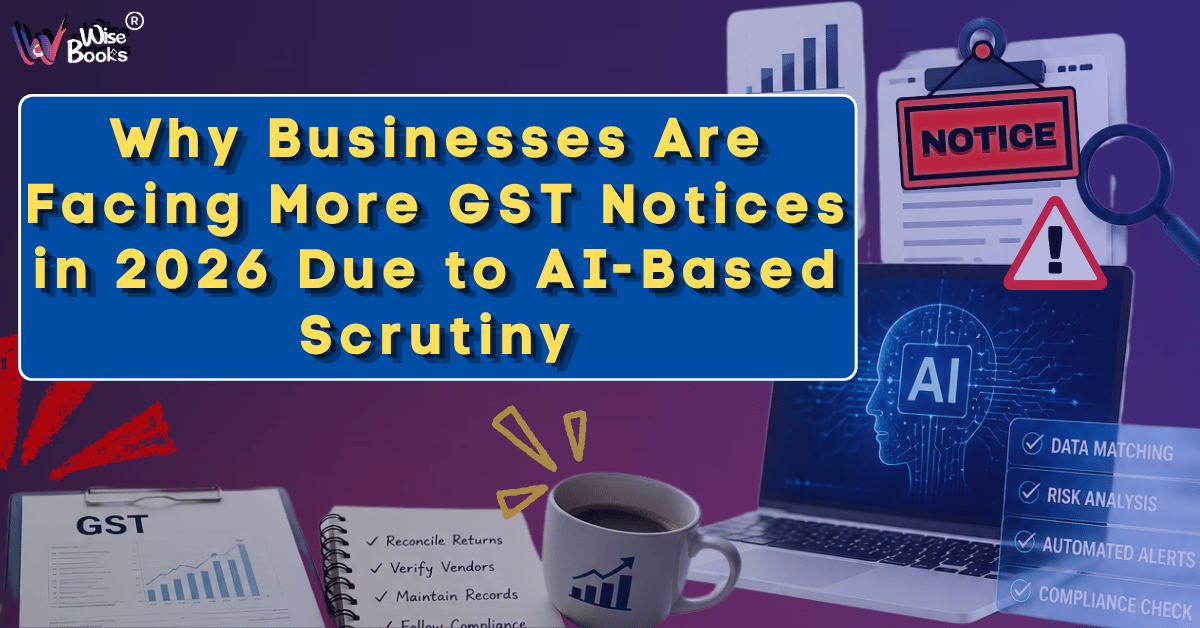
India’s GST compliance system is undergoing a major technological transformation in 2026. With the rapid integration of Artificial Intelligence (AI), Machine Learning (ML), data analytics, e-invoicing systems, and automated reconciliation tools, the Government is now monitoring business transactions more closely than ever before.
As a result, businesses across India from small MSMEs to large corporations are receiving a growing number of GST notices, compliance alerts, and scrutiny communications. In many cases, these notices are not even due to intentional tax evasion. Instead, they arise because modern AI-based systems can instantly detect mismatches, unusual patterns, vendor irregularities, and filing inconsistencies.
The era of manual GST checking is slowly disappearing. Today, GST compliance has become data-driven, automated, and interconnected with multiple financial systems.
What Is AI-Based GST Scrutiny?
AI-based GST scrutiny refers to the use of intelligent software systems by the GST department to automatically analyze taxpayer data and identify suspicious activities, mismatches, or compliance risks.
Instead of relying only on human officers for audits and assessments, the Government now uses advanced technology that continuously monitors:
- GST returns
- E-invoices
- E-way bills
- TDS/TCS records
- Income Tax returns
- AIS/TIS reports
- Banking transactions
- Vendor compliance history
These systems compare data in real time and automatically flag discrepancies.
This means:
Even a small mismatch between your GST returns and actual transactions can trigger an automated notice.
Why GST Notices Are Increasing in 2026
1. Real-Time Data Matching Has Become Stronger
Earlier, GST return verification was slower and more manual. In 2026, AI tools can compare lakhs of invoices within seconds.
The system now cross-checks:
- GSTR-1
- GSTR-3B
- GSTR-2B
- E-invoices
- E-way bills
- Income Tax data
If any figure does not match properly, the taxpayer may automatically enter the scrutiny system.
For example, if your sales turnover in GST differs significantly from your Income Tax return or AIS data, the system may treat it as a potential risk.
2. Fake ITC Detection Has Become More Advanced
Input Tax Credit (ITC) fraud has been one of the biggest concerns under GST. To control fake billing and fraudulent ITC claims, AI systems are now analyzing supplier and buyer behavior together.
The department now checks:
- Whether suppliers are active
- Whether suppliers filed returns
- Whether tax was actually paid
- Whether invoices appear genuine
- Whether transactions look suspicious
Even genuine businesses may face notices if their vendors become non-compliant.
This has made vendor management extremely important in 2026.
3. E-Invoice Integration Is Increasing Transparency
The introduction and expansion of e-invoicing has made invoice-level tracking much easier for authorities.
Now, every e-invoice generated is directly connected with GST systems. AI automatically compares:
- E-invoice data
- GSTR-1 sales data
- GSTR-3B liability data
If businesses under-report sales or show inconsistent values, the system immediately identifies the discrepancy.
This has reduced the possibility of hiding turnover or manipulating invoices.
4. AI Can Detect Unusual Business Patterns
Modern AI systems do not only check calculations — they also study business behavior patterns.
The system can identify:
- Sudden turnover spikes
- Abnormal ITC claims
- Irregular refund patterns
- Unusual tax ratios
- High-value transactions
- Sector-based fraud risks
For example, if a business suddenly claims very high ITC compared to its normal business activity, AI may flag the case for further investigation.
Even seasonal businesses may receive notices if the variation appears suspicious to the system.
5. GST and Income Tax Departments Are Now More Connected
One major reason for increased notices is the integration between GST and Income Tax databases.
Today, authorities can compare:
- GST turnover
- ITR income
- TDS credits
- AIS transactions
- Bank deposits
If the numbers are inconsistent, automated alerts may be generated.
Example:
A company reports ₹8 crore turnover under GST but shows significantly lower business receipts in Income Tax filings. AI immediately detects this mismatch and may trigger scrutiny.
Common Reasons Businesses Receive GST Notices
GSTR-1 and GSTR-3B Mismatch
One of the most common issues is inconsistency between:
- outward supplies reported in GSTR-1
- tax liability paid in GSTR-3B
Even minor differences may trigger system-generated notices.
Businesses often make errors while filing monthly returns, which later become compliance issues.
Vendor Non-Compliance
Businesses now suffer not only because of their own mistakes but also due to vendor failures.
If suppliers:
- fail to file returns,
- cancel GST registration,
- or upload incorrect invoices,
the buyer’s ITC may be questioned.
This is becoming a major challenge for MSMEs and trading businesses.
Excess or Incorrect ITC Claims
AI systems can identify whether businesses are claiming:
- excess ITC,
- blocked credits,
- duplicate credits,
- or ineligible claims.
Improper ITC claims are now one of the biggest reasons for GST scrutiny.
Incorrect HSN/SAC Classification
Wrong tax classification can lead to:
- short payment of tax,
- incorrect GST rates,
- or compliance violations.
AI systems can now compare HSN patterns across industries and identify irregularities automatically.
Delayed Return Filing Patterns
Frequent delays in:
- GSTR filings,
- TDS filings,
- or annual returns
increase a taxpayer’s risk profile.
The system may classify habitual late filers as “high-risk taxpayers.”
Which Businesses Are Under Higher Risk?
Certain sectors are facing heavier scrutiny because of historical fraud trends and high ITC movement.
These include:
- Construction
- Textiles
- Iron & steel
- FMCG distribution
- Scrap business
- Electronics
- Export companies
- E-commerce sellers
MSMEs are especially vulnerable because many still use manual accounting methods and lack proper reconciliation systems.
How Businesses Can Protect Themselves
Perform Monthly Reconciliation
Businesses should regularly reconcile:
- GSTR-1
- GSTR-3B
- GSTR-2B
- Purchase registers
- E-invoice data
Monthly reconciliation helps identify errors before notices are generated.
Verify Vendors Before Claiming ITC
Vendor due diligence is now essential.
Before working with suppliers:
- check GST status,
- filing history,
- return regularity,
- and invoice authenticity.
A compliant vendor reduces future compliance risk.
Use Automated Accounting Software
Modern accounting software helps businesses:
- detect mismatches,
- automate reconciliations,
- monitor compliance,
- and reduce manual filing errors.
AI-based accounting systems are becoming necessary rather than optional.
Maintain Proper Documentation
Businesses should preserve:
- invoices,
- e-way bills,
- payment proofs,
- agreements,
- transport records,
- and reconciliation reports.
Proper documentation is the strongest defense during GST scrutiny.
Avoid Aggressive Tax Practices
Artificially increasing ITC, fake invoicing, or turnover manipulation has become easier to detect through AI analytics.
Short-term tax manipulation can lead to:
- heavy penalties,
- blocked ITC,
- audits,
- and legal proceedings.
Future of GST Compliance in India
India’s GST system is moving toward:
- predictive compliance monitoring,
- automated assessments,
- AI-generated notices,
- and real-time tax intelligence.
In the future, businesses may receive instant alerts even before filing returns if unusual patterns are detected.
Compliance is no longer only about filing returns on time — it is now about maintaining accurate, transparent, and connected financial data.
Conclusion
The rise in GST notices in 2026 reflects the Government’s shift toward technology-driven tax administration. AI-based scrutiny has made the compliance ecosystem more transparent, interconnected, and data-sensitive than ever before.
Today, even small mismatches can trigger automated notices because GST systems are continuously analyzing financial data from multiple sources.
Businesses that continue relying on outdated manual accounting methods may face increasing compliance risks in the coming years.
To stay safe, companies must focus on:
- accurate bookkeeping,
- regular reconciliation,
- vendor compliance monitoring,
- proper documentation,
- and intelligent accounting systems.
In the AI-driven era of taxation, proactive compliance is becoming the key to avoiding GST scrutiny and maintaining long-term business stability.


Comments
oNYNvF