


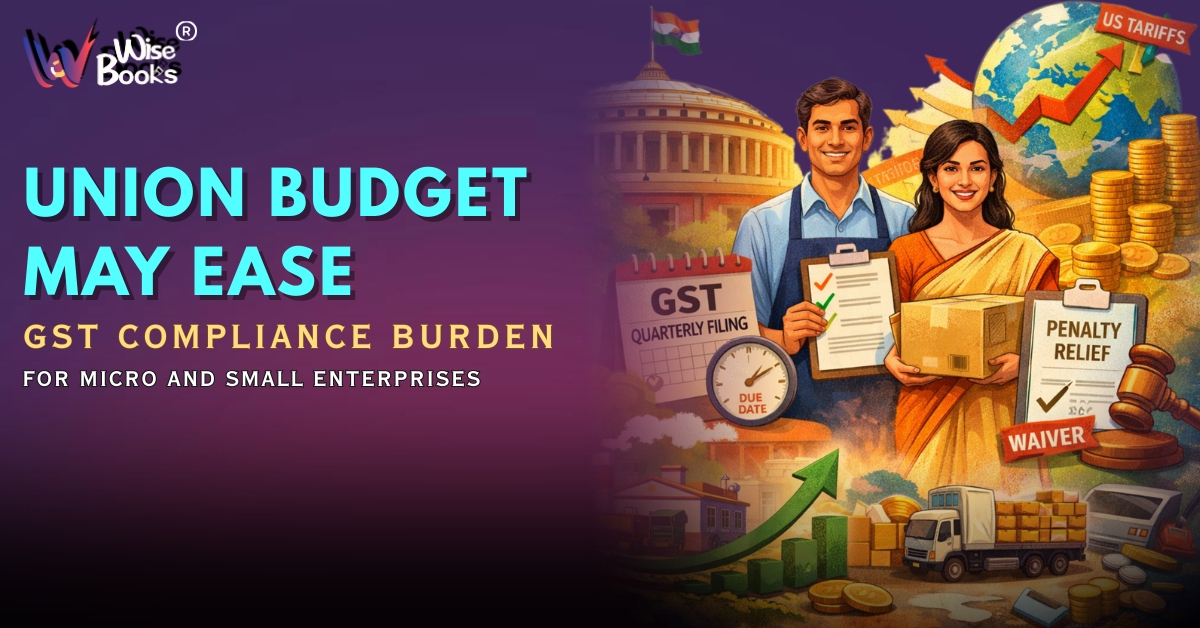
The Union Government is believed to be considering major steps regarding minimizing the Goods and Services Tax (GST) compliance requirement for Micro, Small, and Medium-scale Enterprises (MSEs) in the upcoming Union Budget. As reported in Mint, this discussion is underway due to rising apprehensions of the global economy’s pressure, specifically the implications of increased US tariffs.
Small and micro businesses can be considered the spine of the Indian economy. This segment has been significantly contributing to employment generation, export, and domestic manufacturing. However, the intricacies and stiffness associated with GST compliance have been pegged as major concerns for this segment. With the proposed changes, there could be a paradigm shift towards a more favourable GST regime.
Why GST Compliance Is a Major Concern for MSMEs
Since its introduction, GST has brought uniformity and transparency to India’s indirect tax system. However, for smaller businesses with limited resources, GST compliance has often translated into:
- Frequent return filings
- Strict late fee and interest provisions
- Heavy dependence on professionals
- Cash-flow strain due to advance tax payments
While large enterprises can absorb these compliance costs through dedicated tax teams and automation, micro and small enterprises often struggle to keep pace, leading to unintentional non-compliance.
Proposal 1: Quarterly GST Payment for Micro Enterprises
What Is Being Proposed?
One of the key proposals under consideration is allowing micro enterprises to pay GST on a quarterly basis instead of monthly payments. As per the revised MSME norms, micro enterprises are businesses with an annual turnover of up to ₹10 crore.
Current System
At present, most registered taxpayers are required to:
- File GSTR-1 (outward supplies) monthly or quarterly
- File GSTR-3B (summary return) monthly
- Pay GST liability every month, irrespective of business size
This creates frequent compliance pressure and working capital blockage for smaller businesses.
How Quarterly Payments Can Help
Allowing quarterly GST payments would:
- Improve cash flow management
- Reduce administrative and compliance costs
- Minimise dependency on external consultants
- Allow business owners to focus on operations rather than filings
Such a move would be particularly beneficial for enterprises with seasonal or irregular income patterns.
Proposal 2: Lenient Enforcement and Penalty Relaxation
Current Penalty Structure Under GST
Under Section 47 of the Central GST Act, late fees are imposed for delays in filing returns such as:
- GSTR-1
- GSTR-3B
- GSTR-9 (Annual Return)
Late fees accrue on a daily basis until they reach a prescribed maximum cap. Additionally, delayed tax payments attract interest at 18% per annum, irrespective of the taxpayer’s intent or financial condition.
Proposed Relaxation for MSMEs
The government is reportedly considering a more lenient enforcement approach for MSMEs, especially in cases involving:
- Genuine mistakes
- Procedural errors
- Delays due to financial stress
Under the proposed framework:
- MSMEs may receive warnings instead of immediate penalties
- Late fees may be waived for the first two defaults
- Penal action may be reserved for habitual or wilful defaulters
This approach reflects a shift from a punitive tax regime to a trust-based compliance model.
Why These Changes Matter Now
The proposed GST compliance relaxations come at a crucial time, as micro and small enterprises are facing intense economic pressure both globally and domestically. Unlike large corporations, MSMEs operate with limited financial buffers and are highly sensitive to market volatility, policy changes, and compliance costs.
Impact of Global Economic Pressures
Higher US tariffs and growing global trade uncertainties have weakened export opportunities for small Indian manufacturers and traders. Many MSMEs, either directly exporting or supplying larger exporters, are finding their products less competitive, forcing them to absorb higher costs or lose orders.
At the same time, supply chain disruptions and geopolitical tensions have increased raw material, logistics, and insurance costs. Combined with currency volatility, these factors have squeezed margins and strained working capital. In such conditions, strict GST requirements, especially monthly tax payments and high interest on delays, can push otherwise viable MSMEs into financial stress.
Domestic Challenges Facing MSMEs
Within India, MSMEs are grappling with a series of structural and financial challenges that have compounded their vulnerability.
Tight Credit Availability
Despite various government-backed schemes, access to affordable credit remains a major hurdle. Banks and financial institutions continue to view small businesses as high-risk borrowers, resulting in stricter lending norms, higher collateral requirements, and delayed loan disbursements. Limited access to credit restricts the ability of MSMEs to manage cash-flow gaps, especially when GST payments are due before the actual receipt of customer payments.
Rising Interest Rates
The broader monetary tightening cycle has led to higher borrowing costs. For MSMEs dependent on working capital loans or overdraft facilities, even a marginal rise in interest rates significantly increases financial strain. When GST interest at 18% per annum is added to this burden, delayed compliance becomes an expensive and sometimes unavoidable consequence rather than intentional non-compliance.
Increased Compliance Costs
GST compliance requires regular return filing, reconciliation of invoices, maintenance of digital records, and constant monitoring of rule changes. For micro and small enterprises, this often means hiring external tax consultants or accountants, adding to operational costs. Frequent amendments to return formats, ITC rules, and reporting requirements further increase compliance complexity and the risk of genuine errors.
Frequent Regulatory Changes
The GST framework has evolved continuously since its introduction, with frequent notifications, circulars, and system changes. While these reforms aim to improve efficiency, they also create uncertainty for small businesses that lack the capacity to track and implement changes in real time. Even minor procedural lapses can attract penalties, reinforcing a perception of GST as punitive rather than facilitative.
Why GST Compliance Easing Is a Timely Relief
In this challenging economic environment, easing GST compliance can provide immediate and targeted relief to MSMEs without significantly impacting government revenues. Measures such as quarterly tax payments, penalty waivers for first-time defaults, and a warning-based enforcement approach can improve liquidity, reduce fear of penalties, and encourage voluntary compliance.
Rather than undermining tax discipline, such reforms are likely to strengthen long-term compliance by keeping small businesses financially stable and within the formal tax system. For MSMEs struggling to survive amid global and domestic headwinds, these changes could act as a critical support mechanism, allowing them to focus on recovery, growth, and employment generation.
Expected Benefits for Micro and Small Enterprises
Financial Relief
The proposed GST relaxations are expected to provide significant financial relief to micro and small enterprises. Reduced interest and late fee exposure will ease the burden caused by delayed filings or cash-flow mismatches. Allowing flexible payment timelines can improve liquidity management, enabling businesses to allocate funds more efficiently toward operations, wages, and growth. Additionally, lower dependence on external consultants and reduced penalties will directly bring down the overall cost of GST compliance.
Ease of Doing Business
Simplifying GST compliance will substantially improve the ease of doing business for MSMEs. Fewer return filings and reduced paperwork will free up valuable time and resources, allowing business owners to focus on core activities rather than administrative tasks. Clearer procedures and a more lenient enforcement approach will also reduce anxiety around compliance, especially for minor or unintentional errors, creating a more supportive regulatory environment.
Improved Voluntary Compliance
When tax systems are simpler, predictable, and fair, voluntary compliance naturally improves. MSMEs are more likely to file returns on time, accurately disclose transactions, and remain within the formal economy. A trust-based compliance framework encourages businesses to comply willingly rather than out of fear, ultimately strengthening the tax base while reducing disputes and enforcement costs for the government.
Impact on Government and GST Administration
Strengthening Long-Term Revenue Collection
Although easing GST compliance may appear to reduce tax collections in the short term, such measures can significantly strengthen revenue mobilisation over the long run. Simplified compliance encourages more businesses, especially micro and small enterprises to remain registered and active within the GST system, thereby expanding the overall tax base. When compliance becomes manageable and less punitive, voluntary participation increases, leading to more consistent and sustainable revenue flows.
Reduction in Litigation and Disputes
Complex procedures and strict penalty provisions often result in disputes, appeals, and prolonged litigation, increasing costs for both taxpayers and the government. A lenient, warning-first approach for genuine errors can substantially reduce unnecessary litigation, freeing up judicial and administrative resources. This allows tax authorities to focus on policy enforcement rather than procedural disputes.
Improved Data Accuracy and Compliance Quality
When taxpayers are not under constant fear of penalties, they are more likely to file returns accurately and reconcile data properly. Simplified filing requirements and reduced pressure improve the quality and reliability of GST data, enabling better analytics, risk assessment, and policy planning for the government.
Efficient Use of Administrative Resources
A warning-based enforcement framework can significantly lower the routine compliance burden on GST officers. By reducing the need to process minor defaults and first-time errors, tax officials can redirect their efforts toward high-risk cases, tax evasion, and fraudulent activities, improving overall enforcement efficiency.
Building Trust in the Tax System
Most importantly, these reforms help foster a trust-based relationship between taxpayers and tax authorities. When the government is seen as supportive rather than punitive, compliance shifts from being fear-driven to cooperation-driven, this mutual trust strengthens the credibility of the GST framework and enhances its long-term effectiveness.
Impact on Government and GST Administration
While easing compliance may appear to reduce short-term collections, in the long run it can:
- Expand the tax base
- Reduce litigation and disputes
- Improve data accuracy
- Strengthen trust between taxpayers and tax authorities
A warning-first approach can also reduce administrative workload for GST officers, allowing them to focus on high-risk cases and tax evasion.
Alignment with Government’s MSME Vision
Supporting MSMEs under Atmanirbhar Bharat
The proposed GST relaxations support the government’s goal of strengthening domestic enterprises by reducing regulatory stress and improving the financial stability of micro and small businesses.
Improving Ease of Doing Business
Simplified compliance, fewer penalties, and flexible filing timelines help improve India’s Ease of Doing Business rankings by making taxation less complex and more predictable for MSMEs.
Encouraging Formalisation of Small Businesses
A lenient and supportive GST framework motivates small and informal businesses to register and remain within the formal economy without fear of excessive penalties.
Promoting Sustainable Economic Growth
By easing compliance pressure, MSMEs can focus more on productivity, employment generation, and long-term growth, contributing to overall economic stability.
Complementing Existing MSME Initiatives
These reforms align well with existing measures such as the QRMP scheme, MSME credit guarantee programs, and digital GST platforms, creating a more integrated and MSME-friendly compliance ecosystem.
What Businesses Should Do Now
Maintain Accurate Records
Ensure proper bookkeeping and invoice management to avoid errors when filing returns.
File Returns on Time
Continue timely GST filings to minimise interest and late fees until any new relaxations are officially announced.
Review Past Compliance
Identify any missed filings or errors early and take corrective action to reduce future risk.
Stay Updated on Policy Changes
Regularly track Union Budget announcements, GST notifications, and circulars to stay compliant.
Use Professional and Digital Tools
Leverage tax professionals and compliance automation tools to smoothly adapt to any upcoming changes.
Conclusion
The Union Government’s proposed move to ease GST compliance for micro and small enterprises reflects a timely and pragmatic policy shift. As MSMEs navigate mounting global uncertainties, rising costs, and domestic financial constraints, simplifying GST procedures can provide much-needed operational and financial relief. Measures such as quarterly GST payments, penalty waivers for genuine defaults, and a warning-first enforcement approach signal a transition from a rigid, punitive framework to a more supportive and trust-based tax regime.
Rather than weakening tax discipline, these reforms have the potential to strengthen long-term compliance by keeping small businesses financially stable and actively engaged within the formal economy. By reducing compliance stress, litigation, and administrative bottlenecks, the government can simultaneously expand the tax base, improve data quality, and enhance enforcement efficiency.
If implemented in the upcoming Union Budget, these proposals could mark a significant milestone in GST reform one that aligns closely with the government’s broader MSME vision under Atmanirbhar Bharat and its commitment to ease of doing business. For micro and small enterprises, this could mean greater confidence, improved liquidity, and a more enabling environment to focus on growth, employment generation, and sustainable economic development.


Comments
No comments yet. Be the first to comment!