


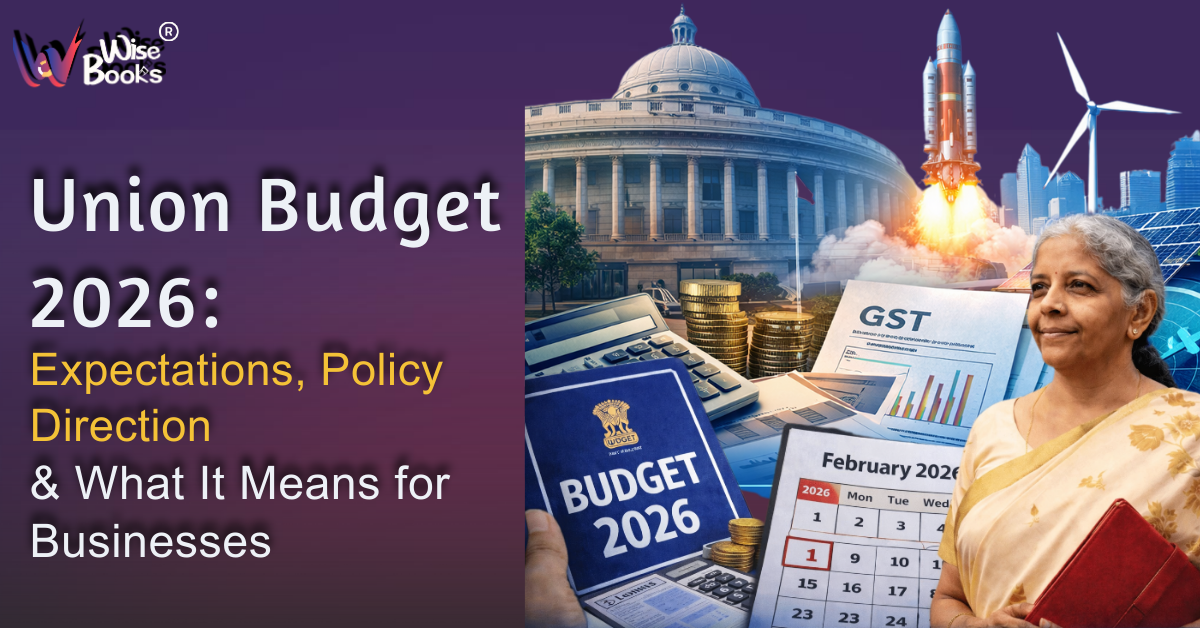
Union Budget 2026: Expectations, Policy Direction & What It Means for Businesses
As Finance Minister Nirmala Sitharaman prepares to present the Union Budget 2026–27 on February 1, the expectations surrounding this Budget are both high and measured. This will mark her ninth consecutive Union Budget, a rare milestone that reflects policy continuity and long-term economic planning. At a time when the global economy remains uncertain due to geopolitical tensions, inflationary pressures, and shifting trade dynamics, India’s fiscal roadmap assumes critical importance.
For business owners, MSMEs, accountants, professionals, and salaried taxpayers, Budget 2026 is expected to prioritise sustained growth without compromising fiscal discipline. Rather than headline-grabbing announcements, the emphasis is likely to be on execution, simplification, and stability with a clear focus on consumption revival, infrastructure-led development, streamlined taxation, and improved compliance efficiency.
Income Tax Relief & Consumption Push
What Is Expected
One of the most closely watched aspects of Budget 2026 is personal income tax, particularly relief for the salaried and middle-income segments. Experts anticipate incremental and targeted income tax relief, rather than sweeping exemptions, to strengthen household purchasing power.
Key expectations include:
- Rationalisation of tax slabs under the new tax regime to make it more attractive across income levels
- Limited fine-tuning of rates instead of introducing new deductions
- Continued policy push to position the new tax regime as the preferred and simplified system
The government is likely to avoid complicating the tax structure and instead focus on predictability and ease of compliance, reducing dependence on exemptions that often lead to disputes and litigation.
Why It Matters
Higher disposable income in the hands of taxpayers has a multiplier effect on the economy. Increased take-home pay translates directly into:
- Higher consumer spending on goods and services
- Improved GST collections due to increased consumption
- Revenue growth for MSMEs, retail businesses, service providers, and manufacturers
From an accounting perspective, simplified tax regimes reduce complexity in salary structuring, tax computation, and compliance planning. Fewer exemptions mean fewer disputes, lower litigation risk, and cleaner financial records—benefiting both taxpayers and professionals managing their compliance.
Fiscal Discipline & Macroeconomic Stability
Fiscal Deficit Outlook
Budget 2026 is expected to reinforce the government’s commitment to fiscal consolidation. The fiscal deficit for FY26 is projected at 4.4% of GDP, and policymakers are expected to stay firmly on this path.
Key expectations include:
- Maintaining deficit targets despite global uncertainties
- Gradual reduction in government borrowing
- Balanced allocation between capital expenditure and welfare spending
This signals responsible governance and strengthens confidence in India’s macroeconomic framework.
Business Impact
Fiscal discipline directly benefits the business environment by ensuring:
- Predictable interest rates, supporting borrowing and expansion plans
- Reduced risk of sudden tax hikes or ad-hoc levies
- Greater confidence for long-term investment and capital allocation
For investors, both domestic and foreign fiscal stability enhances India’s credibility as a reliable growth destination.
Railways & Infrastructure: Capacity Over Expansion
Budget Focus Areas
Railways and infrastructure are expected to remain a central pillar of Union Budget 2026, with railway allocations likely to see an increase of around 5%. Rather than pursuing aggressive network expansion, the government is expected to prioritise capacity enhancement, operational efficiency, and safety modernisation to maximise returns on existing infrastructure investments.
Key focus areas are likely to include:
- Track doubling and development of strategic routes to ease congestion and improve train frequency
- Decongestion of key freight corridors to support faster and more reliable goods movement
- Station modernisation and redevelopment, aimed at improving passenger experience and commercial utilisation
- Implementation of advanced safety systems such as Kavach 4.0, strengthening accident prevention and network reliability
This shift reflects a broader policy intent to improve productivity, logistics efficiency, and safety outcomes while ensuring optimal utilisation of capital expenditure.
Why This Matters for Businesses
Efficient infrastructure is fundamental to cost competitiveness. Improved rail and logistics capacity helps businesses by:
- Reducing transportation delays
- Lowering inventory holding and warehousing costs
- Improving supply chain predictability
For manufacturing units, traders, exporters, and MSMEs, this translates into better margins, faster turnaround times, and enhanced competitiveness.
MSMEs: Credit Access & Compliance Relief
Key MSME Expectations
Micro, Small and Medium Enterprises (MSMEs) continue to form the backbone of India’s economy, and Budget 2026 is expected to place renewed emphasis on strengthening their financial stability and ease of operations. To address persistent cash flow and credit challenges, industry associations have put forward several key proposals, including:
- Interest subvention schemes on MSME loans to reduce borrowing costs
- Enhanced limits under MUDRA loans to support business expansion and working capital needs
- Faster and more streamlined GST refund mechanisms to ease liquidity pressures
- Reduction in regulatory and compliance complexities, particularly for smaller enterprises
These measures aim to improve liquidity, reduce financial stress, and encourage formalisation within the MSME sector.
Accounting & Compliance Perspective
For MSMEs, cash flow management is often more critical than reported profitability. Delays in GST refunds or limited access to affordable credit can significantly disrupt day-to-day operations. Faster refunds and improved institutional credit access can:
- Shorten working capital cycles and improve liquidity planning
- Reduce reliance on informal or high-cost sources of finance
- Strengthen repayment behaviour and long-term creditworthiness
As compliance systems become increasingly data-driven, the role of accurate bookkeeping, timely GST reconciliation, and transparent financial reporting becomes essential. Well-maintained records not only support smoother compliance but also enhance an MSME’s ability to access credit, negotiate better terms, and sustain long-term growth, making professional accounting support a strategic necessity rather than a mere compliance function.
GST Reforms & GST 2.0 Continuity
Expected Developments
Union Budget 2026 is expected to further strengthen the GST 2.0 framework, with an emphasis on improving structural efficiency, reducing disputes, and enhancing revenue certainty for both the Centre and states. The focus is likely to be on fine-tuning existing mechanisms rather than introducing sweeping changes.
Key areas of attention may include:
- Correction of inverted duty structures to reduce working capital blockages and sector-specific distortions
- Targeted GST rate rationalisation for select industries to address anomalies and compliance complexity
- Strengthening revenue protection mechanisms for states to ensure fiscal stability within the GST framework
- Improved refund processing systems and faster dispute resolution, supported by better use of technology and data analytics
These measures aim to make GST more predictable, transparent, and business-friendly.
Practical Impact
A more stable and simplified GST regime can significantly reduce compliance friction for businesses. Key benefits include:
- Lower incidence of classification and rate-related disputes
- Cleaner return filings and smoother reconciliations between GSTR-1, GSTR-3B, and GSTR-2B
- Reduced compliance costs and lower exposure to litigation
As GST enforcement becomes increasingly data-driven, businesses with real-time GST monitoring, accurate reconciliations, and well-maintained books of accounts will be best positioned to adapt smoothly and fully leverage the benefits of ongoing GST reforms.
Defence, Green Energy & Strategic Sectors
Defence
Union Budget 2026 is expected to continue strengthening India’s defence ecosystem by building on the government’s long-term push toward self-reliance and domestic manufacturing. Policy measures are likely to focus on:
- Expanding indigenous defence production under the Atmanirbhar Bharat framework
- Encouraging greater participation from private enterprises, including startups and specialised manufacturers
- Creating new opportunities for defence-linked MSMEs through supply-chain integration, offset policies, and procurement reforms
These initiatives are expected to enhance domestic capabilities, reduce import dependence, and stimulate high-value manufacturing and employment.
Green Energy & Sustainability
Alongside defence, Budget 2026 is likely to deepen the government’s commitment to clean energy and sustainable growth. Anticipated focus areas include:
- Enhanced incentives for renewable energy projects, particularly solar, wind, and green hydrogen
- Support for electric mobility and sustainable logistics, aimed at reducing carbon intensity in transportation
- Policy measures linked to carbon reduction, energy efficiency, and climate commitments
As regulatory frameworks evolve, sustainability is increasingly becoming a financial, regulatory, and compliance imperative, influencing access to funding, tax incentives, and long-term business viability rather than remaining solely an environmental consideration.
Technology, AI & the Digital Economy
Tech Sector Expectations
The technology sector is expected to remain a key focus area in Union Budget 2026, as digital transformation continues to shape India’s economic future. Stakeholders anticipate targeted policy support in areas that enhance innovation, data security, and global competitiveness, including:
- Incentives for artificial intelligence, data centres, and cybersecurity infrastructure
- Continued support for startups, innovation-led enterprises, and the digital ecosystem
- Simplification of compliance frameworks and greater clarity on ESOP taxation, particularly for technology-driven companies
These measures are expected to strengthen India’s position as a global digital hub while encouraging responsible innovation.
Accounting & Financial Transformation
As digitisation deepens, financial management and compliance functions are undergoing a fundamental shift. Businesses are increasingly moving toward technology-enabled accounting systems, resulting in:
- Wider adoption of automated bookkeeping and cloud-based accounting platforms
- Growing reliance on AI-driven financial analysis for forecasting, performance monitoring, and risk assessment
- A transition from manual compliance processes to data-driven, real-time reporting models
In this evolving environment, platforms such as Genie AI by WiseBooks help businesses gain real-time financial visibility, monitor compliance proactively, and generate decision-ready reports enabling faster, more informed business decisions.
What Budget 2026 Means for Businesses & Accountants
Union Budget 2026 is expected to emphasise stability, predictability, and system-driven efficiency, rather than introducing abrupt or disruptive policy changes. The overall policy direction is likely to focus on:
- Reducing uncertainty and strengthening confidence among businesses, investors, and financial institutions
- Accelerating formalisation through transparent, technology-enabled compliance frameworks
- Encouraging organised business practices by rewarding enterprises with structured financial and operational systems
Businesses that consistently maintain:
✔ Clean and accurate books of accounts
✔ GST-compliant, fully reconciled returns
✔ Well-documented, audit-ready financial records
will be better positioned to navigate policy changes smoothly and capitalise on emerging opportunities.
For accountants, tax professionals, and finance teams, Budget 2026 reinforces the growing importance of strong financial governance, automation-driven processes, and advisory-led services. As compliance becomes increasingly data-centric, professionals who help businesses build resilient financial systems will play a critical role in supporting long-term, sustainable growth.
Conclusion
Union Budget 2026 is poised to prioritise stability, predictability, and execution over headline-grabbing reforms. With a strong focus on fiscal discipline, infrastructure efficiency, targeted income tax relief, GST 2.0 continuity, MSME support, and digital transformation, the Budget aims to create an environment that is both growth-oriented and business-friendly.
For businesses, this means that organised operations, clean financial records, and technology-driven compliance will be key to leveraging policy benefits. Faster GST refunds, easier access to credit, and clearer tax structures will improve liquidity, reduce operational risks, and enhance competitiveness.
For accountants and finance professionals, Budget 2026 reinforces the importance of automation, AI-enabled analysis, and advisory-led financial governance. In a landscape where compliance is increasingly data-driven, professionals who guide businesses toward robust financial systems and transparent reporting will be crucial in ensuring sustainable growth and long-term success.


Comments
No comments yet. Be the first to comment!