


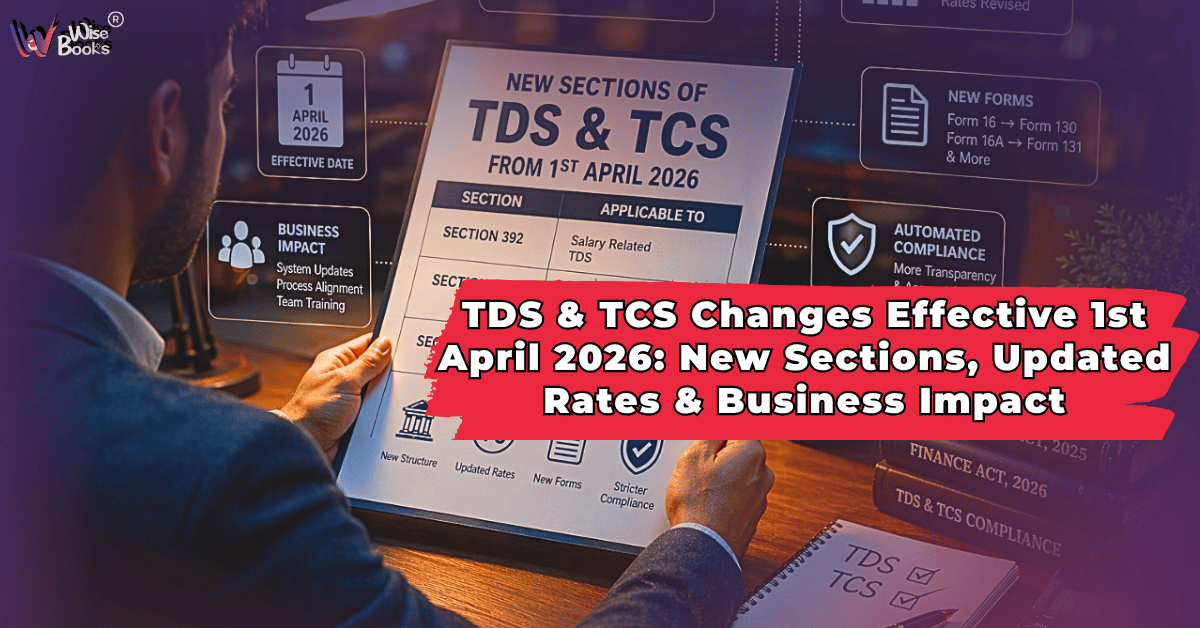
India’s withholding tax system is undergoing a major transformation from 1st April 2026, driven by the Income Tax Act, 2025 and amendments under the Finance Act, 2026.
These changes go beyond minor updates — they introduce new section structures, revised forms, automated compliance systems, and stricter reporting requirements.
If you are handling finance, taxation, or compliance, this guide will help you understand what’s changing and what actions are required immediately.
Key Highlights
- New sections 392, 393, and 394 replace earlier TDS/TCS provisions like 194C, 194J, and 194I
- Form 16 is replaced by Form 130 for salaried individuals
- TDS on NRI property transactions now works using PAN instead of TAN
- Multiple TCS categories now follow a flat 2% rate
- Compliance requirements are becoming more system-driven and data-intensive
Major TDS & TCS Changes Explained
1. Complete Renumbering of TDS Sections
The new framework reorganizes TDS provisions into three primary sections:
- Section 392 → Salary-related TDS
- Section 393 → TDS on non-salary payments (residents & non-residents)
- Section 394 → TCS provisions
This restructuring means all old section references are now invalid.
Businesses must update ERP systems, return filing utilities, and FVU codes to avoid rejection errors.
2. Shift from Assessment Year to Tax Year
The concept of Assessment Year (AY) is being removed.
Going forward:
- Tax Year (TY) = Financial Year
- Example: Income earned in TY 2026–27 will be reported in TY 2027–28
This requires updates across:
- Accounting systems
- Tax documentation
- Return filing formats
3. Form Changes: Form 16 → Form 130
Key form replacements include:
- Form 16 → Form 130
- Form 16A → Form 131
- Form 27D → Form 133
While the structure remains similar, using old form names will lead to non-compliance.
HR and payroll teams must align immediately.
4. Manpower Services Now Clearly Taxable
Manpower supply is now explicitly treated as “work” under TDS provisions.
Applicable rates:
- 1% → Individual/HUF
- 2% → Others
If TDS was previously not deducted on such contracts, it must now be implemented without delay.
5. MACT Interest Fully Exempt
Interest received from the Motor Accident Claims Tribunal is now:
- Completely tax-free
- No TDS applicable
The earlier ₹50,000 threshold has been removed entirely.
6. Automated Lower/Nil TDS Certificates
The process for obtaining lower or zero TDS certificates is now becoming automated.
- System-driven approvals
- Reduced manual intervention
- Faster processing
This is especially beneficial for companies handling large volumes of vendor requests.
7. CBDT Guidelines Now Mandatory
Circulars issued by the Central Board of Direct Taxes are now legally binding.
Earlier, these were often treated as advisory.
From 2026 onwards, non-compliance can lead to penalties and reassessment risks.
8. New Tax Audit Reporting Requirements
The traditional Form 3CD is replaced by Form 26, with expanded disclosures.
New requirements include:
- Total TDS/TCS transactions reported
- Exact count of unreported transactions
- Monetary value of such transactions
This shift demands real-time tracking systems, not manual year-end adjustments.
9. TDS on NRI Property Transactions Simplified
For property purchases from NRIs:
- PAN replaces TAN for TDS compliance
- No need for separate TAN registration
This simplifies compliance for high-value real estate transactions.
10. Revised TCS Rates (Flat 2%)
Several categories now attract a uniform 2% TCS rate, including:
- Alcohol
- Scrap
- Coal & minerals
- Overseas tour packages
- LRS transactions (education/medical)
The removal of slab rates simplifies compliance significantly.
11. Reduced Time for Correction Statements
The window for revising TDS/TCS returns is now:
- 2 years from the end of the financial year
Delayed corrections will no longer be possible beyond this period.
Impact on Businesses & Enterprises
System Upgrades Are Mandatory
- ERP, payroll, and compliance tools must be updated
- Old section codes and formats will cause filing errors
Increased Legal Accountability
- CBDT guidelines now enforceable
- Higher risk of penalties for non-compliance
Payroll Adjustments
- Updated HRA rules
- ₹75,000 standard deduction
- Incorrect calculations may lead to TDS mismatches
Procurement Impact
- Manpower contracts now clearly taxable
- Vendor payments require stricter TDS checks
Penalties for Non-Compliance
|
Default |
Consequence |
|
Failure to deduct TDS |
Interest at 1% per month from the date of deductibility |
|
TDS deducted but not deposited |
Interest at 1.5% per month |
|
Late filing of TDS return |
Rs. 200 per day |
|
Non-deduction of applicable TDS |
Expense disallowed in the deductor's tax computation |
|
Ignoring the binding CBDT guidelines |
Reassessment risk and potential penalty proceedings |
Conclusion
The TDS & TCS changes from April 2026 mark a shift toward automation, transparency, and stricter compliance.
For businesses, this is not just a regulatory update — it is a complete system upgrade requirement.
The sooner systems, processes, and teams are aligned,
The lower the risk of penalties, errors, and operational disruption.
Frequently Asked Questions (FAQs) – TDS & TCS Changes 2026
1. What are the major TDS & TCS changes effective from 1st April 2026?
The major changes include:
- Introduction of new sections 392, 393, and 394
- Replacement of Form 16 with Form 130
- Shift from Assessment Year to Tax Year
- Flat 2% TCS rate for multiple categories
- Increased focus on automated and data-driven compliance
These changes aim to simplify and digitize India’s tax system.
2. Which sections replace the old TDS provisions like 194C, 194J, and 194I?
The new structure introduces:
- Section 392 → Salary TDS
- Section 393 → Non-salary TDS
- Section 394 → TCS
All previous section references will no longer be valid from April 2026.
3. What is the Tax Year (TY) and how is it different from the Assessment Year (AY)?
The Tax Year replaces the Assessment Year system.
- Tax Year = Financial Year
- Example: Income earned in TY 2026–27 will be filed in TY 2027–28
This removes confusion and simplifies tax reporting.
4. What is Form 130 and how does it replace Form 16?
Form 130 is the new TDS certificate for salaried employees, replacing Form 16.
Although the format is similar, using the old form will result in non-compliance.
5. What are the new TCS rates applicable from 2026?
Several categories now attract a flat 2% TCS, including:
- Scrap
- Alcohol
- Coal & minerals
- Overseas tour packages
- LRS transactions (education/medical)
This simplifies the earlier complex rate structure.
6. Is TDS applicable on manpower services from April 2026?
Yes, manpower services are now clearly classified under “work contracts.”
- 1% → Individual/HUF
- 2% → Others
Businesses must deduct TDS on such payments to avoid penalties.
7. Is TDS applicable on MACT compensation or interest?
No, interest received from the Motor Accident Claims Tribunal (MACT) is now:
- Fully tax-exempt
- Not subject to TDS
The earlier ₹50,000 exemption limit has been removed.
8. What changes have been made in TDS for NRI property transactions?
For property purchases from NRIs:
- PAN can be used instead of TAN
- No need for separate TAN registration
This simplifies compliance for buyers.
9. Are CBDT guidelines mandatory from 2026?
Yes, guidelines issued by the Central Board of Direct Taxes (CBDT) are now:
- Legally binding
- Mandatory to follow
Ignoring them can lead to penalties and reassessment.
10. What are the new tax audit requirements for TDS/TCS?
Under the new audit format:
- Detailed reporting is required
- Businesses must disclose:
- Total transactions
- Unreported transactions (count + value)
This requires real-time tracking systems.
11. What is the time limit for correcting TDS/TCS returns?
From April 2026:
- Correction window = 2 years from end of financial year
Late corrections beyond this period will not be allowed.


Comments
lnnuQn
bhhAnO
sLIoOL
sLIoOL
sLIoOL