


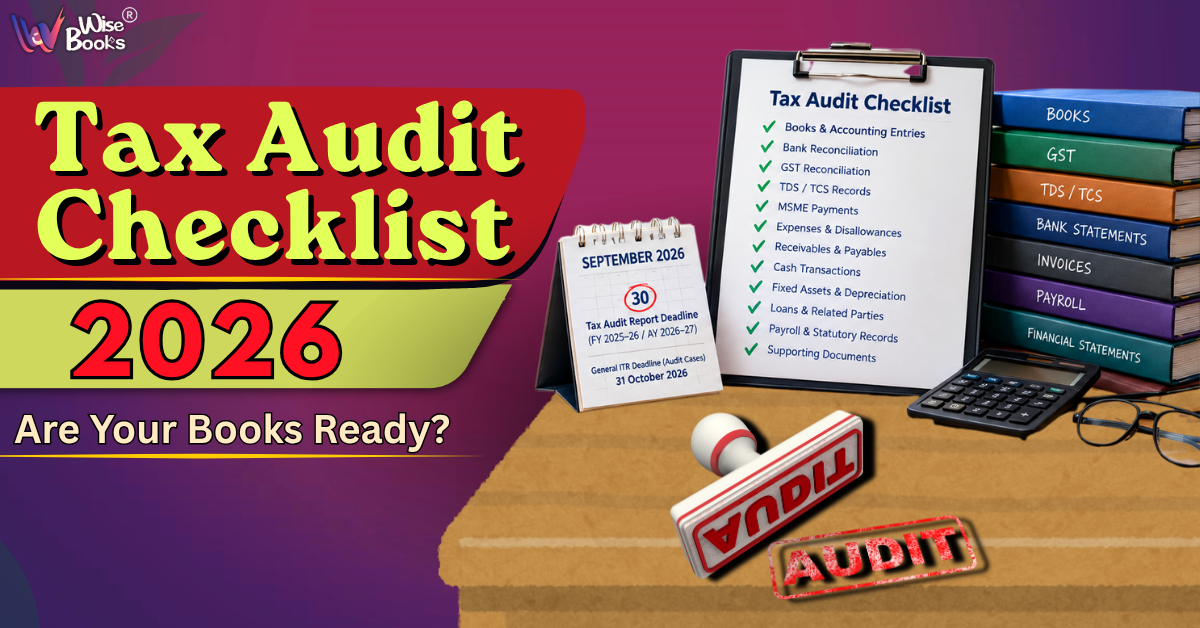
Tax Audit Checklist 2026: Are Your Books Ready?
September is not just another month on the tax calendar. For businesses and professionals covered by tax audit, it is the time to make sure their books, reconciliations and supporting documents are ready for review.
For FY 2025–26 / AY 2026–27, the applicable tax audit report deadline is 30 September 2026, while the general ITR deadline for audit cases is 31 October 2026.
But a tax audit is not simply about filing Form 3CD. Before the audit begins, your books, GST returns, bank statements, TDS records, invoices, payroll records and financial statements should broadly reconcile with each other.
So, the real question is not, “Have we started our tax audit?”
It is:
“Are our books actually audit-ready?”
Why Tax Audit Preparation Matters
A business may have recorded its sales, booked expenses and filed GST returns, yet still face questions during the audit.
The reason is simple: tax compliance does not work in isolation.
A difference between books and GST returns, bank statements and accounting records, or TDS records and books does not automatically mean there is an error or additional tax liability. However, unexplained differences can lead to further verification, adjustments or disclosures.
That is why it is better to identify these issues before the audit reaches the final stage.
Tax Audit Checklist 2026
1. Make Sure Your Books Are Updated
Ensure sales, purchases, expenses, receipts, payments, loans, advances and fixed assets are properly recorded.
Check for pending entries, duplicate invoices, old balances, suspense accounts, negative cash and incorrect ledger classifications.
2. Reconcile All Bank Accounts
Match your books with bank statements and identify differences caused by unpresented cheques, bank charges, interest or missing entries.
Prepare a bank reconciliation statement and clear old unreconciled items.
3. Review GST Reconciliation
Compare:
Books → GSTR-1 → GSTR-3B → GSTR-2B → Purchase Register
Check turnover, output tax, ITC, credit/debit notes, RCM and exempt supplies for unexplained differences.
4. Check TDS and TCS
Verify that TDS/TCS has been deducted, deposited and reported correctly. Reconcile statutory records with your books and keep certificates and returns ready.
5. Review MSME Payments
Identify outstanding balances payable to eligible micro and small enterprises and review their applicable tax treatment under Section 43B(h).
Keep vendor details and supporting documents ready.
6. Review Expenses and Disallowances
Review personal expenses, cash payments, TDS-related disallowances, statutory dues, related-party transactions, provisions and unsupported expenses.
Ensure significant expenses are correctly treated and properly documented.
7. Reconcile Receivables and Payables
Review debtors, creditors, advances, deposits and loans, especially old or unusually large balances.
Obtain confirmations or supporting documents wherever required.
8. Check Cash Transactions
Review cash receipts, payments, advances, loans, deposits, repayments and high-value cash transactions.
Ensure the cash balance shown in the books can be properly explained.
9. Verify Fixed Assets & Depreciation
Check asset purchases, invoices, capitalisation dates, disposals and depreciation calculations.
Ensure additions and deletions are properly supported.
10. Review Loans & Related-Party Transactions
Keep loan agreements, confirmations, repayment details and interest calculations ready.
Also identify and properly document transactions with related parties.
11. Match Payroll & Statutory Records
Reconcile:
Salary Register → Payroll Books → Bank Payments → TDS → PF/ESI
Check employee costs, deductions, payments and outstanding statutory liabilities.
12. Keep Supporting Documents Ready
Organise important documents such as invoices, bank statements, GST/TDS records, payroll records, loan documents, agreements, confirmations and challans.
If a transaction is important, its supporting document should be easy to find.
Important Form Update for 2026
There is also an important transition this year.
For FY 2025–26 / AY 2026–27, the existing Forms 3CA/3CB along with Form 3CD continue to apply.
For Tax Year 2026–27 onwards, the new framework under the Income-tax Act, 2025 introduces Form 26 for tax audits.
Businesses and professionals should therefore be careful not to mix the forms applicable to the two different tax periods.
FY 2025–26 / AY 2026–27 → Forms 3CA/3CB + Form 3CD
Tax Year 2026–27 onwards → Form 26
A Simple 7-Day Audit-Readiness Plan
If your audit preparation is still pending, avoid trying to fix everything at the last minute.
Day 1 – Books: Complete accounting entries and review the trial balance.
Day 2 – Bank & Cash: Complete bank reconciliation and verify cash balances.
Day 3 – GST: Reconcile books with GSTR-1, GSTR-3B and relevant ITC records.
Day 4 – TDS/TCS: Reconcile deductions, deposits and statutory reporting.
Day 5 – Debtors, Creditors & MSME: Review ageing, confirmations and applicable MSME balances.
Day 6 – Expenses & Statutory Dues: Review tax-sensitive expenses and outstanding liabilities.
Day 7 – Documents: Organise invoices, statements, agreements and other supporting records.
This approach can help turn the audit process from “finding problems” into “resolving identified exceptions.”
Final Audit-Readiness Checklist
Before your books go for final audit review, ask:
- Are all accounting entries updated?
- Are all bank accounts reconciled?
- Is the cash balance verified?
- Does GST data broadly reconcile with the books?
- Has ITC been reviewed against relevant records
- Are TDS/TCS balances reconciled?
- Have debtors and creditors been reviewed?
- Have applicable MSME balances been identified?
- Have statutory dues been checked?
- Have significant expenses been reviewed?
- Are fixed assets and depreciation schedules updated?
- Are loans and advances properly supported?
- Are related-party transactions identified?
- Are supporting documents organised?
- Have unusual or high-value transactions been flagged?
If the answer to these questions is yes, you are not just preparing for an audi you are making the audit process clearer, faster and more manageable.
Conclusion
Tax audit should not be treated as something that suddenly arrives in September.
Good audit preparation starts with accurate books, regular reconciliations, proper documentation and timely identification of exceptions.
For FY 2025–26 / AY 2026–27, the applicable tax audit deadline for general cases is 30 September 2026.
So before asking your CA, “When will my audit be completed?”, ask yourself:
“If my CA reviews my books today, can I explain every important number?”
If not, now is the time to get your books audit-ready.


Comments
No comments yet. Be the first to comment!