


A Landmark Judgment That Reinforces the Rule of Law Under GST
The Goods and Services Tax (GST) regime was introduced with one primary objective to simplify indirect taxation while ensuring transparency and seamless flow of Input Tax Credit (ITC). One of the strongest pillars supporting GST is the ITC mechanism, which allows businesses to claim credit for taxes already paid on purchases and use that credit to discharge future GST liabilities.
However, over the years, fraudulent ITC claims through fake invoices, non-existent suppliers, and bogus firms became one of the biggest challenges faced by the GST administration. To combat this menace, the Government introduced Rule 86A of the CGST Rules, 2017, empowering GST authorities to temporarily block suspicious Input Tax Credit.
While the objective behind Rule 86A was genuine, its implementation gave rise to several disputes. In many cases, GST authorities went beyond the powers granted under the law by blocking not only the ITC available in a taxpayer's Electronic Credit Ledger but also future credits that had not yet accrued. This practice came to be known as "negative blocking" of the Electronic Credit Ledger.
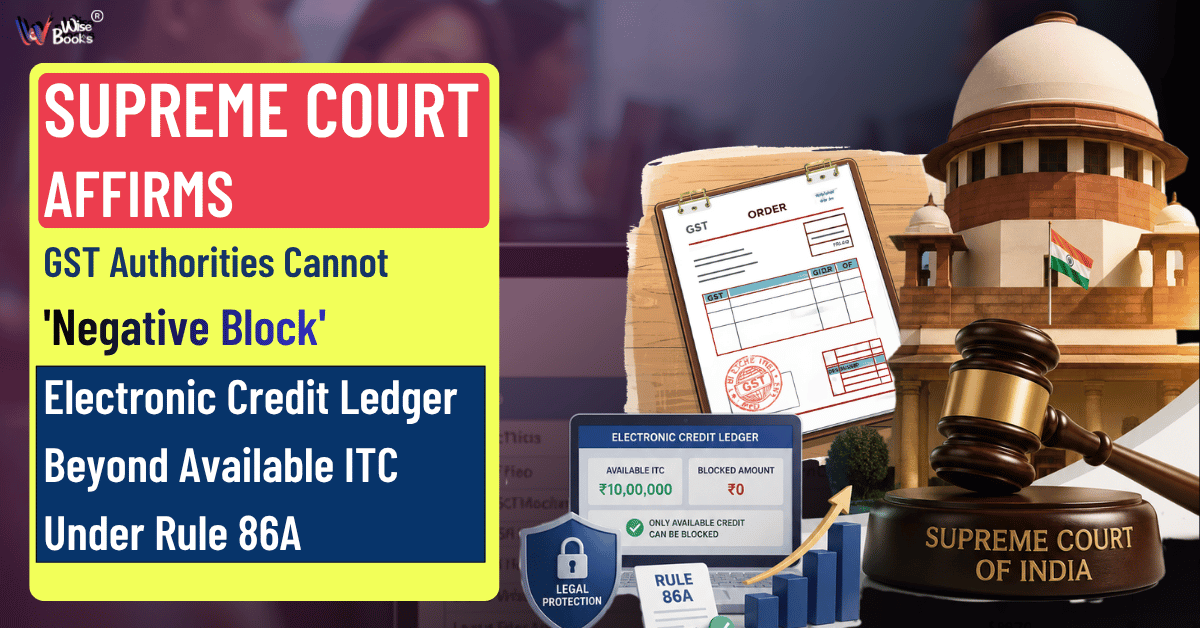
In a significant judgment, the Supreme Court of India has now affirmed that such action is legally impermissible. By dismissing the Revenue's Special Leave Petition (SLP), the Supreme Court upheld the Punjab & Haryana High Court's interpretation that Rule 86A authorizes the blocking of only the ITC actually available in the Electronic Credit Ledger at the time of passing the order. It cannot be used to create an artificial negative balance or freeze future credits.
This decision is expected to have far-reaching implications for taxpayers and GST administration across India.
Understanding Input Tax Credit (ITC)
To appreciate the significance of this judgment, one must first understand how Input Tax Credit works.
Suppose a manufacturer purchases raw materials worth ₹10 lakh and pays GST of ₹1.8 lakh. Later, when the manufacturer sells finished goods and collects GST of ₹3 lakh from customers, he is not required to pay the entire ₹3 lakh to the Government.
Instead,
Output GST Liability: ₹3,00,000
Less: ITC Available: ₹1,80,000
Net GST Payable: ₹1,20,000
This mechanism avoids cascading taxation and ensures GST is ultimately borne only by the final consumer.
The available ITC is reflected in the taxpayer's Electronic Credit Ledger (ECL) on the GST portal.
What is the Electronic Credit Ledger?
Every registered GST taxpayer has three electronic ledgers:
• Electronic Cash Ledger
• Electronic Liability Register
• Electronic Credit Ledger
The Electronic Credit Ledger records the Input Tax Credit legally available to the taxpayer.
This credit is treated almost like a digital wallet that can only be used for payment of GST liability.
Why Was Rule 86A Introduced?
After GST implementation, authorities discovered widespread fraud involving:
• Fake GST registrations
• Bogus invoices without supply of goods
• Circular trading
• Fake ITC claims running into thousands of crores
To prevent immediate misuse of suspicious credit while investigations were underway, Rule 86A was introduced in December 2019.
It empowers the Commissioner or an authorized officer to temporarily restrict the utilization of ITC if there are "reasons to believe" that the credit has been fraudulently availed or is otherwise ineligible.
Importantly, Rule 86A is a preventive measure, not a recovery mechanism. Its purpose is to stop the use of questionable credit during investigation, not to permanently recover tax dues.
What Does Rule 86A Actually Permit?
The language of Rule 86A authorizes authorities to disallow the debit of an amount available in the Electronic Credit Ledger.
The key words are:
"Amount available in the Electronic Credit Ledger."
This means that only the credit already lying in the ledger can be temporarily blocked.
Nothing in Rule 86A authorizes blocking future credits that do not yet exist.
What Is "Negative Blocking"?
Negative blocking is an administrative practice adopted in some cases where GST authorities blocked ITC far exceeding the balance available in the Electronic Credit Ledger.
For example:
Available ITC = ₹10 lakh
Department suspects wrongful ITC = ₹60 lakh
Instead of blocking ₹10 lakh, authorities blocked ₹60 lakh.
The Electronic Credit Ledger therefore showed:
Available Credit: ₹10 lakh
Blocked Amount: ₹60 lakh
Result:
Electronic Credit Ledger = (-₹50 lakh)
This meant that every future ITC earned by the taxpayer automatically became unavailable because it was adjusted against the artificial negative balance.
Although Rule 86A never mentions "negative blocking," some authorities treated it as an extension of their preventive powers.
Why Did Businesses Challenge This Practice?
Businesses argued that negative blocking had devastating commercial consequences.
Whenever fresh ITC became available from genuine purchases, it could not be utilized.
Consequently,
• Working capital remained locked.
• GST liabilities had to be paid entirely in cash.
• Day-to-day business operations became difficult.
• Liquidity was severely affected.
Taxpayers contended that Rule 86A only allows restriction of existing credit and not future credits.
If the department believed additional ITC had been wrongly claimed, it should initiate adjudication under the CGST Act rather than invent a new mechanism by creating negative balances.
The Punjab & Haryana High Court's Decision
Several taxpayers challenged the practice before the Punjab & Haryana High Court.
The High Court carefully interpreted Rule 86A and held that:
• Rule 86A permits blocking only the ITC actually available in the Electronic Credit Ledger.
• It does not authorize creating a negative balance.
• Future credits cannot be blocked.
• Recovery of allegedly inadmissible ITC must be undertaken through the statutory adjudication and recovery provisions under Sections 73, 74, or other applicable provisions of the CGST Act not by expanding Rule 86A beyond its text.
Revenue Challenged the High Court
The Union Government challenged this decision before the Supreme Court by filing Special Leave Petitions (SLPs).
The Revenue argued that broader powers were necessary to safeguard government revenue and prevent fraudulent utilization of ITC.
Supreme Court's Landmark Ruling
The Supreme Court refused to interfere with the Punjab & Haryana High Court's judgment.
The Court dismissed the SLP, thereby affirming that:
• Rule 86A only allows blocking of ITC actually available in the Electronic Credit Ledger.
• Authorities cannot create an artificial negative balance.
• Future ITC cannot be frozen.
• If recovery is required, the department must follow the proper legal process prescribed under the CGST Act.
Although the Supreme Court clarified that the Revenue remains free to pursue other remedies available under law, it made it clear that Rule 86A itself cannot be stretched beyond its statutory limits.
Why Is This Judgment So Important?
This judgment is significant because it reinforces several fundamental legal principles:
1. Statutory Powers Cannot Be Expanded
Government authorities can exercise only those powers expressly granted by legislation.
If Rule 86A authorizes blocking available credit, authorities cannot read into it the power to block future credits.
2. Prevention Is Different From Recovery
Rule 86A is preventive.
Recovery must follow adjudication.
The department cannot bypass statutory safeguards by treating preventive powers as recovery powers.
3. Businesses Cannot Be Penalized Without Due Process
Blocking future credits without adjudication effectively punishes taxpayers before liability is determined.
The judgment restores procedural fairness.
4. Protecting Business Liquidity
Input Tax Credit directly impacts working capital.
Artificial freezing of future credits can severely disrupt genuine businesses.
The judgment helps maintain the liquidity that GST was designed to protect.
Practical Impact on Taxpayers
Following this judgment:
i. GST authorities can block only the ITC available in the Electronic Credit Ledger.
ii. Future credits cannot be automatically frozen.
iii. Artificial negative balances cannot be created.
iv. Wrongly availed ITC must be recovered through the statutory adjudication process.
v. Taxpayers have stronger grounds to challenge illegal negative blocking.
A Balanced Verdict
The judgment does not prevent the GST department from investigating fake ITC or recovering ineligible credit. It simply requires the department to use the correct legal mechanisms.
Authorities continue to have powers under:
- Sections 73, 74 (and the applicable successor provisions, where relevant) for determination and recovery of tax and wrongly availed ITC.
- Rule 86A to temporarily restrict utilization of existing suspicious credit.
- Other enforcement provisions available under the CGST Act.
The ruling therefore strikes a balance between protecting government revenue and safeguarding taxpayers' legal rights.
Conclusion
The Supreme Court's affirmation of the Punjab & Haryana High Court judgment is an important milestone in GST jurisprudence. It reinforces that administrative convenience cannot override statutory language and that tax authorities must act strictly within the powers granted by law.
For businesses, the decision offers greater certainty that genuine future Input Tax Credit cannot be frozen through "negative blocking." At the same time, it preserves the Government's authority to investigate fraud and recover ineligible ITC, but only through the due process established under the CGST Act.
As GST law continues to evolve, this judgment serves as a reminder that effective tax administration must always be balanced with fairness, legal certainty, and respect for the rule of law.


Comments
No comments yet. Be the first to comment!