


Introduction
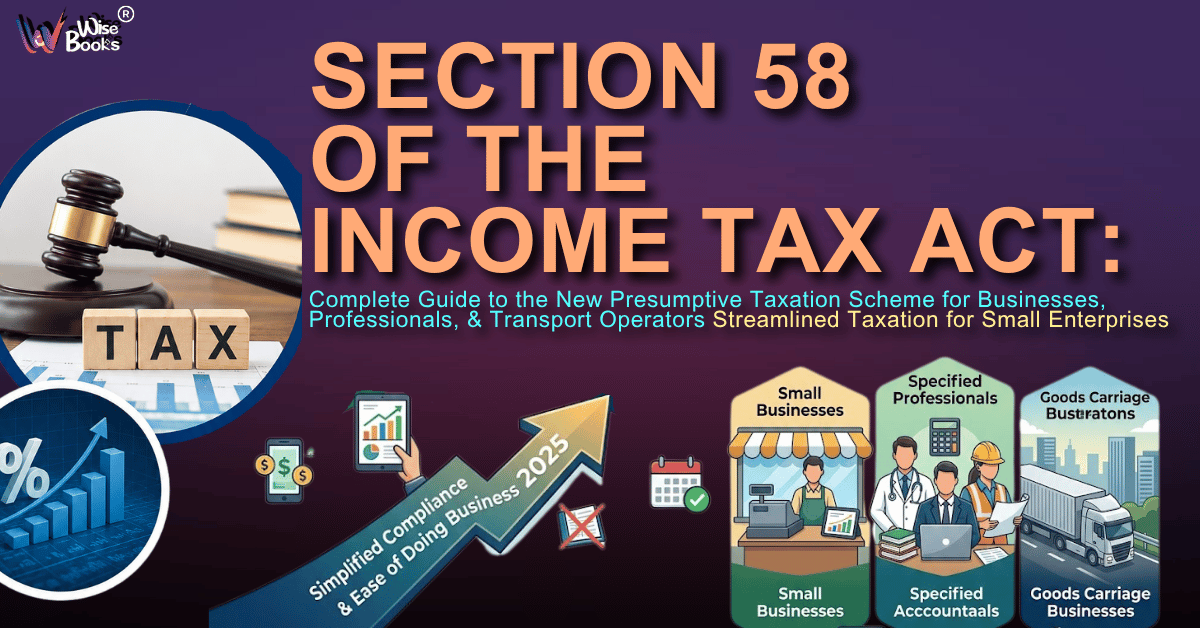
India's tax compliance framework is undergoing a major transformation with the introduction of the Income Tax Act 2025. One of the most significant changes is the introduction of Section 58, which consolidates the earlier presumptive taxation provisions under Sections 44AD, 44ADA, and 44AE into a single unified framework.
For years, small businesses, professionals, and transport operators had to navigate different sections, eligibility criteria, turnover limits, and compliance requirements. The new law simplifies this process by bringing all presumptive taxation provisions under one umbrella.
The objective is clear: reduce compliance burden, encourage digital transactions, simplify record-keeping, and improve ease of doing business for taxpayers.
In this article, we explore Section 58 in detail, including eligibility conditions, turnover limits, tax calculations, audit requirements, lock-in provisions, practical examples, and key benefits.
What is Presumptive Taxation?
Presumptive taxation is a simplified method of calculating taxable income. Instead of maintaining detailed books of accounts and claiming actual expenses, eligible taxpayers can declare income at prescribed rates.
Under this scheme:
i. Detailed bookkeeping is not mandatory.
ii. Tax audits may not be required.
iii. Compliance costs are significantly reduced.
iv. Tax filing becomes easier for small taxpayers.
The government assumes a certain percentage of turnover or receipts as profit and taxes the taxpayer accordingly.
Why Was Section 58 Introduced?
Before the Income Tax Act 2025:
- Section 44AD covered small businesses.
- Section 44ADA covered professionals.
- Section 44AE covered transport businesses.
Each section had different rules and conditions.
Section 58 combines all these provisions into a single, streamlined framework, making compliance easier and reducing confusion.
Category 1: Presumptive Taxation for Small Businesses
This category replaces the earlier Section 44AD.
Eligible Taxpayers
Eligible:
i. Resident Individuals
ii. Hindu Undivided Families (HUFs)
iii. Partnership Firms (excluding LLPs)
Not Eligible:
i. Limited Liability Partnerships (LLPs)
ii. Commission agents
iii. Brokerage businesses
iv. Agency businesses
v. Specified professionals
Turnover Limits
|
Particulars |
Limit |
|
Normal Threshold |
₹2 Crore |
|
Digital Transaction Benefit |
₹3 Crore |
Businesses can claim the enhanced ₹3 crore limit if cash receipts do not exceed 5% of total turnover.
Example
Total Turnover = ₹2.80 Crore
Cash Receipts = ₹8 Lakh
Percentage of Cash Receipts:
₹8,00,000 ÷ ₹2,80,00,000 × 100
= 2.86%
Since cash receipts are below 5%, the taxpayer remains eligible for presumptive taxation.
Presumptive Income Rates
|
Receipt Type |
Presumptive Income |
|
Digital Receipts |
6% |
|
Cash Receipts |
8% |
Numerical Illustration
Digital Sales = ₹1.50 Crore
Cash Sales = ₹50 Lakh
Taxable Income:
6% of ₹1.50 Crore = ₹9,00,000
8% of ₹50 Lakh = ₹4,00,000
Total Presumptive Income = ₹13,00,000
This ₹13 lakh becomes taxable business income.
Five-Year Lock-In Rule
One of the most important provisions under Section 58 is the lock-in mechanism.
If a taxpayer opts for presumptive taxation and later withdraws, they may lose eligibility to re-enter the scheme for the next five assessment years.
Why It Matters
Businesses expecting rapid growth should evaluate future turnover before opting for the scheme.
Category 2: Presumptive Taxation for Specified Professionals
This category replaces the earlier Section 44ADA.
Eligible Professionals
- Doctors
- Chartered Accountants
- Lawyers
- Architects
- Engineers
- Technical Consultants
- Interior Decorators
Gross Receipt Limits
|
Particulars |
Limit |
|
Standard Limit |
₹50 Lakh |
|
Digital Economy Limit |
₹75 Lakh |
The ₹75 lakh threshold applies when cash receipts remain below 5% of total professional receipts.
Presumptive Income Rate
The government assumes:
50% = Profit
50% = Expenses
Example
Professional Receipts = ₹60 Lakh
Presumptive Income = 50%
₹60,00,000 × 50%
= ₹30,00,000
Taxable Professional Income = ₹30 Lakh
No requirement to maintain detailed expense records.
Audit Trigger for Professionals
Tax audit becomes applicable when:
- Income declared is below 50% of receipts, and
- Total income exceeds the basic exemption limit.
Category 3: Presumptive Taxation for Goods Carriage Businesses
This category replaces Section 44AE.
Unlike business and professional taxation, income is calculated based on the number and type of vehicles owned.
Eligibility Condition
The taxpayer must not own more than 10 goods vehicles at any point during the financial year.
Important Example
Owned 10 trucks from April to December.
Purchased 11th truck on January 10.
Result:
Taxpayer becomes ineligible for presumptive taxation for the entire year.
Presumptive Income Calculation
Heavy Goods Vehicle
Income = ₹1,000 per ton per month
Other Goods Vehicles
Income = ₹7,500 per month
Numerical Example
Heavy Vehicle Weight = 18 Tons
Owned for 12 Months
Income:
18 × ₹1,000 × 12
= ₹2,16,000
If taxpayer owns 5 such vehicles:
₹2,16,000 × 5
= ₹10,80,000
Taxable Income = ₹10.80 Lakh
Benefits of Section 58
1. Reduced Compliance Burden
Businesses and professionals avoid extensive bookkeeping requirements.
2. Lower Compliance Costs
Reduced dependency on audits and accounting services.
3. Faster Tax Filing
Returns can be prepared quickly using turnover-based calculations.
4. Encouragement of Digital Transactions
Higher turnover limits reward businesses that use digital payment systems.
5. Simplified Tax Planning
Predictable tax calculations improve cash-flow management.
What Deductions Can Still Be Claimed?
Although business expenses cannot be separately claimed, taxpayers can still claim deductions under Chapter VI-A.
Examples include:
|
Section |
Deduction |
|
80C |
LIC, PPF, ELSS, Tax Saving FD |
|
80CCD(1B) |
NPS Contribution |
|
80D |
Health Insurance Premium |
|
80G |
Donations |
|
80TTA |
Savings Account Interest |
Common Mistakes Taxpayers Should Avoid
Mistake 1
Ignoring the 5-year lock-in provision.
Mistake 2
Incorrect classification of digital and cash receipts.
Mistake 3
Declaring lower profits without understanding audit implications.
Mistake 4
Crossing turnover limits unknowingly.
Mistake 5
Not monitoring cash receipt percentages.
Impact on MSMEs and Professionals
India has over 6 crore MSMEs contributing nearly 30% of GDP and around 45% of exports.
The simplified framework under Section 58 is expected to:
- Improve tax compliance.
- Reduce administrative burden.
- Encourage digital transactions.
- Improve ease of doing business.
- Increase formalization of small enterprises.
For professionals and small business owners, the new framework offers a balance between compliance simplicity and tax transparency.
Conclusion
Section 58 of the Income Tax Act 2025 marks a major shift in India's tax administration system. By consolidating the old Sections 44AD, 44ADA, and 44AE into a single framework, the government has significantly simplified presumptive taxation.
However, taxpayers must carefully evaluate turnover limits, digital transaction conditions, audit triggers, and the five-year lock-in rule before opting for the scheme.
While Section 58 reduces compliance burdens and encourages digital business practices, choosing the presumptive scheme should always be part of a broader tax planning strategy aligned with long-term business goals.
For businesses, professionals, and transport operators seeking simpler compliance and predictable taxation, Section 58 could become one of the most beneficial provisions under the Income Tax Act 2025.


Comments
No comments yet. Be the first to comment!