


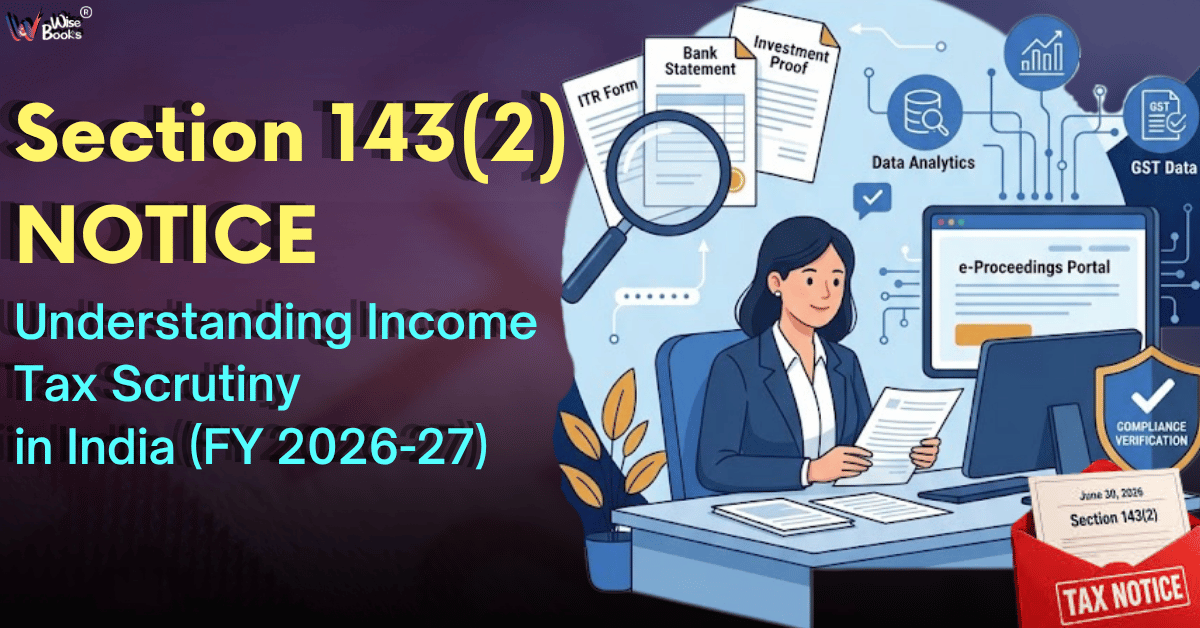
Understanding Income Tax Scrutiny in FY 2026–27: What Every Taxpayer, Professional & Business Owner Must Know
Every year, millions of taxpayers across India successfully file their Income Tax Returns (ITRs), assuming the process is complete once the return is submitted. For most taxpayers, that is indeed the end of the compliance journey.
However, for a selected group of taxpayers, the filing of an ITR is only the beginning.
The Income Tax Department may choose certain returns for detailed examination, commonly known as scrutiny assessment, by issuing a notice under Section 143(2) of the Income-tax Act, 1961.
Receiving a notice under Section 143(2) often creates panic. Many taxpayers immediately assume they have committed tax fraud or made a serious mistake.
The reality is quite different.
A scrutiny notice does not automatically mean you have done something wrong. It simply means that the Income Tax Department wants additional clarification before accepting the income, deductions, exemptions, losses, or claims reported in your return.
With increasing digitization, artificial intelligence, data analytics, AIS, TIS, GST integration, TDS reporting, and financial transaction reporting, the Income Tax Department now has access to a vast amount of taxpayer information. As a result, scrutiny has become more focused, data-driven, and risk-based than ever before.
Understanding why a scrutiny notice is issued, how the selection process works, what documents may be required, and how to respond correctly can save taxpayers from unnecessary stress, penalties, and prolonged litigation.
This comprehensive guide explains everything you need to know about Section 143(2).
What is Section 143(2)?
Section 143(2) empowers the Income Tax Department to verify whether the income declared in your Income Tax Return is correct.
If the Assessing Officer believes that additional verification is required, a notice under Section 143(2) is issued requesting further information, explanations, or supporting documents.
The objective is to ensure that:
- Income has been correctly reported.
- Tax liability has been accurately calculated.
- Deductions are genuine.
- Exemptions are legally claimed.
- Losses are correctly reported.
- No taxable income has been concealed.
The scrutiny process allows the department to examine the return in greater detail before finalizing the assessment.
What Does Scrutiny Assessment Mean?
Scrutiny assessment is a detailed review of your Income Tax Return.
Instead of accepting the return as filed, the department verifies whether all information provided by the taxpayer is accurate and supported by evidence.
The department may ask for:
- Bank statements
- Investment proofs
- Salary records
- Business books of accounts
- GST returns
- Purchase invoices
- Sales records
- Property documents
- Capital gain calculations
- Loan agreements
- Foreign income details
- Tax audit reports
- Financial statements
- Expense vouchers
The purpose is to ensure complete tax compliance.
Does Receiving a Notice Mean You Have Done Something Wrong?
Absolutely not.
Many scrutiny cases are selected through:
- Risk assessment systems
- AI-based algorithms
- Random selection
- Data mismatch analysis
Thousands of honest taxpayers receive scrutiny notices every year simply because certain transactions require additional verification.
The notice itself does not imply tax evasion.
Why Does the Income Tax Department Scrutinise Returns?
The department conducts scrutiny primarily to ensure:
- Accurate reporting of income
- Prevention of tax evasion
- Verification of deductions
- Confirmation of exemptions
- Validation of business expenses
- Detection of fake losses
- Matching financial transactions
- Checking compliance with tax laws
Major Reasons Why Your ITR May Be Selected for Scrutiny
1. High-Value Financial Transactions
Large financial transactions automatically attract attention.
Examples include:
- Purchase of expensive property
- Luxury car purchases
- High-value foreign travel
- Large cash deposits
- Significant mutual fund investments
- High-value stock market transactions
- Substantial credit card spending
If these transactions do not match your reported income, scrutiny may follow.
2. Mismatch Between AIS, TDS and ITR
Today, the department compares your return with information available through:
- Annual Information Statement (AIS)
- Tax Information Statement (TIS)
- Form 26AS
- TDS returns
- GST data
- Banking information
Even small mismatches can trigger further examination.
Examples include:
- Interest income missing from ITR
- Dividend income omitted
- Incorrect TDS claims
- Salary mismatch
- Professional receipts not disclosed
3. Unusually High Refund Claims
A taxpayer claiming an unusually large refund compared to previous years may be selected for verification.
The department may examine:
- TDS credits
- Advance tax payments
- Eligible deductions
- Tax calculations
4. Large Deductions Under Chapter VI-A
Excessive deductions under provisions such as:
- Section 80C
- Section 80D
- Section 80G
- Section 80E
- Section 80CCD
may require documentary proof.
5. Significant Increase or Decrease in Income
If your income suddenly changes without an apparent reason, the system may identify it as a risk.
Examples:
- Income drops by 70%
- Profit suddenly becomes a loss
- Salary increases drastically
- Business turnover fluctuates significantly
6. Business Losses Claimed Repeatedly
Businesses continuously reporting losses while maintaining large operations may attract scrutiny.
The department may verify:
- Books of accounts
- Sales
- Expenses
- Depreciation
- Stock records
7. Capital Gains Transactions
Property and stock market transactions are among the most scrutinized areas.
Common issues include:
- Incorrect purchase cost
- Wrong indexation
- Exemption under Sections 54, 54EC, or 54F
- Sale consideration mismatch
- Unreported capital gains
8. GST and Income Tax Data Mismatch
For businesses, GST data is increasingly compared with ITR figures.
Differences between:
- GST turnover
- Profit and Loss Account
- Income Tax Return
may trigger scrutiny.
9. Cash Transactions
Large cash dealings remain a major compliance risk.
Examples:
- Heavy cash deposits
- Cash withdrawals
- Cash sales
- Cash purchases
10. Frequent Revised Returns
Repeated corrections to the same return may indicate inconsistencies requiring further verification.
11. International Transactions
Taxpayers having:
- Foreign assets
- Foreign income
- Overseas investments
- Foreign bank accounts
may be selected to ensure compliance with disclosure requirements.
12. Information Received from Third Parties
The department receives information from:
- Banks
- Employers
- Mutual fund houses
- Registrars
- Property registrars
- Stock exchanges
- GST authorities
- Financial institutions
If third-party information differs from your return, scrutiny may arise.
Types of Scrutiny Under Section 143(2)
Complete Scrutiny
The Assessing Officer examines the entire return and all related claims.
Limited Scrutiny
Only specific issues identified by the department are examined, such as:
- Capital gains
- Business expenses
- Cash deposits
- Property transactions
When Can a Section 143(2) Notice Be Issued?
A notice under Section 143(2) must be issued within the time limit prescribed under the Income-tax Act. If it is not issued within the applicable statutory time limit, the scrutiny proceedings generally cannot be initiated on the basis of that return. Tax laws and deadlines can change, so taxpayers should verify the applicable timeline for the relevant assessment year.
How Will You Receive the Notice?
The department usually sends notices through:
- Your registered email ID
- Your income tax e-filing account
- SMS alerts
- The Income Tax e-Proceedings portal
Ignoring these communications can lead to adverse consequences.
What Documents May Be Required?
Depending on the issue under scrutiny, you may need:
- Bank statements
- Salary slips
- Form 16
- Form 26AS
- AIS
- Books of accounts
- GST returns
- Purchase invoices
- Sales invoices
- Investment proofs
- Home loan statements
- Property documents
- Mutual fund statements
- Demat account statements
- Capital gain workings
- Loan confirmations
What Happens After You Respond?
The Assessing Officer reviews:
- Your explanations
- Supporting documents
- Financial records
- Income disclosures
- Legal claims
If satisfied, the scrutiny is concluded without any adjustment.
If discrepancies remain, additions to income, tax demands, interest, or penalties may follow depending on the facts and applicable law.
What Happens If You Ignore the Notice?
Ignoring a Section 143(2) notice can lead to serious consequences, including:
- Best judgment assessment by the department
- Additional tax demands
- Interest
- Penalties where applicable
- Prolonged litigation
Prompt and accurate responses are therefore essential.
How to Reduce the Chances of Scrutiny
Although no taxpayer can completely avoid scrutiny, you can reduce the likelihood by:
i. Reporting all income accurately.
ii. Reconcile your ITR with AIS, TIS, and Form 26AS before filing.
iii. Maintaining proper books of accounts.
iv. Keeping documentary evidence for every deduction.
v. Reporting capital gains correctly.
vi. Matching GST turnover with income tax records.
vii. Avoiding inflated deduction claims.
viii. Filing returns on time.
ix. Responding promptly to any notices.
x. Consulting qualified tax professionals for complex transactions.
Final Thoughts
As India's tax administration becomes increasingly digital and data-driven, scrutiny under Section 143(2) is no longer based solely on suspicion. Advanced analytics, cross-verification of financial data, and automated risk assessment help the Income Tax Department identify returns that require closer examination.
Receiving a scrutiny notice should not be viewed as a sign of wrongdoing. Instead, it is an opportunity to demonstrate that your return is accurate and supported by proper documentation.
The key to navigating scrutiny successfully is preparation. Maintaining complete financial records, reconciling your data before filing, reporting income honestly, and responding promptly to any notice can make the process much smoother.
Whether you are a salaried employee, freelancer, professional, business owner, or investor, understanding how Section 143(2) works enables you to stay compliant, reduce unnecessary risks, and handle any scrutiny with confidence and clarity.


Comments
No comments yet. Be the first to comment!