


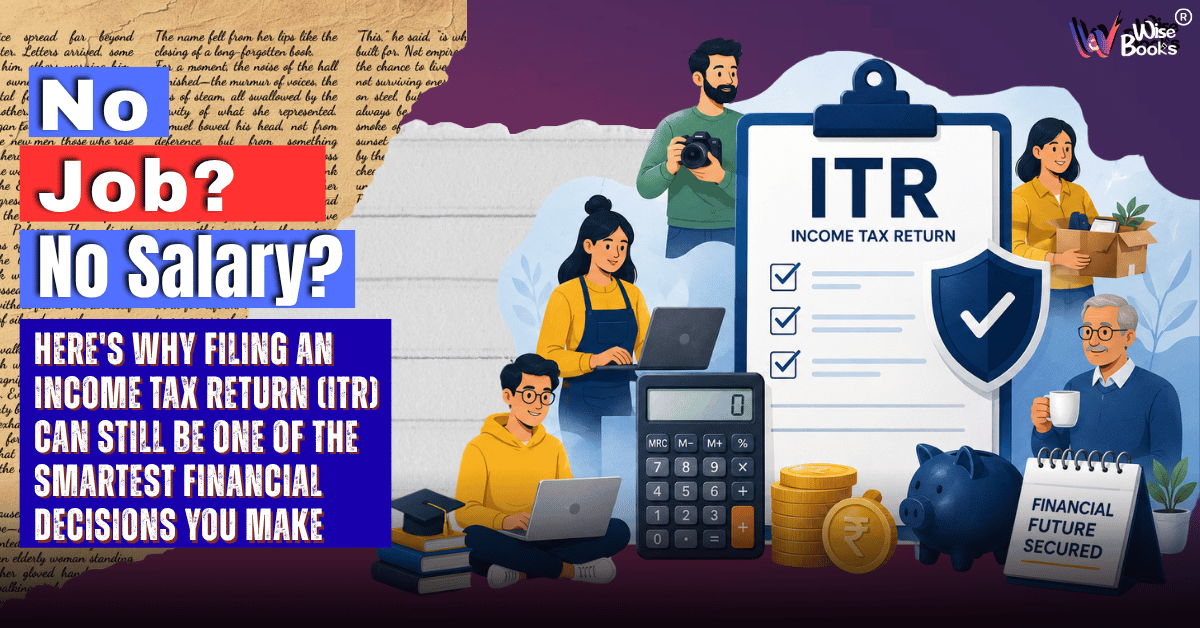
Filing an ITR isn't just about paying taxes - it's About Building Your Financial Identity
When people hear the words Income Tax Return (ITR), the first thought that often comes to mind is, "I don't earn enough, so I don't need to file." Many students, homemakers, unemployed individuals, retirees, freelancers with irregular income, and first-time investors believe that if they don't have a salary or don't owe tax, filing an ITR has no purpose.
However, this is one of the biggest misconceptions about India's tax system.
An Income Tax Return is not merely a document used to calculate taxes. It is also an official financial record that establishes your income history, demonstrates compliance with tax laws, and serves as proof of your financial credibility. Even if you have no taxable income, filing an ITR can provide significant long-term advantages.
Understanding What an ITR Actually Is
An Income Tax Return is an annual declaration submitted to the Income Tax Department that reports:
- Income earned during the financial year
- Taxes already deducted or paid
- Exempt income
- Deductions claimed
- Refunds, if applicable
Many people incorrectly assume that an ITR is only meant for taxpayers who owe income tax. In reality, it also serves as an official financial record maintained by the government.
Think of your ITR as your financial report card.
Just as educational certificates verify your academic achievements, your ITR verifies your financial profile.
Why This Topic Has Become Important in 2026
As the ITR filing season for Assessment Year 2026–27 progresses, tax professionals have observed that many individuals with little or no income skip filing their returns because they assume there is no benefit.
Recent discussions in the financial sector have highlighted that this approach may not always be in a person's best interest. Even where filing is not legally mandatory, voluntarily filing an ITR can make future financial transactions much easier.
Who Should Consider Filing an ITR Even Without a Salary?
Several categories of individuals may benefit from filing:
Students
Students may not have regular employment, but they may receive:
- Interest from bank deposits
- Internship stipends
- Freelancing income
- Investment returns
- Scholarships (where applicable)
Filing an ITR begins building a financial record early.
Homemakers
Many homemakers earn through:
- Home businesses
- Online selling
- Content creation
- Freelancing
- Investments
Even if their income is below the taxable threshold, filing an ITR creates documented financial history
Freelancers With Irregular Income
Income may fluctuate from year to year.
One year may involve significant earnings, while another may involve minimal income.
Maintaining continuous ITR records demonstrates financial consistency.
Retired Individuals
Pension, interest income, rental income, and investment earnings may still exist even after retirement.
An ITR helps maintain accurate financial documentation.
Investors
Even if an individual has no salary, they may receive:
- Interest
- Dividends
- Capital gains
- Mutual fund income
These transactions are often reported to the tax department through financial reporting systems.
Major Benefits of Filing an ITR Even If Tax Is Zero
1. Builds Financial Credibility
Banks and financial institutions prefer applicants with a documented income history.
An ITR acts as proof that your finances are transparent and properly declared.
Whether you apply for:
- Home loans
- Education loans
- Personal loans
- Business loans
banks frequently request ITRs from previous years.
Without filed returns, proving financial capacity becomes more difficult.
2. Helps During Visa Applications
Many countries request Income Tax Returns during visa processing.
This is especially common for:
- Tourist visas
- Student visas
- Business visas
- Immigration applications
Consistent ITR filing demonstrates financial stability and transparency.
3. Claim Tax Refunds
Suppose your bank deducted TDS on:
- Fixed deposits
- Professional payments
- Contract income
- Freelancing income
If your total income is below the taxable limit, you may still be entitled to receive the deducted amount back.
However, the refund can generally be claimed only by filing an Income Tax Return.
4. Creates Long-Term Financial History
Financial institutions value consistency.
A person who files returns every year appears more financially disciplined than someone with no documented financial history.
This becomes valuable years later when:
- Starting a business
- Purchasing property
- Applying for higher credit limits
- Seeking investors
5. Makes Future Tax Compliance Easier
If your income increases later:
- salary
- business profits
- professional income
Having previous ITR records simplifies future compliance.
Situations Where Filing May Still Be Mandatory
Many people believe that income below the exemption limit automatically means filing is unnecessary.
That is not always true.
Certain transactions can trigger mandatory filing requirements even if taxable income is low, such as:
- High-value bank deposits
- Significant foreign travel expenditure
- Ownership of foreign assets
- Certain specified financial transactions
- Companies and firms (which generally must file regardless of profit or loss)
The exact requirements depend on the provisions applicable for the assessment year.
Real-Life Example
Consider a college student who earns:
- ₹45,000 from internships
- ₹20,000 interest from investments
- ₹15,000 through freelance graphic design
The total income is below the taxable threshold.
Legally, the student may not owe income tax.
However, by filing an ITR:
- they establish a financial history,
- can claim any eligible TDS refund,
- and have official income proof for future education loans or overseas studies.
The return becomes a long-term asset rather than just a tax document.
Should Everyone File an ITR?
Not necessarily.
Whether filing is compulsory depends on the Income-tax Act and your specific circumstances.
However, many people who are not legally required to file may still benefit from doing so voluntarily because of the financial, documentation, and compliance advantages discussed above.
Final Thoughts
Income Tax Returns have evolved beyond being a tool solely for tax collection.
Today, they function as one of the most widely accepted indicators of an individual's financial profile.
Whether you are a student beginning your career, a homemaker earning occasional income, a freelancer between projects, or someone without a regular salary, filing an ITR can help establish financial credibility, simplify future transactions, support refund claims, and create a reliable financial record.
As India's financial ecosystem becomes increasingly digital and data-driven, maintaining accurate tax records is no longer just about compliance, it is also about preparing for future financial opportunities.


Comments
No comments yet. Be the first to comment!