


Introduction
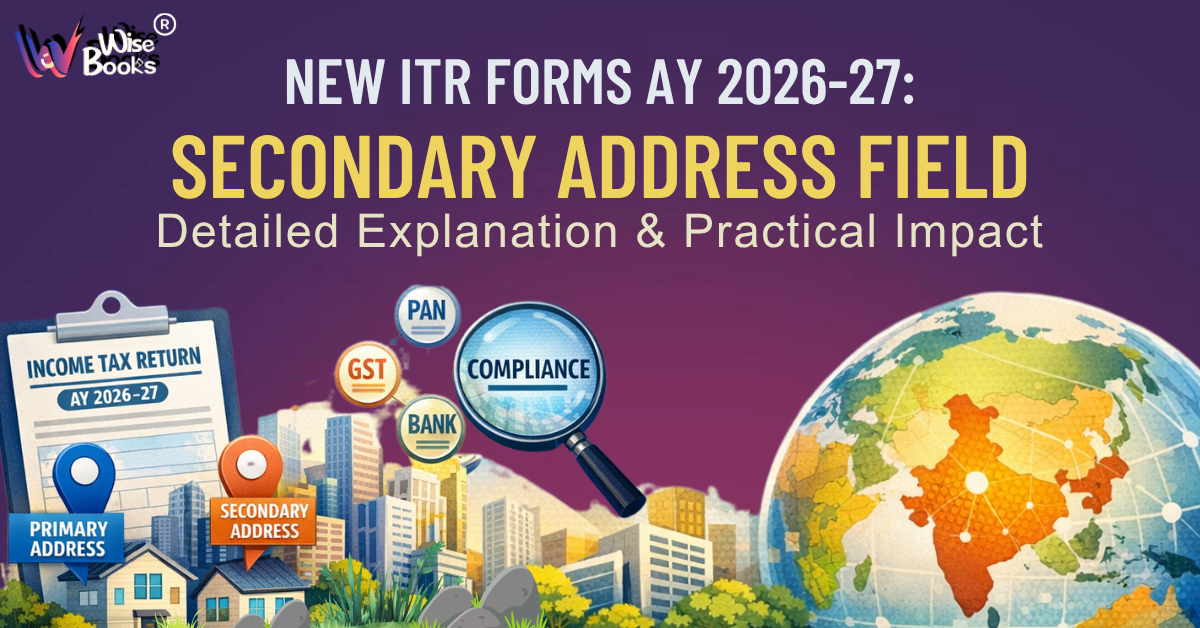
The Income Tax Department has introduced revised Income Tax Return (ITR) forms for Assessment Year 2026–27, incorporating important structural changes in taxpayer reporting. Among these, the introduction of a mandatory secondary address field, along with expanded contact details, stands out as a key development.
This change goes beyond a routine update. It reflects a broader transition toward a data-driven, technology-enabled tax administration system, where accuracy, traceability, and seamless communication are critical. As reported by The Economic Times, this development aligns with India’s move toward a more integrated and intelligent compliance framework.
What Has Changed in the ITR Forms?
Previously, taxpayers were required to provide only a single address with limited supporting contact details. This often resulted in communication inefficiencies and incomplete taxpayer profiling.
Under the updated framework, taxpayers must now report both a primary address, representing their current place of residence or business, and a secondary address, capturing an additional relevant location. The forms also allow multiple contact details and improved reporting for representative taxpayers, ensuring greater clarity and accountability.
In essence, the update introduces:
i. Dual address reporting
ii. Enhanced communication details
iii. Improved taxpayer identification
Understanding the “Secondary Address” Concept
The introduction of the secondary address recognizes the evolving nature of modern taxpayers, who frequently operate across multiple locations. This field allows individuals and businesses to report an additional address that holds relevance for residential, professional, or legal purposes.
For instance, an individual working in one city while maintaining a permanent residence in another can now report both locations accurately. Similarly, professionals operating from both home and office environments can distinguish between personal and business addresses.
This structured reporting improves transparency and ensures continuity in communication, particularly in cases involving relocation, multi-location operations, or international residency scenarios.
Rationale Behind This Change
The introduction of a secondary address is driven by the need to enhance efficiency and reliability within the tax system. One of the primary objectives is to address communication gaps that previously arose due to outdated or incomplete address information. By capturing multiple addresses, the likelihood of successful communication with taxpayers increases significantly.
Additionally, the change strengthens data integration across various platforms, including Income Tax, GST, and banking systems. This enables more accurate data matching and helps identify inconsistencies in taxpayer records.
From a regulatory perspective, the availability of multiple address points also supports fraud detection by allowing authorities to identify irregular patterns, such as the use of non-existent or shared addresses. Furthermore, as tax administration increasingly relies on advanced analytics and AI-based monitoring, the inclusion of additional data fields enhances the effectiveness of these systems.
Key objectives include:
i. Improved communication efficiency
ii. Stronger data validation across systems
iii. Enhanced fraud detection capabilities
iv. Support for AI-driven compliance monitoring
Impact on Taxpayers
The impact of this update extends across various categories of taxpayers. Salaried individuals, particularly those residing in cities different from their permanent homes, will benefit from improved communication and reduced risk of missing notices.
Freelancers and consultants can achieve better clarity in reporting their professional and residential addresses, which may prove beneficial during verification or assessment processes.
For business owners, the ability to report both registered and operational addresses enhances transparency and ensures alignment with GST records—an increasingly critical aspect of compliance.
NRIs and individuals with cross-border connections can also utilize this feature to reflect their dual presence more accurately, aiding in the determination of tax residency and obligations.
Compliance Risks of Inaccurate Information
While the updated structure offers greater flexibility, it also increases the importance of accuracy. Incorrect or outdated address information can result in missed tax notices, which may lead to delayed responses and potential penalties.
Inconsistencies across PAN, GST, and banking records may trigger scrutiny, as automated systems are designed to flag such mismatches. In cases of persistent non-response, the matter may escalate into legal proceedings, depending on the severity of non-compliance.
Potential risks include:
i. Missed communications from tax authorities
ii. Financial penalties and interest liabilities
iii. Increased likelihood of scrutiny or audit
iv. Legal consequences in prolonged cases
Other Notable Enhancements in ITR Forms
In addition to the introduction of the secondary address, the updated ITR forms incorporate several other improvements. Taxpayers can now provide multiple contact details, ensuring communication is not restricted to a single channel.
The reporting framework for representative taxpayers—such as legal heirs or authorized signatories—has been refined to improve accountability and clarity.
Furthermore, the overall structure of the forms has been simplified, reducing complexity and making the filing process more accessible. Enhanced data structuring also improves accuracy and minimizes the scope for errors.
Additional enhancements include:
i. Multiple communication channels
ii. Clearer reporting for representatives
iii. Simplified filing structure
iv. Improved data accuracy
Strategic Implications for Businesses
The changes introduced in the ITR forms reflect a broader shift toward a data-centric compliance environment. Businesses are increasingly operating within an ecosystem where financial data is interconnected and subject to real-time verification.
In this context, maintaining consistency across all regulatory platforms—including GST registration, income tax records, and banking information—is essential. Regular updates to address details, strong bookkeeping practices, and thorough vendor due diligence are critical components of effective compliance management.
Businesses should focus on:
i. Ensuring consistency across regulatory records
ii. Updating information promptly
iii. Maintaining accurate financial documentation
iv. Conducting vendor verification processes
WiseBooks Professional Perspective
At WiseBooks, we advise clients to approach ITR filing as a strategic compliance function rather than a routine obligation. With increasing reliance on automation and data analytics, even minor discrepancies can lead to significant implications.
A proactive approach—centered on data accuracy, consistency, and proper documentation—can help mitigate risks and ensure smooth compliance. Leveraging professional expertise and digital accounting solutions further strengthens this process.
Conclusion
The introduction of the secondary address field represents a meaningful step toward enhancing transparency and efficiency in tax administration. While the change may appear incremental, its implications are substantial in a system increasingly driven by data and technology.
As regulatory frameworks continue to evolve, taxpayers must prioritize accuracy and consistency in their filings. In the current environment, compliance is no longer reactive—it is proactive, structured, and data-focused.


Comments
No comments yet. Be the first to comment!