


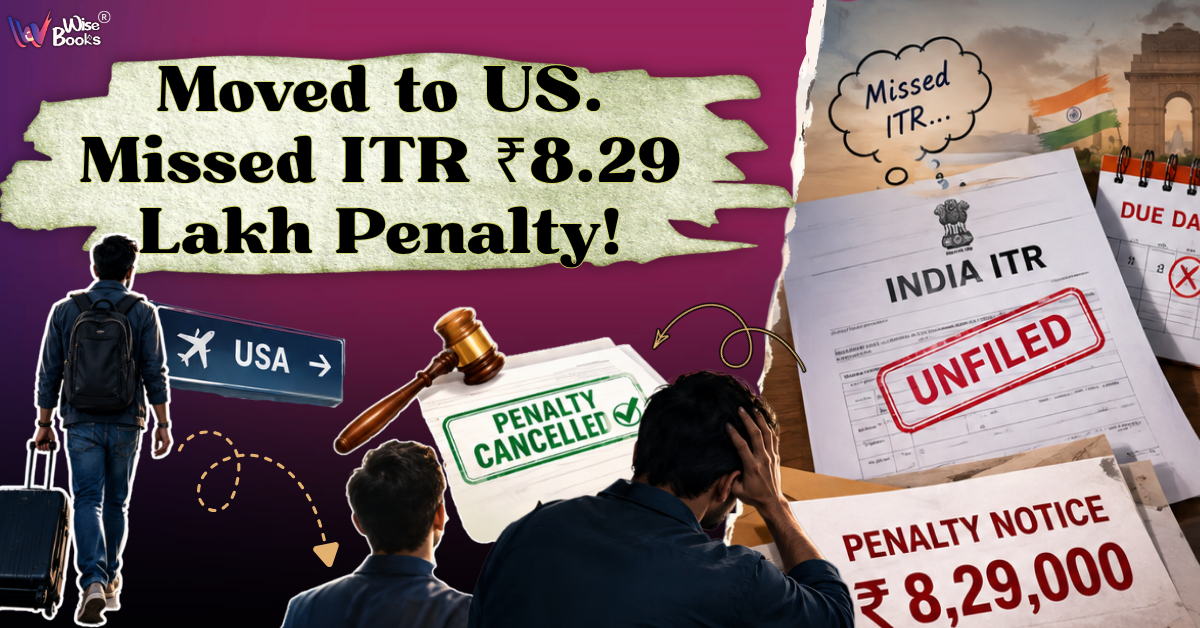
Moving abroad for a new job can come with a long list of things to manage relocation, paperwork, finances and a completely new routine. But what happens when an Indian taxpayer misses an income-tax return deadline during that transition?
A recent case before the Income Tax Appellate Tribunal (ITAT), Jaipur, shows why missing an ITR deadline does not automatically mean that a penalty will survive, especially when the taxpayer can establish a genuine explanation and demonstrate that the tax was voluntarily paid.
The Case: A Taxpayer Moved to the US and Missed His ITR
The taxpayer, Abhishubham Bahadur Saxena, moved to the United States in August 2018 for employment with a multinational company.
For Assessment Year 2018-19, he did not file his original income-tax return under Section 139 within the prescribed time. The belated-return period also expired.
However, before the tax department initiated reassessment proceedings, the taxpayer voluntarily paid around ₹1.62 lakh towards self-assessment tax, interest and late fee on 23 August 2019.
Later, the department found that he had salary income of approximately ₹26.06 lakh and reopened the assessment under Section 148.
Why Was an ₹8.29 Lakh Penalty Imposed?
In response to the Section 148 notice, the taxpayer filed his return on 18 April 2022, declaring total income of around ₹20.50 lakh.
The Assessing Officer accepted this return without making any addition or variation to the declared income.
Despite this, penalty proceedings were initiated under Section 270A. The department treated the income disclosed for the first time in the Section 148 return as under-reported income and considered it as misreporting.
The result was a penalty of ₹8,29,034.
The taxpayer challenged the penalty, but the CIT(A) upheld it. The matter then reached ITAT Jaipur.
What Did the Taxpayer Argue?
The taxpayer explained that he had moved to the US for employment and that the failure to file the return was not intentional.
He also pointed out that he had a history of filing his income-tax returns on time and, importantly, had voluntarily paid the tax, interest and late fee before the department became aware of the issue and initiated reassessment.
There was also no addition made by the Assessing Officer after the return filed in response to Section 148.
The Key Provision: Section 270A(6)(a)
This became the crucial part of the case.
Section 270A generally deals with penalties for under-reporting and misreporting of income. However, Section 270A(6)(a) provides an important exclusion where the taxpayer offers an explanation, the explanation is found to be bona fide, and the taxpayer has disclosed all material facts necessary to substantiate it.
In simple terms, the question was not only whether income had been disclosed later, but also whether the taxpayer had a genuine and substantiated explanation for the situation.
Why Did ITAT Jaipur Delete the Penalty?
ITAT Jaipur considered the overall circumstances of the case.
The Tribunal noted that the taxpayer had moved to the US for employment, had previously been compliant with his ITR filings, had voluntarily paid tax, interest and late fee before reassessment proceedings, and that the reassessment itself did not result in any addition.
Considering these facts, the Tribunal accepted the taxpayer's explanation as bona fide.
Therefore, the income was excluded from the definition of under-reported income under Section 270A(6)(a). Since the basis for the misreporting penalty also failed, the Tribunal deleted the entire ₹8,29,034 penalty.
What About the 49-Day Delay in Filing the Appeal?
There was another interesting procedural aspect.
The taxpayer's appeal before ITAT was delayed by 49 days. He explained that his PAN records showed the wrong jurisdiction, which created difficulties in receiving and responding to the proceedings.
After correcting the PAN address and applying for transfer of jurisdiction, he pursued the matter before the appropriate authority.
ITAT accepted the explanation as a bona fide procedural issue and condoned the delay.
Does This Mean You Can Ignore Your ITR Deadline?
No.
This ruling should not be understood as permission to miss an ITR deadline and assume that any penalty will automatically be cancelled.
The Tribunal's decision was based on the specific facts and circumstances of this case, particularly the taxpayer's explanation, previous compliance history, voluntary payment of tax and the absence of any addition during reassessment.
The case instead highlights why taxpayers should properly document their circumstances and respond to tax proceedings rather than ignoring them.
The Bigger Tax Lesson
For taxpayers living or working abroad, especially those who have recently relocated from India, tax compliance can easily become complicated.
A missed return, an overseas move or a delayed response can later lead to notices, reassessment proceedings and potentially significant penalties.
The key takeaway is simple: missing a deadline can create serious consequences, but the circumstances behind the default and the taxpayer's subsequent conduct can also matter.
If you have received a tax notice, missed an ITR deadline, or are unsure about your tax obligations after moving abroad, reviewing the situation with a tax professional can help you understand the appropriate course of action before the issue becomes more complicated.


Comments
No comments yet. Be the first to comment!