


Complete Guide to Form DPT-3 Filing, Applicability, Due Date, Documents, Penalties, and Compliance Under the Companies Act, 2013
Every financial year ends with a long list of statutory compliances for companies registered under the Companies Act, 2013. While businesses generally focus on Income Tax Returns, GST filings, ROC annual returns, and financial statements, one important compliance that is often ignored is Form DPT-3.
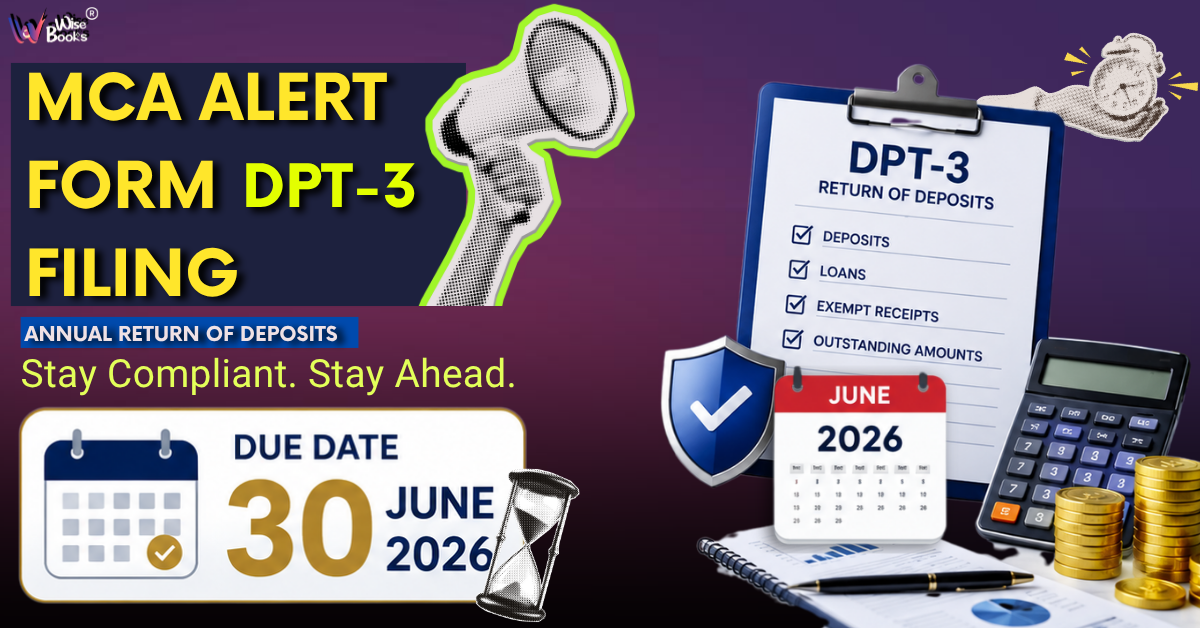
To remind companies of this mandatory filing, the Ministry of Corporate Affairs (MCA) has issued a compliance advisory stating that eligible companies must file Form DPT-3 (Return of Deposits) on or before 30 June 2026. The return must contain details of deposits and certain outstanding amounts as they existed on 31 March 2026.
Many business owners assume that this filing is relevant only for companies that have accepted public deposits. However, this is one of the biggest misconceptions. Thousands of private limited companies that have never accepted a single public deposit are still legally required to file Form DPT-3 because the form also covers various categories of loans and receipts that are legally treated as amounts not considered deposits.
Failure to comply may expose companies to additional filing fees, regulatory scrutiny, and penalties under the Companies Act. Therefore, understanding this annual filing requirement is essential for every company and finance professional.
What Exactly is Form DPT-3?
Form DPT-3 is an annual return prescribed under Rule 16 of the Companies (Acceptance of Deposits) Rules, 2014, framed under the Companies Act, 2013.
Its primary objective is to provide the Ministry of Corporate Affairs with complete information regarding deposits accepted by companies and certain outstanding amounts that are legally excluded from the definition of deposits.
In simple words, the Government wants companies to disclose where their borrowed funds are coming from and what liabilities remain outstanding at the end of every financial year.
Unlike annual financial statements that present the overall financial position of a company, Form DPT-3 specifically focuses on deposits and other reportable borrowings. This enables the MCA to monitor corporate borrowing patterns and strengthen financial transparency across the corporate sector.
MCA DPT-3 Filing Due Date for FY 2025-26
The compliance timeline for Financial Year 2025-26 is straightforward.
|
Particular |
Details |
|
Financial Year |
1 April 2025 – 31 March 2026 |
|
Reporting Date |
31 March 2026 |
|
Filing Form |
DPT-3 |
|
Due Date |
30 June 2026 |
|
Filing Authority |
Ministry of Corporate Affairs (MCA) |
|
Applicable Law |
Companies Act, 2013 |
This means that every company required to file Form DPT-3 must report the outstanding balances as on 31 March 2026, and the completed form should be submitted to the MCA portal before 30 June 2026.
Why Has MCA Made Form DPT-3 Mandatory?
Over the past decade, the Government has significantly strengthened corporate compliance in India. Today, almost every financial transaction is digitally traceable, and regulators increasingly rely on data to monitor financial health and compliance.
Form DPT-3 plays an important role in this regulatory framework.
Instead of waiting until a company faces financial difficulties, the MCA collects annual information about deposits, loans, and exempt borrowings. This helps regulators identify unusual borrowing patterns, monitor financial liabilities, and ensure that companies are not accepting deposits in violation of the Companies Act.
The filing also enhances transparency for stakeholders such as shareholders, investors, banks, auditors, and creditors, who depend on accurate corporate disclosures while making financial decisions.
Why is Form DPT-3 Important for Companies?
Many companies underestimate the importance of this return because they associate it only with public deposits. In reality, Form DPT-3 has become one of the most significant annual ROC compliances.
It serves as an official declaration of a company's outstanding deposits and exempt borrowings, ensuring that the MCA has updated information about the company's financial obligations.
Regular filing demonstrates good corporate governance, improves regulatory compliance, and minimizes the risk of notices during future inspections or audits.
For companies seeking loans, attracting investors, or maintaining strong compliance records, timely filing also reflects disciplined financial management.
Who is Required to File Form DPT-3?
One of the most frequently asked questions is whether every company is required to file this return.
The answer depends on the nature of outstanding receipts as on 31 March 2026.
Generally, the requirement applies to Private Limited Companies, Public Limited Companies, One Person Companies (OPCs), Small Companies, and Section 8 Companies that have accepted deposits or hold outstanding amounts classified as not considered deposits under the Companies (Acceptance of Deposits) Rules.
Even if a company has never accepted public deposits, it may still need to file the form if it has outstanding director loans, secured bank borrowings, inter-corporate loans, or other exempt receipts covered under the Rules.
This is precisely why many businesses unknowingly miss this compliance every year.
What is Meant by "Amounts Not Considered as Deposits"?
The title "Return of Deposits" often creates confusion.
The Companies Act excludes several categories of receipts from the legal definition of deposits. However, these exempt amounts still need to be reported through Form DPT-3 if they remain outstanding as on the reporting date.
For example, loans received from directors are not treated as deposits under the Rules. Similarly, borrowings from scheduled banks, financial institutions, inter-corporate loans, commercial advances received in the ordinary course of business, security deposits, and government grants may also fall within exempt categories subject to prescribed conditions.
Although these receipts are not deposits in the legal sense, they remain reportable through Form DPT-3 wherever applicable.
Practical Example
Suppose ABC Private Limited has never invited or accepted deposits from the public.
However, its Balance Sheet on 31 March 2026 contains the following outstanding liabilities:
- Bank Loan – ₹1.25 Crore
- Director's Loan – ₹30 Lakh
- Inter-Corporate Loan – ₹45 Lakh
- Security Deposit from Customer – ₹8 Lakh
The company may still be required to file Form DPT-3 because these outstanding receipts fall under reportable categories, even though they are not public deposits.
This example highlights why businesses should not assume that "no deposits" automatically means "no DPT-3 filing."
What Information is Reported in Form DPT-3?
The return captures a detailed snapshot of the company's outstanding financial liabilities as on 31 March 2026.
The form generally includes the Corporate Identification Number (CIN), registered office details, net worth, details of deposits accepted, outstanding exempt borrowings, secured and unsecured loans, credit rating (where applicable), auditor's certificate where required, and other prescribed financial information.
The information submitted becomes part of the MCA's compliance database and may be used for regulatory monitoring.
Documents Required Before Filing
Before beginning the filing process, companies should ensure that their financial records are complete.
The filing generally requires details from audited financial statements, outstanding loan schedules, deposit records, director loan confirmations, auditor's certificate wherever applicable, Digital Signature Certificate (DSC), and supporting documents relating to borrowings or charges.
Preparing these documents in advance significantly reduces the chances of filing errors.
How to File Form DPT-3?
The filing process is completely online through the MCA portal.
After logging into the MCA V3 Portal using the company's registered credentials, the company must navigate to the e-Filing section under Deposits and Nidhi Services and select Form DPT-3.
The relevant financial information as on 31 March 2026 must then be entered carefully. After attaching the required documents, the form is digitally signed using the company's Digital Signature Certificate and submitted online along with the applicable filing fee.
Once successfully filed, an acknowledgement is generated by the MCA for future reference.
What Happens if a Company Fails to File DPT-3?
Ignoring Form DPT-3 is not advisable.
Delayed filing may result in additional filing fees and can expose the company to regulatory action under the Companies Act, 2013. Persistent non-compliance may also attract penalties on both the company and its officers in default, depending on the facts of the case.
Apart from financial consequences, non-filing can also affect the company's compliance history, which may become relevant during inspections, due diligence exercises, bank financing, investor reviews, or future ROC filings.
For businesses that value a clean compliance record, timely filing is always the better option.
Key Dates at a Glance
|
Event |
Date |
|
Financial Year Ends |
31 March 2026 |
|
Reporting Position As On |
31 March 2026 |
|
DPT-3 Filing Opens |
After year-end as per MCA availability |
|
Last Date to File Form DPT-3 |
30 June 2026 |
|
Filing Mode |
Online through MCA Portal |
Common Mistakes Companies Make
Every year, compliance professionals observe several recurring mistakes. Some companies wrongly assume that DPT-3 is applicable only to public deposits, while others forget to include outstanding director loans or inter-corporate borrowings. In many cases, businesses wait until the last week of June, leaving little time to collect financial information or rectify errors.
Another common issue is relying on incomplete loan schedules, which may result in inaccurate reporting. These mistakes can be avoided through timely preparation and professional review before submission.
Final Thoughts
Form DPT-3 may appear to be just another annual ROC filing, but it plays a crucial role in India's corporate compliance framework. It is not merely a return for companies accepting public deposits, it is a reporting mechanism that captures various outstanding borrowings and exempt receipts, enabling the Ministry of Corporate Affairs to maintain transparency and monitor corporate financial liabilities.
With the due date of 30 June 2026 approaching, companies should review their balance sheet as on 31 March 2026, identify all reportable amounts, gather the necessary documentation, and complete the filing well before the deadline. Early compliance not only avoids last-minute challenges but also strengthens the company's governance standards and regulatory credibility.
A proactive approach to Form DPT-3 today can prevent unnecessary notices, penalties, and compliance issues tomorrow. For every company registered under the Companies Act, understanding this obligation is no longer optional, it is an essential part of responsible corporate compliance.


Comments
No comments yet. Be the first to comment!