


Introduction
For thousands of companies across India, statutory compliance is one of the most important responsibilities under the Companies Act, 2013. Every registered company is required to file annual financial statements, annual returns, and various statutory forms with the Registrar of Companies (ROC) within prescribed timelines.
However, many companies especially startups, MSMEs, dormant businesses, and small private limited companies often miss these filing deadlines due to financial constraints, lack of awareness, operational difficulties, or administrative oversight. As delays continue, additional filing fees and penalties accumulate, making it increasingly difficult for businesses to become compliant again.
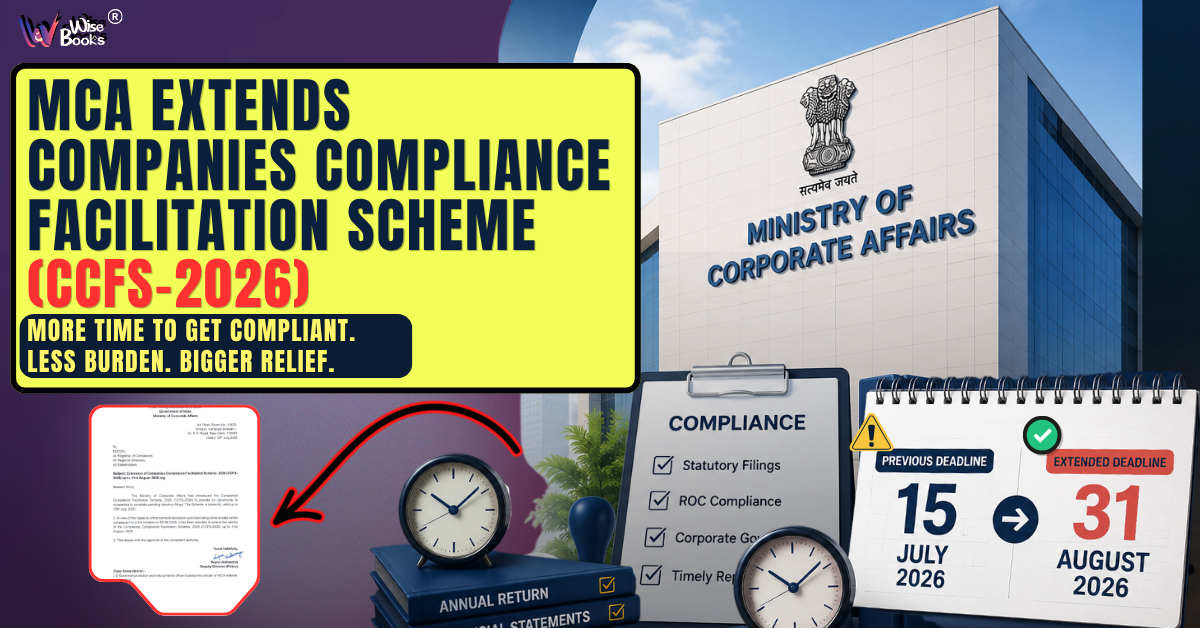
Recognizing these challenges, the Ministry of Corporate Affairs (MCA) introduced the Companies Compliance Facilitation Scheme, 2026 (CCFS-2026) as a one-time compliance relief initiative. The scheme was originally valid until 15 July 2026. Now, through General Circular No. 03/2026 dated 8 July 2026, the MCA has extended the scheme's validity until 31 August 2026, giving companies an additional opportunity to complete pending statutory filings with reduced financial burden.
For businesses that have not yet regularized their compliance status, this extension could be the last opportunity to avoid substantial penalties and restore their legal standing.
What is the Companies Compliance Facilitation Scheme (CCFS-2026)?
The Companies Compliance Facilitation Scheme (CCFS-2026) is a special compliance window introduced by the Ministry of Corporate Affairs to encourage defaulting companies to complete pending statutory filings.
Instead of imposing the full amount of accumulated additional filing fees and penalties, the Government has offered significant financial relief so that companies can voluntarily regularize their compliance records.
The scheme supports the Government's broader objectives of:
- Improving corporate compliance
- Reducing inactive and non-compliant companies
- Promoting ease of doing business
- Maintaining accurate corporate records
- Encouraging voluntary compliance rather than punitive enforcement
Rather than focusing solely on penal action, the scheme provides businesses with an opportunity to correct past defaults and move forward with clean compliance records.
Latest MCA Update: Scheme Extended Until 31 August 2026
The Ministry of Corporate Affairs has officially extended the validity of the Companies Compliance Facilitation Scheme from 15 July 2026 to 31 August 2026.
This extension provides companies with approximately six additional weeks to:
- Complete overdue annual filings
- File pending statutory forms
- Rectify long-standing compliance defaults
- Avail concessional additional filing fees
According to the MCA, the extension was granted after considering practical difficulties faced by stakeholders and disruptions affecting the MCA21 portal's operations.
Why Was the Extension Necessary?
Many companies were unable to complete their filings before the original deadline due to various operational challenges.
Some of the major reasons include:
1. MCA Portal Technical Issues
The MCA21 system experienced operational disruptions and reduced processing capacity following technical issues related to its data centre infrastructure, affecting timely filing of statutory documents.
2. Large Volume of Pending Filings
As the deadline approached, the number of companies attempting to file overdue forms increased significantly, resulting in heavy portal traffic and processing delays.
3. Professional Workload
Chartered Accountants, Company Secretaries, and compliance professionals were simultaneously handling:
- Income Tax Return filings
- GST compliances
- TDS returns
- ROC annual filings
The extension provides additional time to manage these responsibilities effectively.
Who Can Benefit from the Extended Scheme?
The scheme is particularly beneficial for:
- Private Limited Companies
- One Person Companies (OPCs)
- Small Companies
- Startups
- MSMEs
- Dormant companies
- Companies with long-pending ROC filings
- Companies intending to become compliant before regulatory action
Businesses that have accumulated substantial additional filing fees over several years stand to gain the most from this relief.
Key Benefits of the Extension
1. Reduced Additional Filing Fees
One of the biggest attractions of CCFS-2026 is the substantial reduction in additional filing fees.
Eligible companies are required to pay:
- Normal statutory filing fees, plus
- Only 10% of the applicable additional fees, instead of the full amount.
This effectively provides around a 90% concession on accumulated additional filing fees, significantly lowering the cost of regularizing overdue filings.
2. Opportunity to Regularize Compliance
Companies can update long-pending records with the Registrar of Companies and restore their compliance status.
This helps businesses:
- Improve legal standing
- Enhance credibility
- Facilitate fundraising
- Support banking and lending requirements
- Avoid future regulatory complications
3. Relief from Future Penalties
Timely filing under the scheme may help companies avoid further enforcement actions related to delayed annual filings, subject to the scheme's conditions and applicable law.
4. Easier Business Continuity
Many businesses face challenges while:
- Raising investments
- Obtaining loans
- Participating in tenders
- Entering strategic partnerships
Maintaining updated ROC records improves corporate credibility and simplifies these business activities.
Which Forms Are Covered?
The scheme primarily covers pending filings relating to:
Annual Financial Statements
- AOC-4
- AOC-4 XBRL
- AOC-4 CFS
Annual Returns
- MGT-7
- MGT-7A
Auditor Appointment
- ADT-1
The scheme also provides concessional provisions for eligible companies opting for dormancy or strike-off under specified conditions.
Why Businesses Should Not Ignore This Opportunity
Many companies postpone ROC filings because accumulated penalties appear unaffordable.
However, continued non-compliance can eventually result in:
- Heavy financial liabilities
- Regulatory notices
- Difficulties in obtaining funding
- Compliance risks for directors
- Operational and governance challenges
By utilizing the extended scheme, companies can significantly reduce these risks while restoring compliance at a much lower cost.
What Companies Should Do Before 31 August 2026
Businesses should use this extended window to:
- Review all pending ROC filings.
- Identify overdue statutory forms.
- Prepare updated financial statements and annual returns.
- Coordinate with their Chartered Accountant or Company Secretary.
- Complete filings before 31 August 2026.
- Retain acknowledgements and filing records for future reference.
Delaying action until the final days may lead to portal congestion and unnecessary complications.
How This Extension Supports Ease of Doing Business
The Government has consistently focused on improving India's corporate compliance ecosystem.
Instead of relying solely on punitive measures, initiatives like CCFS-2026 encourage businesses to voluntarily regularize defaults and maintain transparent corporate records.
For MSMEs and startups, this approach reduces compliance costs while promoting responsible corporate governance.
Ultimately, the extension strengthens:
- Corporate transparency
- Regulatory compliance
- Ease of doing business
- Investor confidence
- Long-term business sustainability
Final Thoughts
The MCA's decision to extend the Companies Compliance Facilitation Scheme (CCFS-2026) until 31 August 2026 offers a valuable second chance for companies that have fallen behind on statutory filings. With reduced additional fees, the opportunity to update overdue ROC records, and relief from prolonged non-compliance, businesses should treat this extension as a strategic compliance window rather than waiting for enforcement action.
Whether you are a startup, MSME, private limited company, or dormant entity, now is the ideal time to review pending ROC filings and regularize your compliance. Acting before the deadline can help avoid future penalties, strengthen corporate governance, and enhance your company's credibility with investors, lenders, and regulators.


Comments
No comments yet. Be the first to comment!