


India's tax landscape has undergone a remarkable transformation since the introduction of the Goods and Services Tax (GST) in 2017. Over the years, GST has become one of the country's most important revenue sources, helping create a unified market while simplifying indirect taxation.
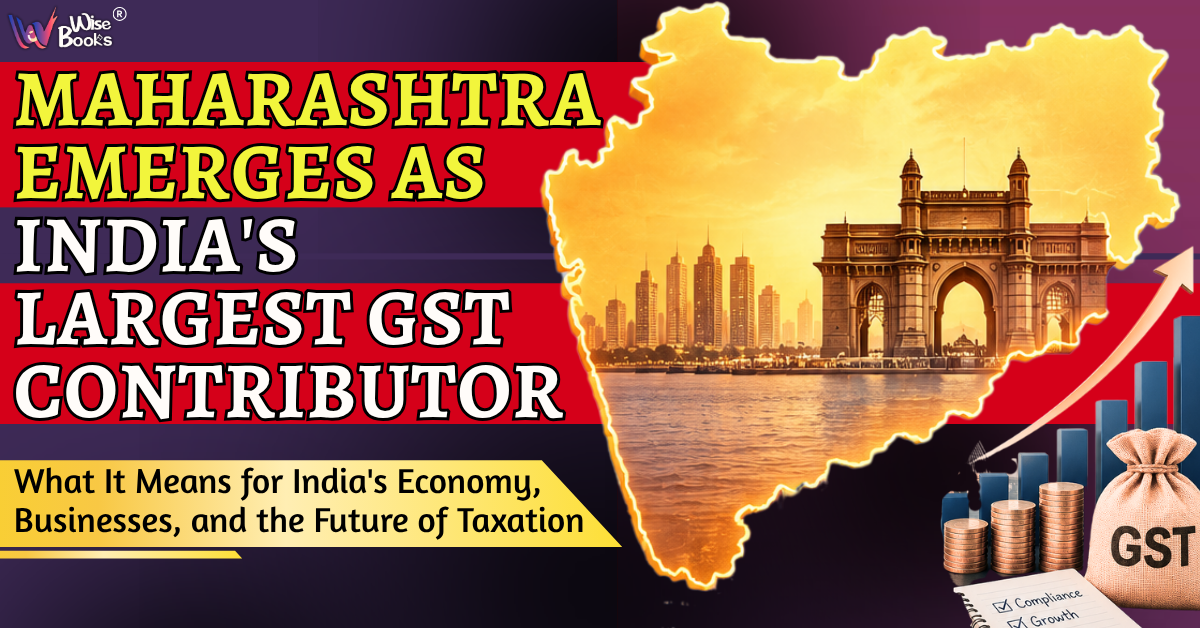
Now, a recent report by India Ratings and Research (Ind-Ra) has highlighted a significant milestone: Maharashtra has emerged as the country's largest contributor to state tax revenues under the GST system.
The achievement reflects Maharashtra's economic strength, thriving service sector, strong manufacturing base, growing digital economy, and robust consumer spending.
But the bigger question is this:
Why has Maharashtra taken the top position, and what does this tell us about India's economy?
Let's understand the complete picture.
Maharashtra's impressive GST performance
According to available data, Maharashtra recorded GST collections of more than ₹3.61 lakh crore, making it the highest-contributing state in the country.
The leading states include:
|
Rank |
State |
Major growth drivers |
|
1 |
Maharashtra |
Services, manufacturing, finance |
|
2 |
Karnataka |
Information technology and startups |
|
3 |
Gujarat |
Manufacturing and exports |
|
4 |
Tamil Nadu |
Automobile and industrial production |
|
5 |
Haryana |
Industrial growth and trade |
Why is Maharashtra leading the country?
1. Mumbai – India's financial capital
Mumbai is home to:
- Major banks
- Insurance companies
- Financial institutions
- Stock exchanges
- Large multinational corporations
A substantial portion of India's financial activity takes place in Mumbai, naturally increasing GST collections.
2. A powerful service sector
The service sector contributes nearly 60% of Maharashtra's economy, making it the state's biggest growth engine.
Major sectors include:
- Banking
- Information technology
- Telecommunications
- Entertainment
- Logistics
- Real estate
- Consulting services
Every transaction in these industries contributes to GST revenue.
3. Massive consumer spending
GST is a destination-based tax, which means the tax is collected where goods and services are consumed rather than where they are produced.
Because Maharashtra has a large population with higher purchasing power, consumption levels remain extremely high.
This directly increases GST collections.
4. Strong industrial base
Maharashtra contributes approximately one-fourth of India's industrial output.
Some of the largest industrial hubs are located in:
- Mumbai
- Pune
- Nashik
- Nagpur
- Thane
- Aurangabad
The state has developed strong industries in:
- Chemicals
- Automobiles
- Pharmaceuticals
- Petroleum products
- Textiles
- Engineering
5. Higher foreign investment
Maharashtra continues to attract large amounts of foreign investment.
This leads to:
i. New factories
ii. Higher production
iii. Greater employment
iv. Increased consumption
v. Improved tax collections
How does GST benefit from Maharashtra's growth?
When businesses perform well, the government collects more taxes.
The cycle works like this:
Investment → Production → Employment → Consumption → GST Revenue
This process strengthens:
- Government finances
- Infrastructure development
- Public services
- Economic growth
Maharashtra versus other major states
Although Maharashtra remains the leading contributor, several other states are rapidly expanding.
Karnataka
Karnataka benefits from Bengaluru's strong technology ecosystem and startup culture.
Gujarat
Gujarat continues to perform strongly because of manufacturing, exports, and industrial development.
Uttar Pradesh
Large infrastructure investments and increasing industrialization have significantly improved tax collections.
Tamil Nadu
Tamil Nadu remains one of India's strongest automobile and manufacturing hubs.
What does this mean for businesses?
This development carries several important lessons for business owners.
Strengthen GST compliance
Businesses should focus on:
- Timely return filing
- Invoice reconciliation
- Input tax credit (ITC) management
- Proper bookkeeping
Embrace digital transformation
Technology-driven businesses are expanding rapidly, and companies that adapt quickly will have a significant advantage.
Prepare for stricter scrutiny
As GST collections increase, authorities are also strengthening data analytics and compliance monitoring systems.
Businesses should ensure that:
- Records are accurate.
- Vendor details are verified.
- E-invoices are properly maintained.
- Input tax credits are correctly claimed.
The bigger picture
Maharashtra's success is not merely about collecting higher taxes.
It reflects something much larger:
- Rising consumer confidence
- Strong economic growth
- Greater digital adoption
- Expansion of the formal economy
- Increased compliance among taxpayers
The state's performance demonstrates how a strong combination of industry, services, technology, and consumption can contribute to sustainable economic growth.
Final thoughts
Nearly nine years after the introduction of GST, the tax system has become one of the strongest pillars of India's economy.
Maharashtra's rise to the top shows that states with diversified economies, strong infrastructure, high consumption levels, and better compliance mechanisms are likely to continue leading India's growth story.
For businesses, the message is clear:
Better compliance is no longer just a legal requirement it is a competitive advantage.


Comments
No comments yet. Be the first to comment!