


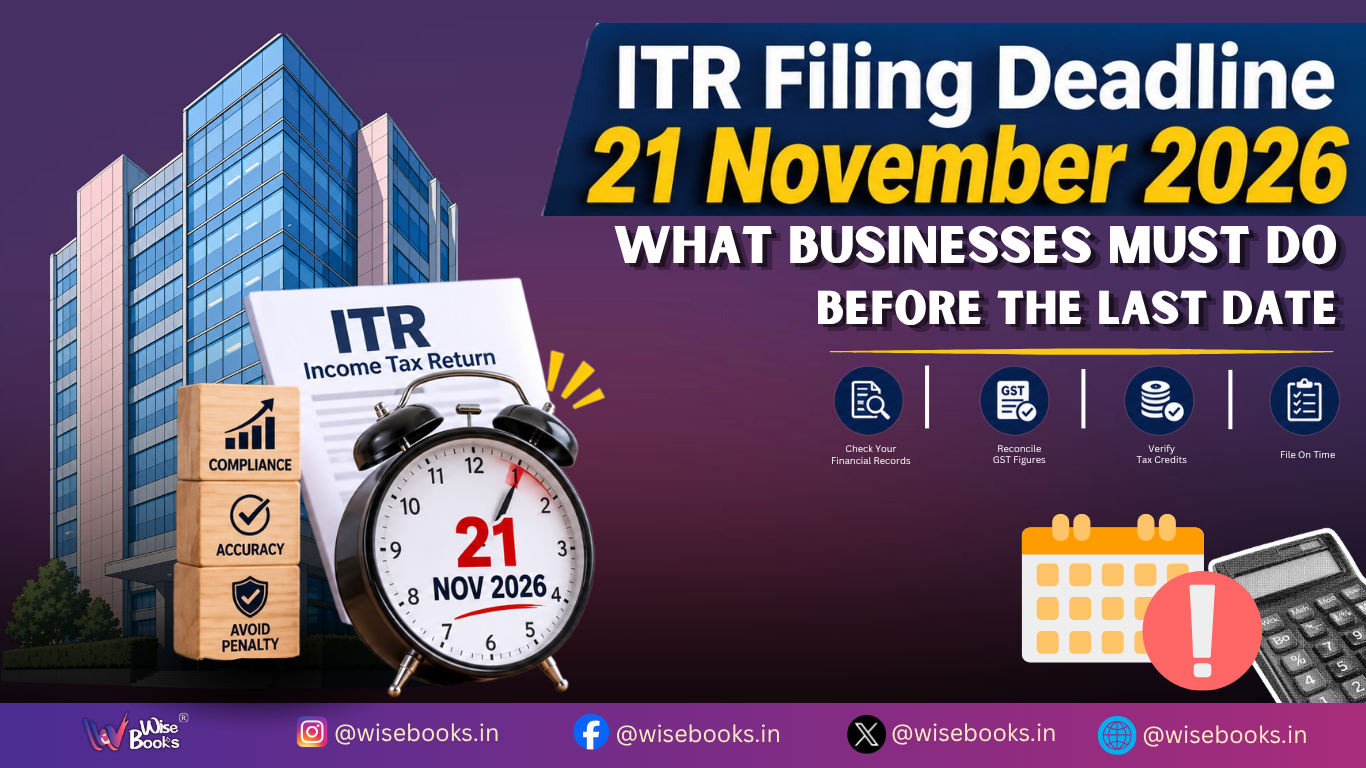
The income tax return filing deadline is approaching, and businesses with audited accounts have an important date to remember: 21 November 2026.
The Central Board of Direct Taxes (CBDT) extended the ITR filing deadline for specified audit cases for Assessment Year (AY) 2026–27, giving eligible taxpayers additional time to complete their income tax compliance.
However, an extension does not mean businesses can afford to wait until the last minute. Incomplete financial records, mismatched GST figures, and unverified tax credits can delay filing and increase the risk of errors.
Here is what businesses need to know and do before the revised ITR due date.
What Is the Revised ITR Filing Deadline for AY 2026–27?
Through its announcement dated 28 September 2026, the CBDT extended the due date for filing income tax returns for specified taxpayers whose accounts are subject to audit under the Income-tax Act, 1961.
The revised deadlines are:
|
Compliance |
Original Due Date |
Revised Due Date |
|
Tax audit report |
30 September 2026 |
21 October 2026 |
|
Income tax return for eligible audit cases |
31 October 2026 |
21 November 2026 |
Important: The 21 November extension does not apply to every taxpayer. It applies to the specified audit category covered by the CBDT's extension. Salaried individuals and businesses whose returns were due earlier should not assume their deadlines have changed.
1. Finalise Your Books of Accounts
Before filing your income tax return, ensure your books of accounts are complete, accurate, and up to date.
Businesses should review:
- Sales and purchase entries
- Bank statements and bank reconciliations
- Customer and vendor balances
- Outstanding receivables and payables
- Business expenses and supporting invoices
- Fixed assets and depreciation
- Loans, advances, and interest expenses
Accurate bookkeeping helps ensure that the income reported in the ITR reflects the actual financial position of the business.
2. Reconcile GST Returns with Your Books
GST reconciliation is an important step in income tax return preparation.
Differences between accounting records and GST returns can raise questions during tax assessments. Businesses should compare their sales, purchases, and tax figures across:
- GSTR-1
- GSTR-3B
- GSTR-2B
- Books of accounts
Review differences in turnover, credit notes, debit notes, input tax credit, and timing adjustments. Document legitimate differences and correct errors wherever necessary.
3. Verify TDS, TCS, and Advance Tax Credits
Tax credits should be checked carefully before submitting the ITR.
Businesses should reconcile:
- Tax Deducted at Source (TDS)
- Tax Collected at Source (TCS)
- Advance tax payments
- Self-assessment tax payments
Compare the amounts claimed in the return with Form 26AS, AIS, TDS certificates, and payment challans, as applicable.
If a tax credit is missing or incorrect, contact the deductor or resolve the discrepancy before filing, wherever possible.
4. Review Your Tax Audit Report
For businesses subject to tax audit, the audit report is a key part of the ITR filing process.
The tax audit report deadline for eligible AY 2026–27 cases was extended to 21 October 2026. Businesses should confirm that their applicable audit report has been furnished and that the information in the report agrees with their final financial statements and income tax return.
Pay particular attention to:
- Turnover and gross receipts
- Depreciation and fixed assets
- Expenses requiring specific disclosures
- Related-party transactions
- Tax deductions and disallowances
- Other applicable Form 3CD disclosures
5. Check Your ITR Form and Tax Regime
Selecting the correct ITR form is essential for accurate filing.
The applicable form depends on the taxpayer's legal status, income sources, business activities, and other conditions. Companies, firms, and individuals with business income may have different filing requirements.
Before submitting the return, verify:
- The correct ITR form
- The applicable tax regime, where relevant
- Business and professional income
- Capital gains and other income
- Deductions and exemptions
- Required schedules and disclosures
A careful review can help prevent avoidable filing errors and subsequent corrections.
6. Complete the Filing and E-Verification on Time
Filing the return is not the final step. The ITR must also be verified within the prescribed period.
After submitting the return:
1. Download and save the ITR acknowledgement.
2. Complete e-verification using an available method, such as Aadhaar OTP, net banking, or another permitted option.
3. Check the return status on the Income Tax Department's e-filing portal.
4. Keep supporting documents and tax payment records safely stored.
An unverified return may not be treated as a validly filed return.
What Happens If You Miss the 21 November ITR Deadline?
Missing the applicable due date can have financial and compliance consequences, depending on your circumstances.
These may include:
- Late filing fees under the applicable provisions
- Interest on unpaid tax
- Restrictions on carrying forward certain losses
- Delayed processing of refunds
- Additional compliance requirements
Eligible taxpayers may be able to file a belated return within the permitted period, subject to applicable conditions. However, filing after the due date may involve additional costs and limitations.
The best approach is to complete the filing before the deadline rather than rely on a later correction or belated return.
Frequently Asked Questions (FAQs)
What is the last date for filing ITR for audit cases in AY 2026–27?
The revised deadline is 21 November 2026 for specified taxpayers covered by the CBDT extension.
Does the 21 November ITR deadline apply to all taxpayers?
No. The extension applies to the specified audit category. Other taxpayers may have different due dates.
What is the tax audit report deadline for AY 2026–27?
For eligible audit cases covered by the extension, the tax audit report deadline was 21 October 2026.
What documents should businesses prepare before filing ITR?
Businesses should prepare financial statements, books of accounts, bank statements, GST returns, TDS/TCS records, tax payment challans, audit reports, and supporting documents relevant to their income and deductions.
Can I file my ITR after 21 November 2026?
Eligible taxpayers may be able to file a belated return within the prescribed period, subject to applicable provisions, fees, and restrictions.


Comments
No comments yet. Be the first to comment!