

Introduction
Input Tax Credit (ITC) is an important part of the Goods and Services Tax (GST) system, allowing eligible businesses to reduce their output tax liability by claiming credit for GST paid on business purchases and expenses.
However, claiming ITC requires more than recording purchase invoices in accounting books. Businesses must also ensure that their purchase records match the information reported by suppliers and reflected in the GST portal.
One of the most common compliance challenges is a mismatch between ITC recorded in purchase registers and the credit available in Form GSTR-2B. These discrepancies may arise due to incorrect invoice details, delayed supplier reporting, non-filing of returns, or differences in tax amounts.
If such differences remain unresolved, businesses may face ITC reversals, interest liabilities, and GST department notices.
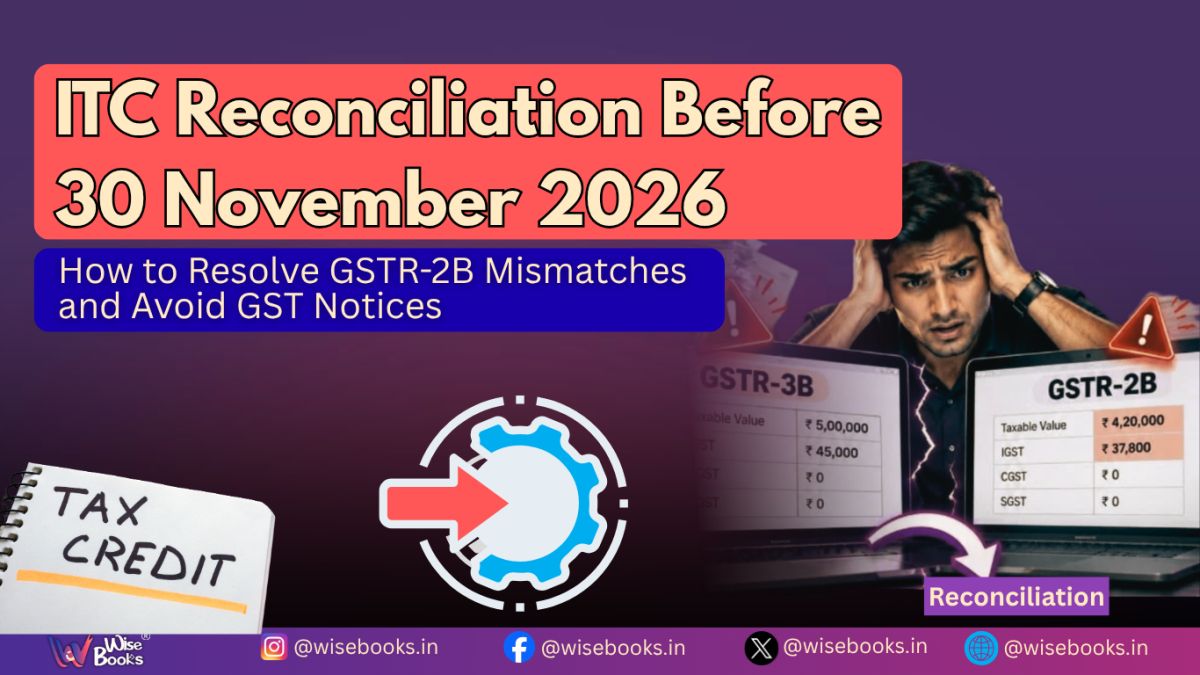
The issue becomes particularly important in November 2026, as 30 November 2026 is the statutory deadline for claiming eligible ITC relating to FY 2025–26 under Section 16(4) of the CGST Act, subject to the condition relating to filing the annual return.
Businesses should therefore review their purchase records, reconcile GSTR-2B, and identify pending ITC before the applicable deadline.
What Is ITC Reconciliation Under GST?
ITC reconciliation is the process of comparing the input tax credit recorded in a business's purchase register with the corresponding information available in the GST portal.
The purpose is to verify whether the GST paid on purchases has been correctly reported by suppliers and whether the recipient is eligible to claim the corresponding credit.
For example, a business purchases raw materials worth ₹5,00,000 and pays GST of ₹90,000. Its accounting department records the purchase and the corresponding ITC in its purchase register.
However, if the supplier fails to report the invoice in GSTR-1, the transaction may not appear in the recipient's GSTR-2B.
This creates a difference between the accounting records and the GST portal.
Regular reconciliation helps businesses identify missing invoices, incorrect GSTINs, duplicate entries, differences in tax amounts, and potentially ineligible credits.
Difference Between GSTR-2B and Purchase Register
GSTR-2B: It is an auto-drafted, static ITC statement generated on the GST portal using information furnished by suppliers and other specified sources. It contains details of invoices, debit notes, credit notes, amendments, and other specified inward supplies.
Purchase Register: It is an internal accounting record maintained by a business to track purchases, supplier details, invoice values, and applicable GST amounts.
Comparing these two records helps businesses identify discrepancies and determine the ITC that may be claimed after satisfying the applicable statutory conditions.
Common Reasons for GSTR-2B and Purchase Register Mismatches
ITC discrepancies can occur due to errors in supplier reporting, accounting entries, or differences in reporting periods. Some of the most common reasons include:
1. Supplier has not filed GSTR-1: If a supplier fails to report an invoice, it may not appear in the recipient's GSTR-2B. Businesses should follow up with suppliers and request appropriate reporting.
2. Incorrect GSTIN reporting: An incorrect recipient GSTIN can cause an invoice to appear under another taxpayer's records. The supplier should correct the details through the applicable amendment mechanism.
3. Difference in taxable value or GST amount: The supplier may report a different taxable value or tax amount from what is recorded in the purchase register. Businesses should verify the original invoice and request corrections wherever necessary.
4. Delayed invoice reporting: Suppliers sometimes report invoices in subsequent tax periods. Businesses should monitor subsequent GSTR-2B statements to identify such invoices and avoid duplicate claims.
5. Credit notes and debit notes: If credit notes, debit notes, or invoice amendments are not properly considered, the ITC calculation may become inaccurate.
6. Duplicate purchase entries: Duplicate invoice entries in accounting software can result in excess ITC being recorded. Invoice-level verification helps identify and correct these errors.
Important GST Rules and the 30 November 2026 ITC Deadline
Businesses must understand the legal provisions governing ITC eligibility before claiming or reversing credit.
Under Section 16(2) of the CGST Act, a registered taxpayer must satisfy the prescribed conditions, including possession of a valid tax invoice, receipt of goods or services, communication of supplier-reported invoice details, payment of applicable tax to the Government, and furnishing the required return.
Another important provision is Section 16(4), which prescribes the time limit for claiming ITC.
Generally, eligible ITC must be claimed by the earlier of:
- 30 November following the end of the relevant financial year; or
- The date of furnishing the relevant annual return.
For FY 2025–26, the applicable statutory deadline is 30 November 2026, provided the relevant annual return has not been furnished earlier.
Businesses should also consider Rule 37 of the CGST Rules, which requires reversal or payment back of ITC, with applicable interest as prescribed, where the recipient fails to pay the supplier the value of the supply along with tax within 180 days from the invoice date. Credit may be re-availed after payment in accordance with the applicable provisions.
Therefore, reviewing pending invoices and outstanding supplier payments is equally important during ITC reconciliation.
How to Reconcile GSTR-2B with Purchase Registers
A systematic reconciliation process helps businesses identify discrepancies before filing GST returns.
The following steps can help accounting teams maintain accurate ITC records:
- Download GSTR-2B: Obtain the relevant month's statement from the GST portal and review the available invoice and ITC details.
- Extract the purchase register: Export purchase data from accounting software, including GSTIN, invoice number, date, taxable value, and tax amounts.
- Match invoice details: Compare supplier GSTINs and invoice numbers to identify missing or incorrectly reported invoices.
- Verify tax amounts: Check taxable values and CGST, SGST, and IGST amounts for differences.
- Identify discrepancies: Separate missing invoices, duplicate entries, delayed invoices, credit notes, and potentially ineligible ITC.
- Coordinate with suppliers: Request corrections wherever invoice details have been reported incorrectly or omitted.
- Prepare a reconciliation statement: Maintain a record of matched invoices, differences, reasons, and corrective actions.
- Verify eligible ITC: Make appropriate reversals and adjustments before reporting eligible credit in GSTR-3B.
Businesses should perform this reconciliation regularly instead of waiting until the statutory deadline.
Understanding GST DRC-01C Notices for ITC Mismatches
Another important aspect of ITC reconciliation is Form GST DRC-01C.
Under Rule 88D of the CGST Rules, the GST system may issue an electronic intimation when ITC claimed in GSTR-3B exceeds the ITC available in GSTR-2B beyond the prescribed amount and percentage.
The intimation is issued in Part A of Form GST DRC-01C, requiring the taxpayer to explain the difference or pay the applicable amount.
After receiving the intimation, businesses should examine the discrepancy and identify its reason.
If excess ITC has been wrongly claimed and is not eligible, the taxpayer may pay the applicable amount along with interest, wherever payable, through Form GST DRC-03.
If the difference is due to a genuine and explainable reason, the taxpayer can submit an appropriate explanation through Part B of DRC-01C along with supporting reconciliation records.
Ignoring such intimations can lead to further compliance proceedings. Therefore, businesses should review notices promptly and provide an appropriate response within the prescribed time.
Practical Example of ITC Reconciliation
Consider a business with the following ITC records:
|
Amount |
Amount |
|
ITC as per purchase register |
₹1,80,000 |
|
ITC reflected in GSTR-2B |
₹1,50,000 |
|
Total difference |
₹30,000 |
After reviewing the records, the accounting team identifies the following reasons:
|
Reason |
Amount |
|
Invoice not reported by supplier |
₹15,000 |
|
Invoice reported in a subsequent period |
₹10,000 |
|
Duplicate purchase entry |
₹5,000 |
|
Total |
₹30,000 |
The business should contact the supplier regarding the missing invoice, monitor subsequent GSTR-2B statements, and remove the duplicate entry from its accounting records.
It should then verify the statutory eligibility of the credit and maintain supporting documentation.
This example demonstrates why invoice-level reconciliation is important. A difference should not automatically be treated as eligible ITC or as a permanent loss of credit.
Best Practices to Avoid ITC Mismatches and GST Notices
Businesses can improve their GST compliance process by following a few important practices:
- Perform monthly GSTR-2B and purchase register reconciliation.
- Maintain supplier-wise records of missing invoices.
- Regularly monitor supplier filing compliance.
- Review credit notes, debit notes, and amendments.
- Track outstanding supplier payments under the 180-day rule.
- Identify blocked and otherwise ineligible ITC.
- Maintain detailed reconciliation statements and supporting documents.
- Use accounting software and automated reconciliation tools wherever possible.
- Review pending eligible ITC before the statutory deadline.
These practices help businesses maintain accurate accounting records, reduce avoidable discrepancies, and strengthen their compliance position during GST scrutiny.
Conclusion
ITC reconciliation is an essential part of GST compliance and should be treated as a continuous accounting responsibility rather than a year-end exercise.
Differences between GSTR-2B and purchase registers may arise due to supplier reporting errors, incorrect GSTINs, delayed invoices, duplicate entries, and accounting adjustments. If these discrepancies are not identified and addressed, they can result in incorrect ITC claims, reversals, interest liabilities, and GST-related notices.
With the 30 November 2026 deadline approaching for eligible ITC claims relating to FY 2025–26, businesses should review their purchase records, coordinate with suppliers, and resolve pending discrepancies within the applicable statutory timelines.
A systematic reconciliation process helps businesses claim eligible ITC accurately, maintain reliable financial records, and strengthen their overall GST compliance.


Comments
No comments yet. Be the first to comment!