


Introduction
Receiving an income-tax notice can be stressful, especially when it is followed by a penalty worth lakhs of rupees. But does every case of unreported income automatically justify a penalty? A recent ruling by the Income Tax Appellate Tribunal (ITAT), Jaipur Bench, highlights why the legal basis of a penalty matters just as much as the amount involved.
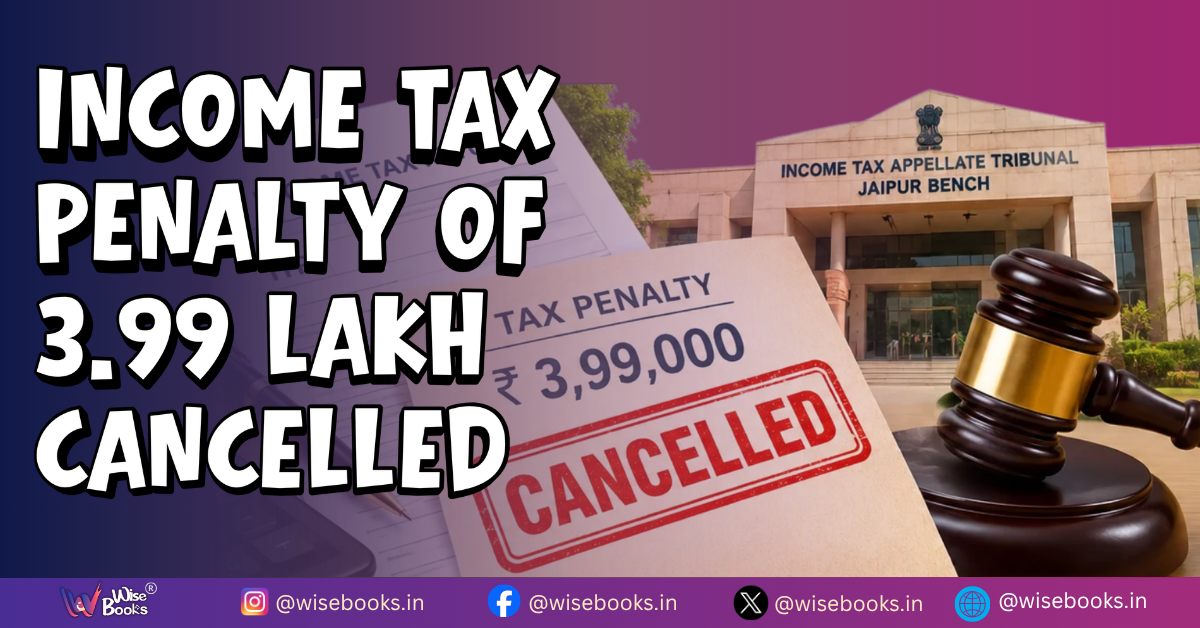
In a case involving a taxpayer from Sikar, Rajasthan, the Income Tax Department imposed a penalty of approximately ₹3.99 lakh after the taxpayer filed an Income Tax Return (ITR) declaring income of ₹12.9 lakh following a tax notice. The tribunal subsequently cancelled the penalty after identifying defects in the way the penalty proceedings had been initiated.
The decision highlights an important aspect of tax compliance: taxpayers must fulfil their filing obligations, while tax authorities must follow the applicable legal procedure when imposing penalties.
What Happened in the ₹3.99 Lakh Income-Tax Penalty Case?
The case concerned Assessment Year (AY) 2018–19. According to reports, the taxpayer had not initially filed an ITR. After receiving a notice from the Income Tax Department, he filed a return declaring income of ₹12.9 lakh.
The Assessing Officer (AO) initiated penalty proceedings under Section 270A of the Income-tax Act, 1961, treating the income as under-reported and imposing a penalty of approximately ₹3.99 lakh. The Commissioner of Income Tax (Appeals) upheld the penalty, prompting the taxpayer to approach ITAT Jaipur.
On 23 September 2026, the tribunal ruled in the taxpayer's favour and cancelled the penalty.
The decision was not a general exemption for people who fail to file returns. Instead, it focused on a significant procedural issue: the authorities had not clearly identified the specific statutory provision under Section 270A(9) that allegedly made the taxpayer's conduct misreporting of income.
Source: The Economic Times — ITAT Jaipur cancels ₹3.99 lakh penalty.
Why Did ITAT Jaipur Cancel the Penalty?
The central issue was the distinction between identifying under-reported income and establishing misreporting of income under the law.
The tribunal found that the Assessing Officer had not adequately specified which particular category of misreporting under Section 270A(9) was applicable. The penalty notice and assessment proceedings did not clearly communicate the precise statutory charge that the taxpayer needed to answer.
This matters because a taxpayer must know the legal basis of an allegation to prepare an effective response. Simply identifying a difference in reported income does not, by itself, establish every condition necessary for imposing the enhanced penalty applicable to misreporting.
The tribunal relied on earlier judicial decisions addressing similar defects in penalty proceedings and concluded that the penalty could not be sustained.
The key takeaway: A penalty must be supported by the relevant legal requirements and a properly framed notice. The ruling does not mean that the Income Tax Department cannot penalise genuine under-reporting or misreporting.
What Is Section 270A of the Income-tax Act?
Section 270A deals with penalties for under-reporting and misreporting of income. It allows the tax authorities to impose a penalty in addition to the tax payable when the applicable legal conditions are satisfied.
Understanding the distinction between these two categories is important for taxpayers and businesses.
1. Under-reporting of income
Under-reporting generally arises in situations specified by the law where the income assessed or reassessed exceeds the relevant income reported or previously assessed.
The penalty under Section 270A(7) is generally 50% of the tax payable on the under-reported income, subject to the statutory provisions and applicable exceptions.
2. Misreporting of income
Misreporting is a more serious category involving specified circumstances, such as misrepresentation or suppression of facts, certain unrecorded receipts or investments, false entries in books, or other conduct listed under Section 270A(9).
Under Section 270A(8), the penalty for under-reporting resulting from misreporting is generally 200% of the tax payable on the under-reported income.
These percentages apply to the relevant tax payable on the under-reported income, not directly to the total income or the amount of the tax notice.
For the statutory provisions, refer to the official text of Section 270A.
Does Every ITR Filing Mistake Lead to a Penalty?
No. The consequences depend on the facts of the case, the applicable legal provisions and whether the statutory conditions for a penalty are met.
A missed filing deadline, an incorrect income declaration and deliberate misreporting are not automatically interchangeable situations. Section 270A also contains specific exclusions, including certain cases involving a bona fide explanation supported by disclosure of all material facts.
However, taxpayers should not assume that an honest mistake automatically removes their liability. They may still need to explain the circumstances, provide supporting documents and respond within the prescribed time.
The ITAT Jaipur ruling discussed here turned on defects in the penalty proceedings. It should not be interpreted as a blanket rule that failing to file an ITR, or subsequently disclosing income, protects a taxpayer from penalties.
What Should You Do If You Receive an Income-Tax Notice?
A notice should never be ignored. Taking timely action can help you understand the issue and respond with the relevant information.
Check the notice carefully. Review the assessment year, the section under which the notice has been issued, the income or transactions in question and the response deadline.
Reconcile your financial records. Compare your ITR, Form 26AS, AIS, TIS, bank statements, salary records and other relevant documents to identify discrepancies.
Understand the allegation. Determine whether the matter concerns non-filing, under-reporting, misreporting, a proposed adjustment or another compliance issue. Different issues may require different responses.
Submit a factual response. Provide supporting evidence and explain any genuine error or omission. Do not rely solely on an argument that the mistake was unintentional.
Seek professional advice when necessary. If a substantial penalty is proposed, a chartered accountant or qualified tax professional can help assess the notice, the applicable provisions and the available remedies.
What Does This Ruling Mean for Businesses and Accountants?
For businesses, the decision reinforces the importance of maintaining accurate financial records and complying with income-tax filing requirements.
For accountants and tax professionals, it also highlights the importance of reviewing the legal basis of a penalty notice rather than focusing exclusively on the amount demanded. Proper documentation, reconciliation and timely communication can help resolve discrepancies before they become more complicated disputes.
At the same time, taxpayers should distinguish between a procedural defect in a penalty order and a substantive exemption from tax compliance. The cancellation of a penalty in one case does not eliminate the obligation to file returns or pay taxes where legally due.
Conclusion
The cancellation of the ₹3.99 lakh penalty by ITAT Jaipur is a reminder that tax proceedings must follow the law. While taxpayers are responsible for reporting their income accurately and meeting filing obligations, tax authorities must establish the appropriate legal basis when imposing penalties.
For individuals and businesses, the best approach remains straightforward: maintain complete records, file returns on time, address discrepancies promptly and respond carefully to tax notices.
Tax compliance is not just about filing returns. It is also about keeping the right records, understanding your obligations and knowing how to respond when a dispute arises.
Disclaimer: This article is for general informational purposes and is not legal or tax advice. The outcome of an individual case depends on its facts and applicable law. Consult a qualified tax professional for advice on a specific notice or penalty.
Frequently Asked Questions (FAQs)
1. Why did ITAT Jaipur cancel the ₹3.99 lakh income-tax penalty?
ITAT Jaipur cancelled the penalty because the authorities had not adequately specified the applicable category of misreporting under Section 270A(9) of the Income-tax Act, 1961. The tribunal found defects in the penalty proceedings.
2. What was the income-tax penalty imposed on the taxpayer?
The Income Tax Department imposed a penalty of approximately ₹3.99 lakh on a taxpayer who declared income of ₹12.9 lakh for Assessment Year 2018–19 after receiving a tax notice.
3. What is Section 270A of the Income-tax Act?
Section 270A provides for penalties for under-reporting and misreporting of income. The applicable penalty depends on the circumstances of the case and the relevant legal provisions.
4. What is the penalty for under-reporting income under Section 270A?
Generally, the penalty for under-reporting income is 50% of the tax payable on the under-reported income, subject to applicable statutory provisions and exceptions.
5. What is the penalty for misreporting income under Section 270A?
Where under-reporting results from misreporting as defined under Section 270A(9), the penalty is generally 200% of the tax payable on the under-reported income, subject to the applicable law.
6. Does failing to file an ITR automatically lead to a penalty under Section 270A?
Not necessarily. The consequences depend on the circumstances, the applicable provisions and whether the legal conditions for imposing a penalty are satisfied. Non-filing may also attract separate consequences under other provisions of income-tax law.
7. Can an income-tax penalty be cancelled because of a defective notice?
A penalty may be cancelled where a tribunal or court finds that a material legal or procedural requirement was not satisfied. However, the outcome depends on the facts and applicable law; not every defect automatically invalidates a penalty.
8. What should a taxpayer do after receiving an income-tax notice?
A taxpayer should carefully review the notice, check the assessment year and response deadline, reconcile financial records, gather supporting documents and submit an accurate response. Professional advice may be helpful in cases involving substantial tax demands or penalties.
9. What is the difference between under-reporting and misreporting of income?
Under-reporting generally involves income falling within the statutory definition of income that has not been adequately reported. Misreporting refers to specified circumstances listed under Section 270A(9), such as certain forms of misrepresentation, suppression or false entries. The distinction can affect the applicable penalty.
10. Does cancelling an income-tax penalty mean the taxpayer does not have to pay tax?
No. Cancellation of a penalty does not automatically cancel the underlying tax liability. Tax, interest and penalties are separate matters and must be assessed according to the applicable law and the tribunal's findings.
11. How can businesses reduce the risk of income-tax penalties?
Businesses can reduce compliance risks by maintaining accurate books of accounts, reconciling income and financial records, reporting transactions correctly, filing returns within the applicable deadlines and responding promptly to notices.
12. Where can taxpayers check official income-tax rules and notices?
Taxpayers can visit the Income Tax Department's e-Filing Portal for filing services, notices and compliance information, and consult the official text of Section 270A for the relevant penalty provisions.
Disclaimer: These FAQs are for general informational purposes only. Penalty provisions and legal outcomes depend on the facts of each case and the applicable law.


Comments
No comments yet. Be the first to comment!