


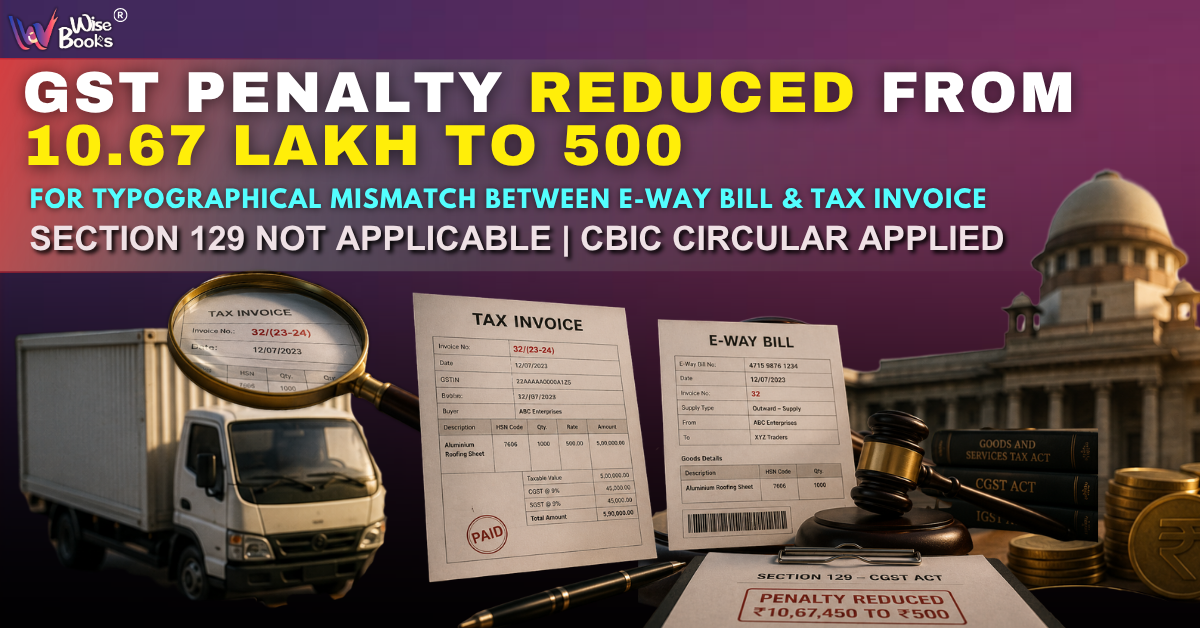
Can a simple typing mistake in a GST e-way bill result in a penalty of more than ₹10 lakh?
For one taxpayer, the answer initially appeared to be yes. However, the Uttarakhand High Court recently delivered an important judgment that reinforces a key principle of GST law: a genuine clerical mistake should not be treated the same as tax evasion.
In this case, the Court set aside a penalty of ₹10.67 lakh imposed under Section 129 of the CGST Act and directed that only the nominal penalty under the CBIC Circular should apply because the discrepancy was merely a typographical error.
The ruling provides valuable guidance for businesses, transporters, accountants, and GST professionals who regularly deal with e-way bills and invoices.
What Was the Case About?
The dispute arose when a vehicle transporting aluminium roofing sheets was intercepted by the GST authorities during transit.
The driver produced all the necessary documents, including tax invoices and e-way bills. However, during verification, officers noticed that the invoice numbers mentioned on the invoices did not exactly match the invoice references appearing in the e-way bill documentation.
The invoices were recorded as "32/(23-24)" and "33/(23-24)", while the e-way bill reflected them as "32" and "33". Apart from this documentation error, all other details including the goods being transported matched correctly.
Why Did the GST Department Impose Such a Huge Penalty?
The tax authorities treated the mismatch as a violation under Section 129 of the CGST Act, which deals with the detention and release of goods in transit.
On that basis, they imposed a penalty of ₹10,67,450.
According to the department, the inconsistency between the invoice references and the e-way bill was sufficient to invoke the detention provisions.
What Did the Taxpayer Argue?
The taxpayer challenged the penalty before the Uttarakhand High Court.
The main arguments were:
- The mistake was purely clerical.
- There was no intention to evade GST.
- The goods matched the invoices and e-way bills.
- All taxes had been properly accounted for.
- The transporter did not receive any undue benefit from the error.
The taxpayer also relied on the CBIC Circular dated 14 September 2018, which specifically states that proceedings under Section 129 should not normally be initiated for certain minor discrepancies in e-way bill documents.
What Did the High Court Decide?
After examining the facts, the High Court ruled in favour of the taxpayer.
The Court observed that:
- The discrepancy was only a typographical or human error.
- The department itself admitted that the goods matched the supporting documents.
- There was no evidence of tax evasion.
- There was no financial benefit gained from the mistake.
- Invoking Section 129 in these circumstances was not justified.
Accordingly, the Court quashed the penalty order and directed that the amount deposited should be refunded after deducting only the nominal penalty prescribed under the CBIC Circular.
Why Was the Penalty Reduced to ₹500?
The reduction was based on CBIC Circular No. 64/38/2018-GST dated 14 September 2018.
This circular recognises that some mistakes occur due to human error and clarifies that, for specified minor discrepancies in e-way bills, authorities should not invoke the stringent provisions of Section 129.
Instead, only a general nominal penalty is applicable under Section 125 where the conditions of the circular are satisfied.
Does This Mean Every GST Penalty Will Be Reduced?
No. This judgment should not be interpreted as meaning that all GST penalties have been reduced or waived.
If businesses:
- transport goods without valid documents,
- deliberately suppress transactions,
- generate fake invoices,
- wrongly claim ITC, or
- intentionally evade tax,
they may still face substantial penalties and other action under the GST law.
This decision applies to situations where the error is genuinely clerical and there is no evidence of tax evasion.
Key Takeaways for Businesses
Every GST-registered business can learn from this judgment:
- Double-check invoice numbers before generating e-way bills.
- Maintain consistency between invoices and e-way bills.
- Keep complete supporting documents during transportation.
- Rectify documentation errors as soon as they are detected.
- Maintain evidence showing that any discrepancy was accidental.
- Stay updated with CBIC circulars and important court decisions.
Final Thoughts
The Uttarakhand High Court's ruling is a reminder that GST compliance should be enforced fairly. While deliberate tax evasion deserves strict action, genuine clerical mistakes should not automatically attract severe penalties.
For businesses, the lesson is clear: accuracy in GST documentation remains essential, but if a minor human error occurs without any intention to evade tax, courts may protect taxpayers from disproportionate penalties where the law and CBIC guidance support such relief.


Comments
No comments yet. Be the first to comment!