


“We filed both GSTR-1 and GSTR-3B. So why does it matter if the figures are different?”
For many businesses, GST compliance means filing returns on time. But timely filing is only one part of compliance. Your books, invoices, GSTR-1 and GSTR-3B should present a consistent picture of your business transactions.
When these figures do not reconcile, the difference may require investigation and explanation.
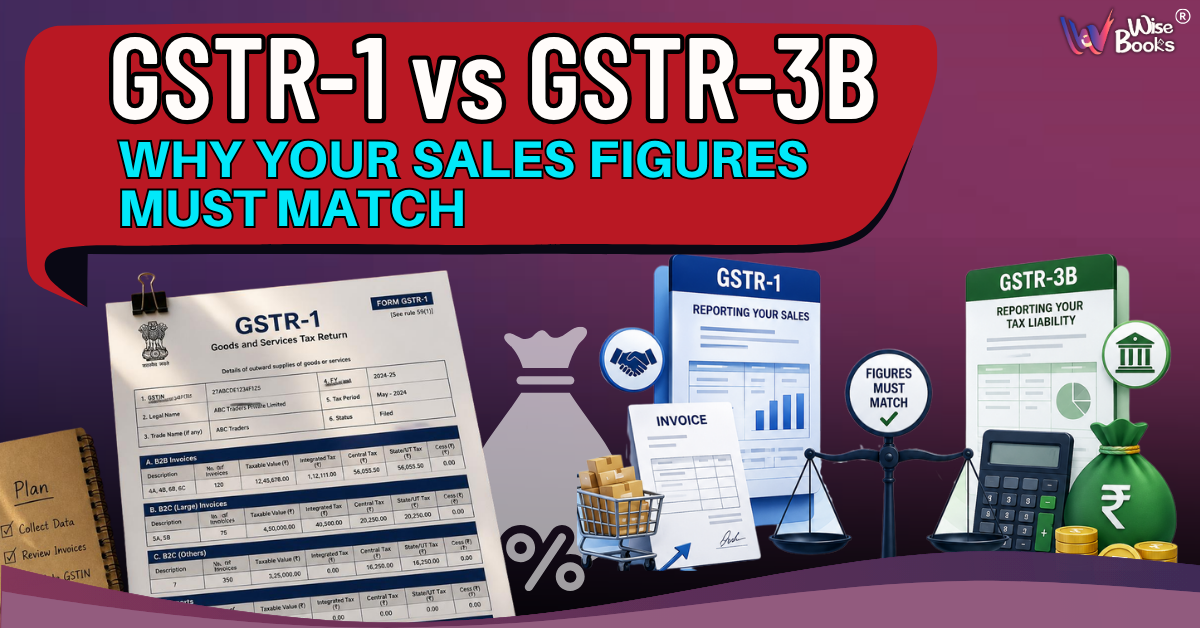
GSTR-1 vs GSTR-3B: What’s the Difference?
GSTR-1 — Reporting Your Sales
GSTR-1 is used to report details of outward supplies made during the tax period.
It generally includes:
- B2B and B2C supplies
- Export supplies
- Credit and debit notes
- Amendments
- HSN-wise details
Simply put:
GSTR-1 tells the GST system what you sold.
GSTR-3B — Reporting Your Tax Liability
GSTR-3B is a summary return used to report relevant GST liability, input tax credit and tax payable, and to discharge the applicable tax liability.
Simply put:
GSTR-3B tells the GST system how much GST liability you are reporting and paying.
Why Should the Figures Match?
Suppose your books show ₹20 lakh of taxable sales, and you report ₹20 lakh in GSTR-1.
But your GSTR-3B shows only ₹18 lakh.
There is now a ₹2 lakh difference.
A difference may have a valid reason, such as a timing difference, amendment or credit note. But an unexplained difference can indicate an accounting or reporting error.
The objective of reconciliation is not simply to make the numbers identical. It is to understand and document the reason for every difference.
Common Reasons for GST Mismatch
1. Missed Invoices
An invoice may be recorded and reported in GSTR-1 but missed while preparing GSTR-3B.
2. Credit or Debit Notes
A credit or debit note may be considered in one return but missed in another.
3. Previous-Period Amendments
Changes made to invoices from earlier periods can create differences between monthly figures.
4. Incorrect GST Rate
The taxable value may be correct while the GST amount is calculated using an incorrect rate.
5. B2B/B2C Classification
Incorrect classification of supplies can lead to reporting differences and customer-level reconciliation issues.
6. Timing Differences
Some differences may arise because a transaction or adjustment is reported in a different tax period.
A Simple Example
Suppose:
Sales as per books: ₹20,00,000
GST liability: ₹3,60,000
GSTR-1 reports the same figures.
But GSTR-3B reports:
Taxable supplies: ₹18,00,000
GST liability: ₹3,24,000
The difference is ₹2,00,000 in taxable value and ₹36,000 in GST.
The first question should not be:
“How do we make the figures match?”
It should be:
“Why is there a difference?”
Once the reason is identified, the appropriate corrective action can be determined.
How Should Businesses Reconcile?
A simple monthly process can prevent major problems later:
Books of Accounts → Sales Register → GSTR-1 → GSTR-3B → Reconciliation
Before filing, check:
- Are all invoices recorded?
- Are credit and debit notes included?
- Are GSTINs and GST rates correct?
- Does GSTR-1 agree with the sales records?
- Does the relevant liability in GSTR-3B reconcile with GSTR-1?
- Can every significant difference be explained?
Why Monthly Reconciliation Matters
Waiting until the end of the financial year can make reconciliation difficult.
With months of invoices, amendments and credit notes, tracing an old mismatch becomes time-consuming.
Monthly reconciliation helps identify errors while the records are still fresh.
For businesses covered by e-invoicing, the reconciliation process should also consider the relationship between books, e-invoices, GSTR-1 and GSTR-3B.
The Correct Way to Reconcile GSTR-1 and GSTR-3B
Start With Your Books
GST reconciliation should begin with your books of accounts. Review the sales records, invoices, taxable values and GST amounts to establish the correct figures before comparing them with your GST returns.
Reconcile With GSTR-1
Next, compare your accounting records with GSTR-1. Ensure that the outward supplies, taxable values and tax amounts reported in GSTR-1 are consistent with your sales records. Any differences should be identified and reviewed.
Compare With GSTR-3B
After reviewing GSTR-1, compare the relevant figures with GSTR-3B. If the numbers differ, identify the reason rather than simply changing one figure to match the other. The difference should be supported by the underlying records.
Maintain a Reconciliation Table
A simple reconciliation statement can help track whether your figures are consistent:
|
Particulars |
Books |
GSTR-1 |
GSTR-3B |
Difference |
|
Taxable Outward Supplies |
₹20,00,000 |
₹20,00,000 |
₹20,00,000 |
Nil |
|
IGST |
₹1,80,000 |
₹1,80,000 |
₹1,80,000 |
Nil |
|
CGST |
₹90,000 |
₹90,000 |
₹90,000 |
Nil |
|
SGST |
₹90,000 |
₹90,000 |
₹90,000 |
Nil |
If a difference appears, the reason should be documented clearly, whether it relates to an amendment, credit note, timing difference or another valid adjustment.
Reconcile Every Month
Monthly reconciliation makes it easier to identify discrepancies while the records are still fresh. It helps maintain consistency between your books, GSTR-1 and GSTR-3B and makes GST compliance more accurate and manageable.


Comments
No comments yet. Be the first to comment!