


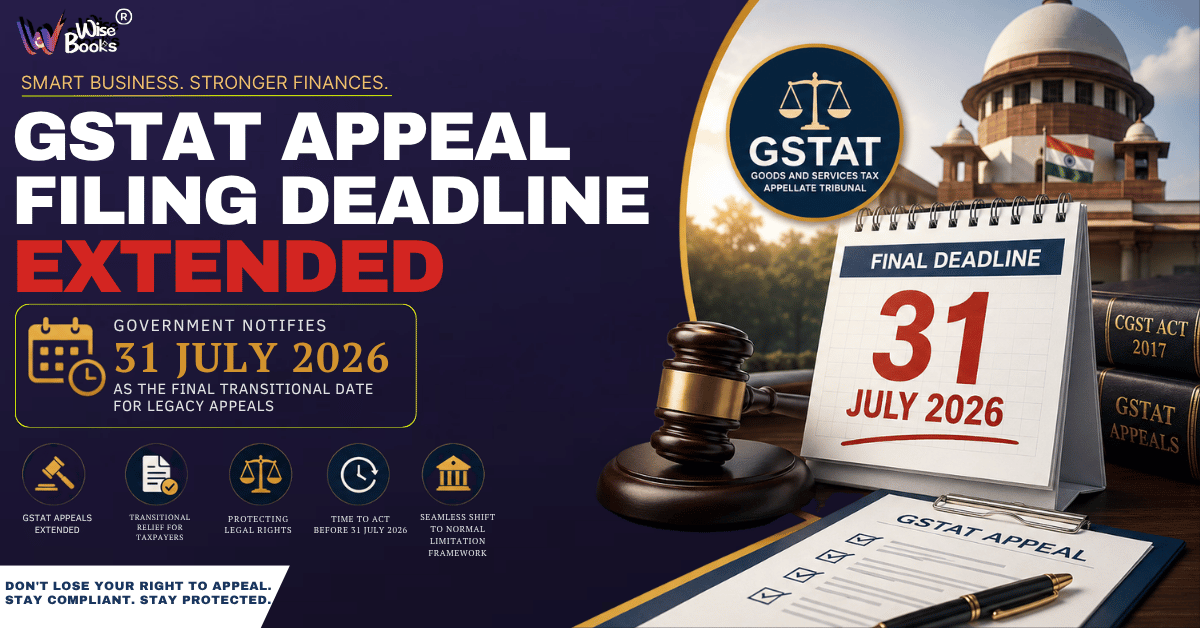
What the Latest CGST Notification Means for Taxpayers, Businesses, and the GST Department
The Goods and Services Tax (GST) ecosystem has witnessed another significant compliance update. Recognizing the challenges faced by taxpayers due to the delayed operationalisation of the Goods and Services Tax Appellate Tribunal (GSTAT), the Central Government has issued a fresh notification extending the timeline for filing certain GST appeals and departmental applications.
This notification provides a final transitional window for taxpayers and tax authorities to file pending appeals before the GST Appellate Tribunal, ensuring that no party loses its legal right merely because the Tribunal was not fully operational.
If your business has received a GST order and is planning to challenge it before the GSTAT, this update could be extremely important.
In this article, we explain the latest notification, why it was issued, who can benefit from it, the applicable deadlines, and what businesses should do next.
Background: Why Was This Notification Required?
The Goods and Services Tax Appellate Tribunal (GSTAT) is the second appellate authority under the GST law. It provides taxpayers with an opportunity to challenge orders passed by the Appellate Authority before moving to the High Courts.
Although the GST law has existed since 1 July 2017, the GST Appellate Tribunal was not operational for several years. As a result, thousands of taxpayers who wished to file appeals were unable to do so because the forum itself was unavailable.
To ensure taxpayers were not unfairly prejudiced, the Government had earlier issued a notification on 17 September 2025, prescribing special timelines for filing appeals once the Tribunal became functional.
The latest notification now supersedes the earlier notification and introduces revised transitional deadlines.
Its primary objective is to provide one final opportunity for taxpayers and the department to file pending GSTAT appeals before the normal statutory limitation periods begin to operate.
What Does the Latest Notification Say?
The Central Government has issued a notification under:
- Section 112(1) of the Central Goods and Services Tax (CGST) Act, 2017, and
- Section 112(3) of the CGST Act,
prescribing revised timelines for filing appeals before the Goods and Services Tax Appellate Tribunal.
The notification clearly distinguishes between:
- Appeals filed by taxpayers, and
- Applications filed by the GST department.
1. Extended Time Limit for Taxpayers
The Government has notified:
31 July 2026
as the last date for filing appeals before the GST Appellate Tribunal where the order sought to be appealed was communicated before 1 May 2026.
This means businesses that received GST appellate orders before 1 May 2026 have been granted a final opportunity to file their appeals before the Tribunal.
Example
Suppose a taxpayer received an appellate order on:
15 January 2026
Under normal circumstances, the appeal period would have expired much earlier.
However, because of the Government's transitional notification, the taxpayer can now file the GSTAT appeal up to 31 July 2026.
This ensures that businesses are not deprived of their appellate rights merely because the Tribunal was not fully functional.
2. Appeals for Orders Communicated On or After 1 May 2026
The notification also clarifies that orders communicated on or after 1 May 2026 will no longer receive this special relaxation.
Instead, these appeals will follow the normal limitation period prescribed under Section 112(1) of the CGST Act.
Under Section 112(1):
- Taxpayers must file appeals within three months from the date on which the order is communicated.
This marks the transition from the special relief period back to the regular statutory framework.
Example: If an order is communicated on: 20 May 2026
The taxpayer cannot wait until 31 July 2026 merely because that date appears in the notification.
Instead, the taxpayer must calculate the limitation period based on the normal three-month rule prescribed under the GST law.
3. Relief Granted to the GST Department
The notification is not limited to taxpayers.
It also extends the timeline for the GST department to file applications before the Appellate Tribunal.
Where departmental applications relate to orders passed before 1 February 2026, the Government has permitted filing up to:
31 July 2026
This provides the department sufficient time to transition into the operational Tribunal framework.
4. Normal Limitation for Departmental Applications
For departmental applications relating to orders passed on or after 1 February 2026, the special relaxation will no longer apply.
Instead, such applications will be governed by Section 112(3) of the CGST Act.
The prescribed limitation period is:
Six months
from the relevant date specified under the Act.
Understanding the Transition
The notification effectively divides appeals into two categories.
|
Category |
Time Limit |
|
Orders communicated before 1 May 2026 |
Appeal can be filed up to 31 July 2026 |
|
Orders communicated on or after 1 May 2026 |
Normal limitation of 3 months applies |
Similarly,
|
Departmental Cases |
Time Limit |
|
Orders passed before 1 February 2026 |
Applications allowed up to 31 July 2026 |
|
Orders passed on or after 1 February 2026 |
Normal limitation of 6 months applies |
Why Is This Notification Important?
For many taxpayers, this notification preserves an important legal remedy.
Without this transitional extension:
- Businesses could have permanently lost their right to challenge GST orders.
- Appeals may have become time-barred despite the Tribunal not being operational.
- Significant tax disputes might have remained unresolved.
The Government has therefore attempted to ensure fairness by providing one final window before restoring the normal limitation framework.
Who Should Pay Immediate Attention?
This notification is particularly relevant for:
- Businesses involved in GST litigation
- Manufacturers
- Traders
- Exporters
- Service providers
- MSMEs
- Tax consultants
- Chartered Accountants
- GST practitioners
- Corporate tax departments
Any taxpayer who has received an adverse GST appellate order before 1 May 2026 should immediately review whether an appeal before the GSTAT is required.
What Businesses Should Do Now
Instead of waiting until the last moment, businesses should begin preparing immediately.
A practical checklist includes:
- Review all pending GST appellate orders.
- Verify the date on which the order was communicated.
- Identify whether the case qualifies for the transitional deadline.
- Consult your GST advisor or legal counsel.
- Gather supporting documents and evidence.
- Prepare appeal papers well before 31 July 2026.
- Avoid last-minute filing issues or technical portal delays.
Early preparation can reduce compliance risks and ensure that valuable appellate rights are not lost.
Final Thoughts
The latest GST notification represents an important step in completing the transition to a fully operational Goods and Services Tax Appellate Tribunal.
By notifying 31 July 2026 as the final deadline for specified legacy appeals and departmental applications, the Government has sought to protect the rights of taxpayers who were affected by the delayed establishment of the Tribunal while simultaneously restoring the regular statutory limitation framework for future cases.
Businesses involved in GST disputes should carefully review whether their cases fall within the transitional window. Missing this deadline could result in the loss of an important appellate remedy.
If your business has received an adverse GST order or you are unsure about your eligibility to file an appeal, professional guidance can help you assess your legal options and ensure timely compliance.
Need Expert Assistance with GST Appeals?
At WiseBooks, we assist businesses with GST litigation, appellate proceedings, GST compliance, accounting, bookkeeping and tax advisory services. Whether you need help evaluating a GST order, preparing an appeal before the GST Appellate Tribunal, or managing end-to-end GST compliance, our team is here to support you with practical, professional, and timely solutions.


Comments
No comments yet. Be the first to comment!