

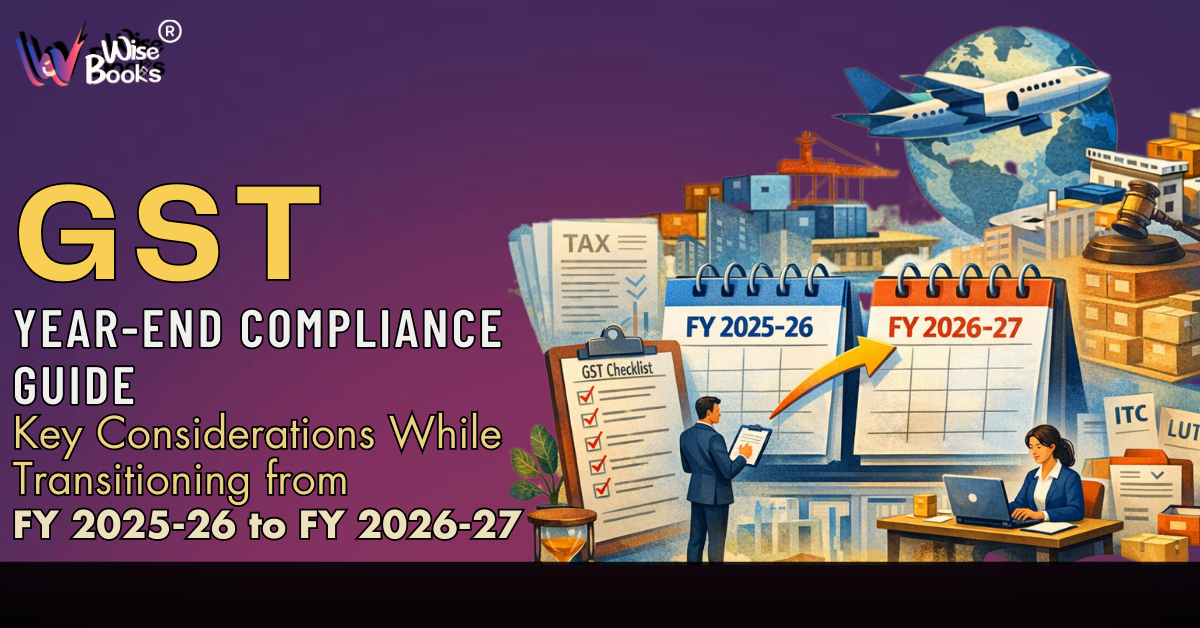
As the financial year 2025–26 approaches its conclusion and businesses prepare for the new financial year 2026–27, it becomes essential to review Goods and Services Tax (GST) compliances and undertake necessary corrective actions before closing the books of accounts.
The transition between financial years is a critical period for businesses, accountants, and tax professionals because it involves final reconciliation of GST returns, verification of input tax credit claims, evaluation of compliance thresholds, and preparation for new regulatory requirements. Failure to conduct proper year-end GST reviews may result in incorrect tax reporting, denial of input tax credit (ITC), penalties, or litigation with tax authorities.
Therefore, businesses must perform a detailed compliance check covering return filings, reconciliations, eligibility of ITC, vendor compliance, export documentation, and GST litigation exposure. This article highlights the key GST compliance requirements and practical considerations for businesses while closing FY 2025–26 and beginning FY 2026–27.
1. Filing of Letter of Undertaking (LUT) for Zero-Rated Supplies
Businesses engaged in export activities or supplying goods and services to Special Economic Zone (SEZ) units or developers without payment of IGST must file a Letter of Undertaking (LUT) every financial year.
Under GST law, the following supplies qualify as zero-rated supplies:
• Export of goods outside India
• Export of services outside India
• Supply of goods or services to SEZ units or SEZ developers for authorized operations
Taxpayers making such supplies have two options:
1. Export with payment of IGST and claim refund later, or
2. Export without payment of tax under LUT and claim refund of accumulated ITC
Most exporters prefer the LUT route, as it avoids blockage of working capital.
For FY 2026–27, businesses intending to make zero-rated supplies must file the LUT before undertaking such supplies, ideally by 31 March 2026 to avoid disruption in export transactions from 1 April 2026.
Failure to file LUT in time may result in exports being treated as taxable supplies, which could create unnecessary compliance and refund complications.
2. Opting for GST Composition Scheme for FY 2026–27
The GST Composition Scheme is designed to simplify compliance for small businesses by allowing them to pay tax at a fixed rate on turnover instead of regular GST rates.
Eligible taxpayers include:
• Manufacturers
• Traders
• Restaurants (not serving alcohol)
Businesses opting for the composition scheme benefit from:
• Lower tax rates
• Quarterly return filing
• Reduced compliance burden
However, they cannot:
• Collect GST from customers
• Claim Input Tax Credit (ITC)
To opt for the composition scheme for FY 2026–27, eligible taxpayers must file Form CMP-02 by 31 March 2026.
If a taxpayer shifts from the regular scheme to the composition scheme, the following adjustments must be made:
• ITC claimed on inputs, work-in-progress, and finished goods lying in stock must be reversed.
• ITC on capital goods must be reversed proportionately based on the remaining useful life.
This reversal must be reported through Form ITC-03, which must be filed by 30 May 2026.
3. QRMP Scheme – Quarterly Return Monthly Payment
The Quarterly Return Monthly Payment (QRMP) scheme was introduced by the GST Government to reduce the compliance burden for small taxpayers.
Under this scheme:
• Businesses with aggregate turnover up to ₹5 crore can file GSTR-1 and GSTR-3B quarterly
• Tax liability must still be paid monthly
This scheme improves compliance efficiency while maintaining steady tax payments.
Businesses can opt-in or opt-out of QRMP scheme until 30 April 2026 for FY 2026–27.
Before selecting this scheme, businesses should analyze:
• Invoice volume
• ITC dependency of customers
• Cash flow implications
• Compliance convenience
4. Declaration from Goods Transport Agency (GTA)
GST provisions allow Goods Transport Agencies (GTA) to choose between two taxation methods:
1. Forward Charge Mechanism – GTA charges GST on invoice and pays tax to government.
2. Reverse Charge Mechanism (RCM) – Recipient of service pays GST.
If GTA opts for forward charge, the service recipient is not required to pay tax under RCM.
However, businesses must obtain a written declaration from GTA service providers opting for forward charge and keep it in their records as supporting documentation during audits or assessments.
This documentation helps justify non-payment of GST under RCM.
5. Resetting Invoice Number Series for the New Financial Year
As per GST advisory issued in 2019, taxpayers should begin a fresh invoice numbering series at the start of every financial year.
This requirement aligns with Rule 46 of CGST Rules (for tax invoices) and Rule 49 (for bills of supply).
A new invoice series improves:
• Systematic accounting
• Traceability of transactions
• Audit compliance
Failure to maintain proper invoice numbering may cause difficulties while:
• Generating E-Way Bills
• Filing GSTR-1 returns
• Claiming GST refunds
Therefore, businesses should configure accounting systems and ERP software to automatically reset invoice series from 1 April 2026.
6. Recalculation of Aggregate Turnover
Many GST compliances depend on aggregate turnover, including:
• GST registration requirement
• Eligibility for composition scheme
• QRMP scheme applicability
• E-invoicing applicability
• Rule 86B restrictions
Aggregate turnover includes:
• Taxable supplies
• Exempt supplies
• Exports
• Inter-state supplies
But excludes GST taxes themselves.
Businesses must calculate the aggregate turnover for FY 2025–26 accurately to determine their compliance obligations for FY 2026–27.
7. Year-End Reconciliation of Outward Supplies
A comprehensive reconciliation should be performed between:
• Turnover recorded in books of accounts
• Turnover reported in GST returns
Important reconciliation checks include:
• Book turnover vs GSTR-1 turnover
• Stock verification (physical vs accounting records)
• Opening and closing goods-in-transit
• Opening and closing unbilled revenue
• Advances received and adjusted against invoices
• Advances remaining unadjusted
Such reconciliations help detect errors before finalizing financial statements.
8. Year-End Reconciliation of Inward Supplies
Businesses must also verify Input Tax Credit records through inward supply reconciliation.
Important areas to review include:
• ITC balance as per books vs electronic credit ledger
• ITC not reflected in GSTR-2B
• ITC parked under reversal or reclaim ledger
• Vendor write-offs where ITC was previously claimed
• Damaged or missing stock requiring ITC reversal
Proper reconciliation helps prevent future GST notices or ITC denial.
9. ITC Reversal for Unpaid Vendors (Rule 37)
Under Rule 37 of CGST Rules, if payment to a vendor is not made within 180 days from invoice date, ITC claimed earlier must be reversed along with interest.
Therefore, businesses must:
• Conduct vendor aging analysis
• Identify invoices unpaid beyond 180 days
• Reverse the corresponding ITC
However, once payment is made to the vendor, the reversed ITC can be reclaimed in future returns.
10. Compliance for Export Refunds and FEMA Rules
Exporters claiming GST refunds must comply with Foreign Exchange Management Act (FEMA) provisions.
Export proceeds must be realized within 9 months from the date of invoice.
If export proceeds are not realized within the permitted time:
• Refund claimed earlier must be deposited back with interest
• Payment must be made within 30 days of expiry of FEMA time limit
However, if export proceeds are realized later, the exporter may reclaim the refund again.
11. Mandatory E-Invoicing for Businesses Crossing ₹5 Crore Turnover
Businesses whose aggregate turnover exceeds ₹5 crore during FY 2025–26 must implement e-invoicing from 1 April 2026.
This involves:
• Registering on the Invoice Registration Portal (IRP)
• Generating Invoice Reference Numbers (IRN)
• Uploading invoices to the e-invoice system
Failure to generate e-invoices when required may result in invalid tax invoices and denial of ITC to recipients.
12. Reverse Charge Compliance
Businesses must verify RCM applicability for transactions such as:
• Import of services
• Legal services
• Director remuneration
• Security services
• GTA services
• Renting from unregistered persons
Incorrect RCM compliance may lead to interest and penalty liabilities.
13. New GST Portal Compliance Updates
Several technical changes have been introduced on the GST portal.
HSN Automation in GSTR-1
Taxpayers will no longer manually enter HSN codes. Instead, they must select codes from a dropdown list.
DRC-03A Adjustment Facility
A new form GST DRC-03A allows taxpayers to adjust voluntary payments made earlier under DRC-03 against confirmed demand orders.
This reduces unnecessary recovery proceedings by the department.
14. Mandatory Input Service Distributor (ISD) Mechanism
The Finance Act 2024 amended GST provisions to make Input Service Distributor (ISD) registration mandatory for businesses receiving invoices for input services on behalf of multiple GST registrations.
This provision became effective from 1 April 2025.
Businesses operating across multiple states must ensure proper distribution of ITC through ISD.
15. Administrative Compliance on GST Portal
Before the financial year closes, businesses should also verify administrative information on the GST portal.
Important checks include:
• Updating bank account details for refunds
• Verifying Aadhaar authentication of authorized signatory
• Updating authorized signatory details
• Removing inactive or closed bank accounts
These updates must be filed using Form GST REG-14.
16. GST Litigation and Contingent Liability Review
Businesses must review pending GST litigation to evaluate potential financial exposure.
Important steps include:
- Tracking pending notices (ASMT-10, SCN under Sections 73 or 74)
- Reviewing confirmed demand orders
- Ensuring appeals are filed within 3 months
- Paying mandatory 10% pre-deposit for appeals
- Assessing contingent liabilities under Ind AS 37 / AS 29
Proper documentation helps businesses prepare for future audits or departmental scrutiny.
Conclusion
The financial year transition from FY 2025–26 to FY 2026–27 is a critical period for GST compliance. Businesses must conduct thorough reviews of GST returns, reconcile ITC claims, verify supplier compliance, and address pending issues before closing the books.
Proactive GST planning not only ensures regulatory compliance but also improves financial accuracy, prevents ITC disputes, and minimizes litigation risk.
Organizations that perform detailed year-end GST reviews will enter the new financial year with clean records, improved compliance, and reduced tax exposure.
Disclaimer:The information provided in this article is for educational purposes only and should not be considered legal, tax, or accounting advice. Businesses should consult professional advisors before implementing any GST-related decisions.


Comments
No comments yet. Be the first to comment!