


Background & Legislative Intent
The GST regime was introduced with the core philosophy of seamless flow of Input Tax Credit (ITC) across the value chain. ITC ensures that tax is levied only on value addition, thereby eliminating cascading effects.
However, over time, the government observed large-scale misuse of ITC through:
i. Fake invoicing without actual supply
ii. Circular trading to inflate ITC
iii. Creation of shell entities to pass on fraudulent credits
iv. High turnover with negligible cash tax payment
To address this, the government introduced Rule 86B vide Notification No. 94/2020 – Central Tax dated 22.12.2020, effective from 1 January 2021.
The rule acts as a risk control mechanism, ensuring that certain taxpayers contribute a minimum amount of tax in cash, thereby establishing a financial trail and discouraging fraud.
Legal Framework of Rule 86B
Rule 86B is inserted under the CGST Rules, 2017, and derives its authority from:
i. Section 49 of CGST Act – governs payment of tax, interest, penalty
ii. Section 49(12) – allows the government to prescribe restrictions on utilisation of ITC
Core Provision
Rule 86B states:
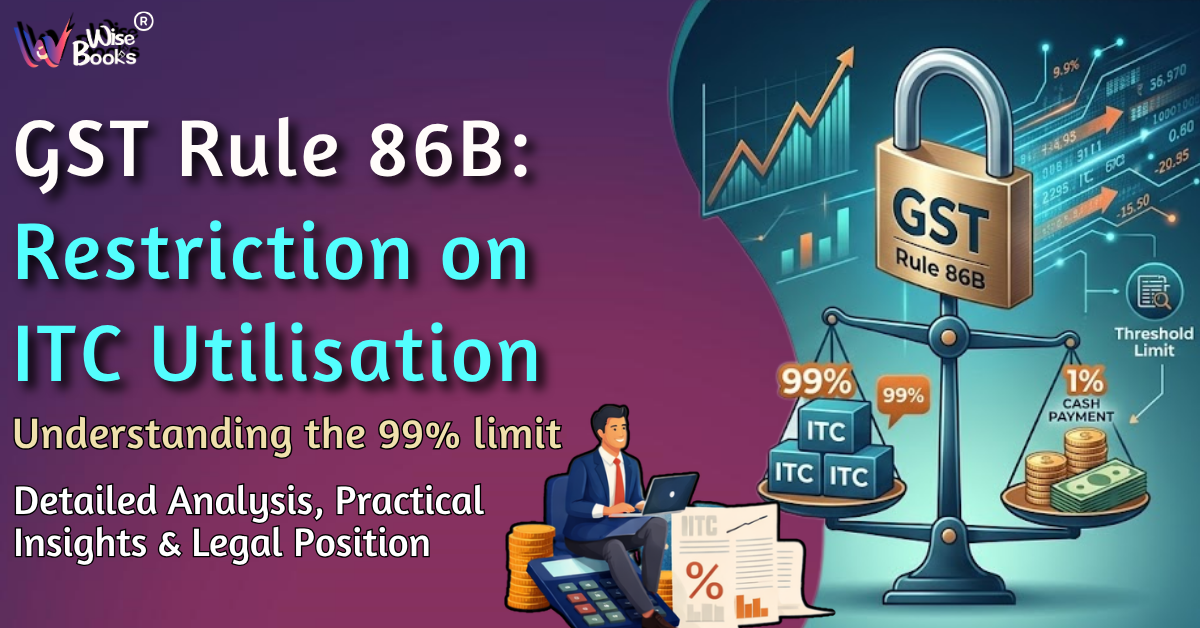
i. Where taxable supplies (excluding exempt & zero-rated supplies) exceed ₹50 lakh in a month,
ii. The registered person shall not use ITC to discharge more than 99% of output tax liability
Thus:
Minimum 1% of output tax must be paid in cash
Scope of Applicability
Threshold Limit
i. Applicable when taxable turnover > ₹50 lakh in a month
ii. Important: This is month-wise, not annual
Exclusions from Turnover Calculation
The following are excluded:
i. Exempt supplies
ii. Zero-rated supplies (exports, SEZ supplies)
Only taxable domestic supplies are considered
Exceptions to Rule 86B (Detailed Interpretation)
Rule 86B provides relief to genuine taxpayers through specific carve-outs:
Income Tax Payment Condition
If any of the following persons have paid income tax > ₹1 lakh in each of the last 2 financial years:
i. Proprietor
ii. Partner
iii. Managing Director / Whole-time Director
iv. Any key person
Practical Insight:
This condition acts as a credibility test — financially compliant taxpayers are considered low risk.
Refund-Based Exception
If the taxpayer has received refund > ₹1 lakh in the previous financial year on account of:
i. Export under LUT
ii. Inverted duty structure
Rationale:
Exporters and inverted duty businesses inherently accumulate ITC → hence exempted.
Minimum Cash Payment Already Made
If the taxpayer has already discharged >1% of output tax liability in cash cumulatively during the current financial year.
Important Practical Note:
i. This is cumulative, not month-wise
ii. Once satisfied, restriction may not apply further
Government Entities
Exempted categories:
i. Government departments
ii. Public Sector Undertakings (PSUs)
iii. Local authorities
iv. Statutory bodies
Practical Working of Rule 86B (Expanded Examples)
Example 1: Basic Case
i. Output Tax Liability: ₹20,00,000
ii. ITC Available: ₹20,00,000
Restriction:
i. Max ITC usable = ₹19,80,000
ii. Cash payment = ₹20,000
Example 2: Exception Case (Income Tax Paid)
i. Turnover > ₹50 lakh
ii. IT paid > ₹1 lakh in last 2 years
Rule 86B not applicable → Full ITC allowed
Example 3: Mid-Year Trigger
i. April–June turnover < ₹50 lakh → Rule not applicable
ii. July turnover = ₹75 lakh → Rule applies
Insight:
Businesses must monitor turnover every month dynamically
Impact Analysis on Different Sectors
Traders & Distributors
i. Low margin, high turnover
ii. Significant ITC utilisation
Impact: High working capital blockage
Manufacturing Sector
i. Moderate impact due to value addition
ii. Still manageable with planning
Exporters
i. Mostly exempt due to refund condition
Startups & Growing Businesses
i. Sudden spike in turnover → unexpected applicability
ii. Cash flow stress
Accounting & Compliance Implications
Cash Flow Planning
Businesses must:
i. Allocate funds for mandatory cash payment
ii. Adjust working capital cycles
ERP / Accounting Adjustments
· Systems must track:
i. Monthly turnover
ii. ITC utilisation ratio
iii. Exception eligibility
GSTR-3B Filing Strategy
i. ITC utilisation must be carefully planned
ii. Avoid excess ITC usage → system may block filing
Legal Position – Detailed Analysis
Whether Rule 86B Overrides the Act?
A key legal debate:
i. Section 49 allows ITC utilisation
ii. Rule 86B restricts it
Question:
Can rules override statutory rights?
Judicial trend suggests:
i. Rules can impose procedural restrictions
But cannot deny substantive rights
ITC – Vested Right or Conditional Benefit?
Courts have held:
i. ITC is a statutory right
ii. But subject to conditions & restrictions
Thus:
Rule 86B is viewed as a temporary utilisation restriction, not denial
Constitutional Validity
Possible challenges:
(a) Article 14 – Equality
Arbitrary threshold ₹50 lakh/month
(b) Article 19(1)(g) – Business Freedom
Restriction on working capital
(c) Proportionality Principle
Whether 1% mandatory cash is excessive?
Current status:
i. No landmark judgment striking down Rule 86B
ii. Courts generally uphold anti-evasion measures
Judicial Approach (Trend)
Courts tend to:
i. Support government in fraud prevention
ii. Allow restrictions if reasonable & proportionate
Thus:
Rule 86B likely to sustain legally unless proven arbitrary
Departmental Perspective
From GST authorities’ viewpoint:
· Rule 86B acts as a behavioral control mechanism
· Helps identify:
i. Fake ITC chains
ii. Shell companies
iii. Suspicious turnover patterns
It is also used in:
i. Risk profiling
ii. Audit selection
iii. Investigation triggers
Practical Issues & Industry Concerns
1. One-Size-Fits-All Approach
Same rule for genuine & risky taxpayers
2. Cash Flow Stress
Especially in high-volume businesses
3. Monthly Applicability Confusion
Frequent applicability changes
4. Lack of Clarity
Interpretation of exceptions varies
Strategic Compliance & Best Practices
1. Monthly Monitoring System
Track turnover & applicability
2. Evaluate Exceptions Regularly
Income tax, refunds, cash payments
3. Cash Flow Forecasting
Plan 1% liability in advance
4. Documentation Readiness
Maintain proof for exception claims
5. Professional Review
Periodic GST health check
Comparative Insight (Before vs After Rule 86B)
|
Particular |
Before Rule 86B |
After Rule 86B |
|
ITC Utilisation |
100% allowed |
Restricted to 99% |
|
Cash Payment |
Optional |
Mandatory (1%) |
|
Compliance Monitoring |
Low |
High |
|
Fraud Control |
Weak |
Strengthened |
Key Takeaways
i. Rule 86B ensures minimum cash contribution
ii. Applies only beyond ₹50 lakh monthly turnover
iii. Multiple exceptions reduce burden on genuine taxpayers
iv. Creates working capital pressure
v. Legally sustainable but debatable
Conclusion
Rule 86B represents a shift from free-flow ITC system → controlled utilisation model. While its intent is justified in combating fraud, its blanket applicability has practical implications for genuine businesses.
Going forward, businesses must:
i. Shift from reactive to proactive compliance
ii. Integrate tax planning with financial planning
iii. Use technology and expert guidance


Comments
?????????? ???????? ???????, ?????????? ??????????? ?????????, ?????????, ??????, ????? ?? ?????????? ?????. ?????? ?????????????? ?? ??????, ??? ??????????? ???? ???????? ??????: ??????? ?????? ? ??????? ???????????? ???????, ???????? ?? ???????????????? ???????, ??????? ??????????????? ?? ?????? ??? ????????????? ?????????????. ????????? ????? ???????????? ???????? ???????, ???????????? ????????, ?????????????? ??????? ?? ??????, ?? ???????? ???????? ?????? ??????????. ????????? ?? ?????????? ?? ?????? ?? <a href=https://necatli.space/>necatli.space</a>, ?? ?????????? ?'??????? ??????? ????????? ? ???????? ?????, ?????????? ???????? ?? ?????? ??????, ? ????????????? ?????? ?????????? ?????????.