


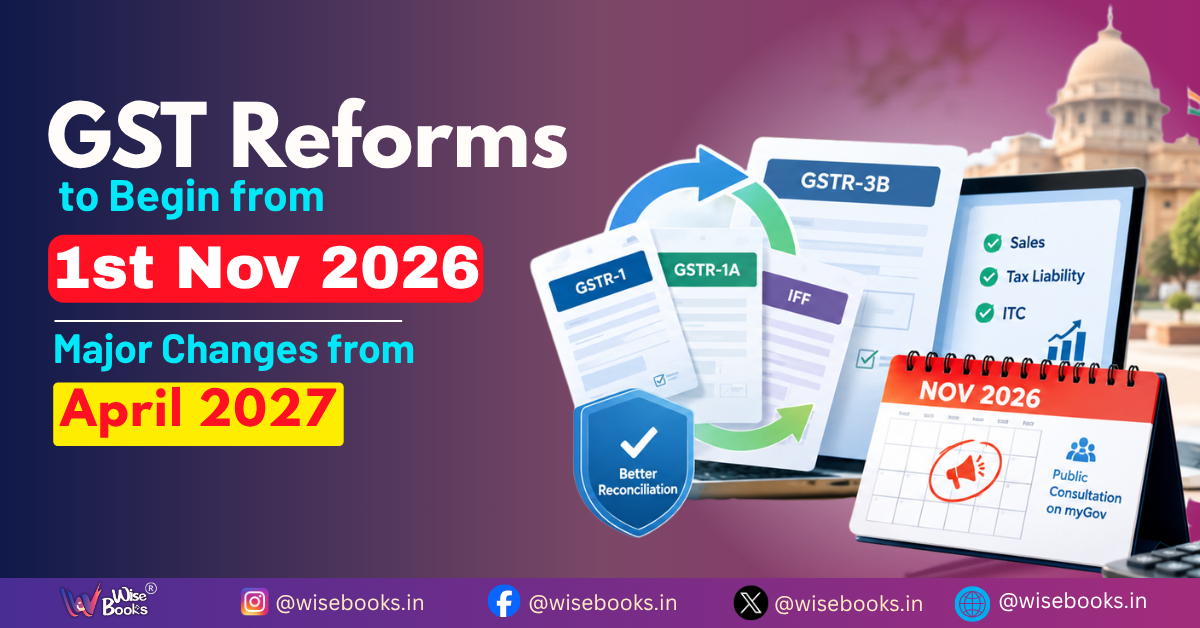
The Government of India is preparing a consultation on proposed changes to the Goods and Services Tax (GST) return filing system, with the aim of reducing reporting discrepancies and improving reconciliation between tax liabilities and Input Tax Credit (ITC). According to reports published in October 2026, draft rules, forms and related guidance are expected to be made available on the myGov portal for public feedback from 1 November to 30 November 2026. The proposed revised return processes are expected to take effect from 1 April 2027, subject to the consultation and finalisation process. Source: Financial Express.
For businesses, the proposed revamp is worth watching because GST compliance depends on consistency between invoices, accounting records, reported sales, tax payments and eligible input tax credits.
Why Is the Government Considering a GST Return Revamp?
One of the continuing challenges under GST is the mismatch between information reported across different returns. Differences in sales figures, tax liabilities and ITC can lead to reconciliation problems, system-generated intimations and potential disputes with tax authorities.
At present, businesses use forms such as GSTR-1 to report outward supplies and GSTR-3B to declare summary tax liabilities and discharge their tax obligations. The Invoice Management System (IMS) also supports invoice-level review and reconciliation relevant to ITC.
The proposed changes are intended to improve how these reporting processes work together and reduce the need for corrections after returns have been filed.
According to reporting on the consultation, the government is considering enhancements to GSTR-1, GSTR-1A and the Invoice Furnishing Facility (IFF), alongside improvements intended to reconcile reported information with GSTR-3B more effectively.
Proposed Changes to GSTR-1, GSTR-1A and IFF
GSTR-1 is used by regular taxpayers to report outward supplies. GSTR-1A provides a mechanism for specified amendments to details of outward supplies for the same tax period, while the Invoice Furnishing Facility is available to eligible quarterly filers for furnishing invoice details for relevant periods.
The proposed revamp aims to improve the accuracy and consistency of information furnished through these mechanisms. Better alignment could help businesses identify errors earlier and reduce differences between outward-supply reporting and summary tax-payment returns.
However, the detailed draft forms and final instructions will determine exactly how the revised reporting process operates. Businesses should not assume that the existing forms or filing requirements have already changed.
Better Reconciliation Between Sales, Tax Liability and ITC
Reconciliation is an important part of GST compliance because the figures reported in returns must be supported by the underlying records.
For example, a business may record sales in its accounting software but report a different taxable value in its GST return because of an incorrect invoice, a credit note or a timing difference. Similarly, purchase records and ITC claims may not align with the information available through the GST system.
The proposed reforms aim to address such inconsistencies through improvements to return forms and the Invoice Management System. If implemented with clear correction mechanisms, these changes could help taxpayers identify and resolve discrepancies before they lead to further compliance issues.
Could the Changes Reduce GST Notices?
Return mismatches are a significant source of GST compliance concerns. Reporting on the proposed revamp has highlighted the role of discrepancies between reported sales and tax payments in triggering notices and system-generated communications.
Improved data consistency could reduce avoidable errors and make reconciliation more straightforward. However, the proposed changes cannot be assumed to eliminate GST notices. Notices may also arise from other issues, including ineligible ITC claims, incorrect tax classification, delayed payments or other non-compliance.
Businesses should therefore continue to maintain reliable records and review their returns before filing.
What Should Businesses Do Before the Proposed Changes Take Effect?
Although the draft proposals are expected to be available for consultation in November, businesses can strengthen their compliance processes now.
Reconcile books with GST returns: Compare sales recorded in the accounting system with GSTR-1 and GSTR-3B and investigate differences.
Review ITC claims: Check purchase invoices, supplier details and eligibility before claiming input tax credit.
Track credit notes and amendments: Maintain clear records of invoice corrections, discounts, returns and other adjustments.
Review the Invoice Management System: Ensure that relevant invoices are reviewed and handled correctly within the applicable filing process.
Monitor official announcements: Read the draft proposals when published and follow the final notifications and implementation instructions.
Improve accounting controls: Assign responsibility for reviewing returns, resolving discrepancies and maintaining supporting documents before submission.
What Should Businesses Expect in November 2026?
The November consultation is expected to provide stakeholders with an opportunity to review the proposed changes and offer feedback. Businesses, accountants, tax professionals and industry associations may wish to examine the draft forms and procedures closely.
The consultation period is expected to run from 1 November through 30 November 2026. The government is considering implementation of the revised return processes from 1 April 2027, subject to the outcome of the consultation and final approval.
The final requirements may differ from the draft proposals. Taxpayers should therefore distinguish between changes being considered and requirements that have been formally notified.
Conclusion
The proposed GST return revamp signals a continued focus on reducing reporting mismatches and improving reconciliation across GST filings. For businesses, the potential benefits will depend on how effectively the final system handles invoice adjustments, timing differences and corrections.
The best preparation is to maintain accurate books, reconcile returns regularly, review ITC carefully and stay informed about official announcements. Businesses that strengthen these practices now will be better positioned to adapt when the revised return processes are finalised.
FAQs: Questions and Answers
Q1. What is the proposed GST return form revamp in November 2026?
Answer: The government is expected to seek public feedback on proposed changes to GST return forms and filing procedures during November 2026. The objective is to simplify return filing, reduce discrepancies, and improve reconciliation between tax liabilities and Input Tax Credit (ITC).
Q2. When are the proposed GST return form changes expected to be implemented?
Answer: The proposed changes could take effect from 1 April 2027, subject to consultation, finalisation, and official notification by the government.
Q3. Which GST return forms may be affected by the proposed changes?
Answer: The proposed revamp may affect GSTR-1, GSTR-1A, and the Invoice Furnishing Facility (IFF), along with improvements in reconciliation with GSTR-3B.
Q4. What is the purpose of changing GST return forms?
Answer: The main objective is to improve accuracy in GST reporting, minimise differences between reported sales and tax liabilities, and make ITC reconciliation more efficient for businesses.
Q5. What are GSTR-1, GSTR-1A, and GSTR-3B used for?
Answer: GSTR-1 is used to report outward supplies, GSTR-1A allows amendments to outward supply details for the same tax period, and GSTR-3B is a summary return used to declare tax liabilities and pay GST.
Q6. How could the proposed GST return changes affect businesses?
Answer: Businesses may need to review their accounting processes, invoice reporting practices, and reconciliation procedures. If implemented, the changes could help reduce reporting errors and improve compliance.
Q7. How can businesses prepare for the proposed GST return revamp?
Answer: Businesses can start by reconciling their books with GST returns, verifying sales and purchase invoices, reviewing ITC claims, tracking amendments and credit notes, and strengthening their internal compliance checks.
Q8. What role does the Invoice Management System (IMS) play in GST compliance?
Answer: The Invoice Management System helps taxpayers review and manage invoices reported by suppliers. Using it regularly can support more accurate invoice matching and ITC reconciliation.
Q9. Will the proposed changes eliminate GST notices and mismatches?
Answer: The proposed changes aim to reduce discrepancies and improve reporting accuracy. However, businesses must continue maintaining accurate records and complying with GST requirements, as the changes cannot guarantee that notices or mismatches will be eliminated.
Q10. Where can businesses find updates about the proposed GST return changes?
Answer: Businesses should monitor official GST portal announcements, notifications from the Central Board of Indirect Taxes and Customs (CBIC), and the proposed public consultation on the myGov portal. They should rely on official notifications for confirmed implementation details.


Comments
No comments yet. Be the first to comment!