


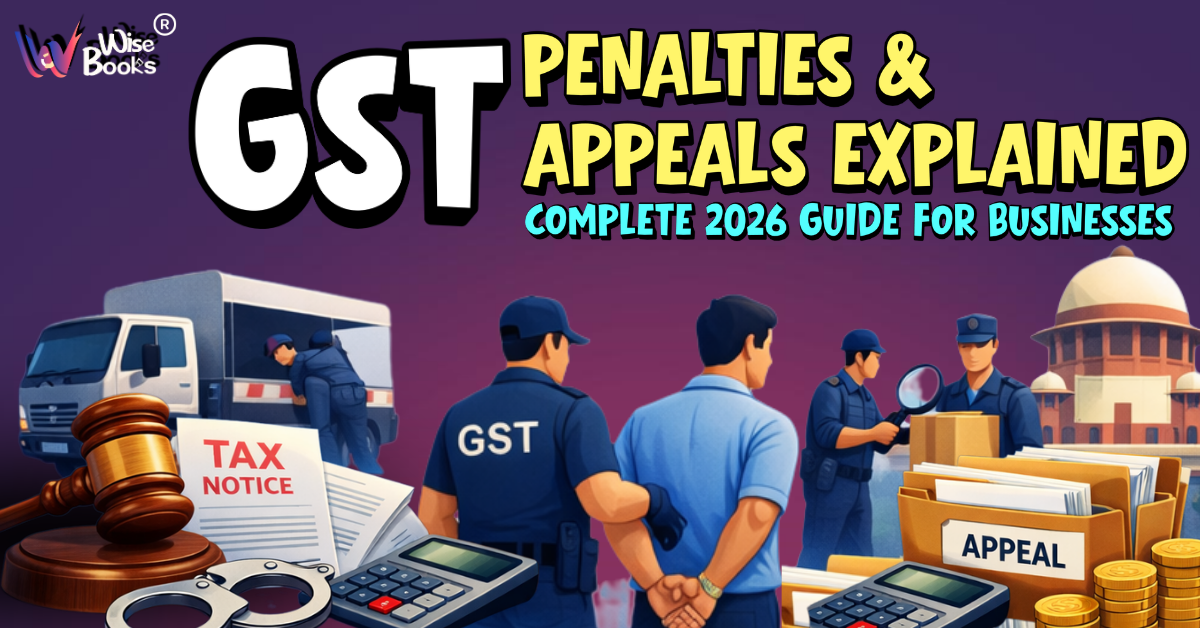
In India, the GST framework has been designed not just to simplify taxation, but also to strictly prevent tax evasion, fraud, and non-compliance. To achieve this, the law includes detailed provisions relating to offences, penalties, prosecution, inspection, and appeals.
For businesses and professionals, understanding these provisions is extremely important because even a small mistake—intentional or not—can lead to financial penalties, notices, or legal complications.
This guide provides a deep and structured explanation of GST offences, penalties, and the appeal mechanism.
Key Takeaways
1. 21 Offences Defined Under GST Law
The GST law (Section 122(1) of the CGST Act) clearly defines 21 different types of offences.
These offences cover a wide range of non-compliant activities such as non-registration, fake invoicing, wrongful ITC claims, and tax evasion practices. The objective is to ensure that every taxpayer follows a transparent and accountable system.
2. Penalties Are Mandatory for Non-Compliance
If any offence is committed, penalties are not optional—they are legally enforceable.
The amount of penalty depends on factors like the nature of default, intention (fraud or genuine error), and tax amount involved. This ensures fairness while maintaining strict discipline in the system.
3. Authorities Have Investigation Powers
GST officers (Joint Commissioner or higher) have the authority to act if they suspect tax evasion.
If there is a belief that a taxpayer has suppressed transactions, claimed excess Input Tax Credit (ITC), or manipulated records, authorities can initiate inspection, search, and seizure actions.
Offences Under
Below are the major categories of GST offences, each explained clearly:
1. Non-Registration Under GST
If a business crosses the prescribed turnover limit but fails to register under GST, it becomes a punishable offence.
This is considered a serious lapse because it leads to complete tax evasion, as transactions remain outside the GST system.
2. Issuing Fake or No Invoices
Businesses must issue proper invoices for every supply.
If a taxpayer supplies goods/services without an invoice, or issues fake invoices without actual supply, it is treated as fraudulent activity, often used for wrongful ITC claims.
3. Failure to Deposit Collected GST
If a business collects GST from customers but does not deposit it with the government within 3 months, it is a major violation.
This is treated seriously because the taxpayer is acting as a custodian of government tax.
4. TDS/TCS Non-Compliance
Failure to deduct or collect TDS/TCS, or not depositing it with the government, is an offence.
This impacts the entire compliance chain and may lead to penalties and interest liabilities.
5. Wrongful ITC Claims
Claiming Input Tax Credit without actually receiving goods or services is a common but serious offence.
This directly impacts government revenue and is often linked with fake invoicing networks.
6. Submission of False Information
Providing incorrect details during GST registration or filing fake returns/documents is punishable.
Such actions indicate intent to mislead authorities, increasing the risk of investigation.
7. Fraudulent Refund Claims
Claiming GST refunds fraudulently is considered a high-risk offence.
This leads to heavy penalties, prosecution, and possible arrest.
8. Suppression of Turnover
Deliberately hiding sales or underreporting turnover to reduce tax liability is a clear case of tax evasion.
This often results in penalties along with interest and scrutiny notices.
9. Obstruction & Illegal Handling of Goods
Activities like transporting goods without documents, tampering with seized goods, or obstructing officers are also offences.
These actions interfere with law enforcement and compliance checks.
GST Penalties
1. Late Filing of GST Returns
Late filing attracts both late fees and interest.
Key Points:
i. ₹50 per day (₹25 CGST + ₹25 SGST)
ii. ₹20 per day for NIL returns
iii. 18% annual interest on unpaid tax
Explanation:
Late filing not only increases financial burden but also disrupts compliance flow.
If returns are not filed on time, the system blocks future filings, creating a chain reaction of non-compliance.
2. Non-Filing of GST Returns
Failure to file returns has serious consequences.
Explanation:
If GSTR-3B is not filed, GSTR-1 cannot be submitted. This leads to business disruptions, inability to claim ITC, and increased scrutiny from tax authorities.
3. Penalty Without Fraud Intent
Penalty = 10% of tax due or ₹10,000 (whichever is higher)
Explanation:
This applies when the mistake is genuine (clerical or unintentional).
The law ensures that even genuine errors are penalized to maintain discipline, but at a lower severity level.
4. Penalty With Fraud Intent
Penalty = 100% of tax amount (minimum ₹10,000)
Explanation:
When fraud is involved, the law imposes strict punishment to deter such practices.
This may also include prosecution and imprisonment, depending on the amount involved.
Inspection, Search & Seizure
1. Inspection
Authorities can inspect business premises if tax evasion is suspected.
Explanation:
This is usually the first step where officers verify records, stock, and transactions to identify discrepancies.
2. Search & Seizure
If strong evidence is found, officers can search premises and seize goods/documents.
Explanation:
Seizure ensures that important evidence is not destroyed and can be used in legal proceedings.
3. Goods in Transit Rules
Goods above ₹50,000 must carry proper documents like invoice, e-way bill, etc.
Explanation:
If documents are missing, goods and vehicles can be detained.
Release is allowed only after payment of tax and penalty, ensuring compliance during transportation.
Compounding of Offences
Compounding allows taxpayers to settle cases without lengthy litigation.
Explanation:
Instead of going through court procedures, the taxpayer can pay a compounding fee and close the case.
This is beneficial for saving time, money, and legal effort, but is not available for high-value offences (> ₹1 crore).
Prosecution Under GST
Prosecution involves criminal proceedings for serious offences.
Explanation:
If fraud is intentional (like fake invoicing or fraudulent refunds), the taxpayer may face criminal charges, which can lead to imprisonment and fines.
Arrest Under GST
Authorities can arrest individuals involved in serious offences.
Explanation:
Arrest is applicable in cases involving significant fraud.
The person must be presented before a magistrate within 24 hours, ensuring legal protection while enforcing strict action.
Appeals Under GST
1. Right to Appeal
Any taxpayer dissatisfied with an order can file an appeal.
Explanation:
This ensures fairness and gives taxpayers an opportunity to challenge incorrect or unfair decisions.
2. Appeal Hierarchy
i. First Appellate Authority
ii. GST Appellate Tribunal
iii. High Court
iv. Supreme Court
Explanation:
The multi-level structure ensures that cases can be reviewed at different levels for justice and accuracy.
3. Pre-Deposit Requirement
A minimum of 10% of disputed tax must be deposited before filing an appeal.
Explanation:
This prevents misuse of the appeal system and ensures only genuine cases are pursued.
Advance Ruling (Preventive Approach)
Businesses can seek clarification before entering transactions.
Explanation:
Advance ruling helps avoid future disputes by providing certainty on GST treatment, making it a proactive compliance strategy.
Conclusion
GST compliance is not just about filing returns—it is about maintaining accuracy, transparency, and discipline in financial reporting.
Understanding offences, penalties, and appeals helps businesses:
i. Avoid costly mistakes
ii. Reduce legal risks
iii. Maintain smooth operations
With expert support from WiseBooks, businesses can stay fully compliant and focus on growth without worrying about GST complexities.


Comments
At some point I needed to check whether my laptop supports a RAM upgrade. That’s
when I discovered https://znayka.com.ua.
I couldn’t find detailed specifications on most websites. Many sources were incomplete.
On this site I found practical upgrade information, along with clear diagrams that made everything much easier to understand.
It’s worth visiting this platform if you want reliable information about laptops and hardware upgrades.
VulkanSpieles Casino Polska to platforma, ktora laczy nowoczesne mozliwosci z bezpiecznymi metodami platnosci i przyjaznym interfejsem.
Wielu graczy docenia latwosc rejestracji i szybkie wyplaty, co wplywa na pozytywne doswiadczenia.
vulkan spiele [url=https://vulkan-spiele4.com]https://vulkan-spiele4.com/[/url]