

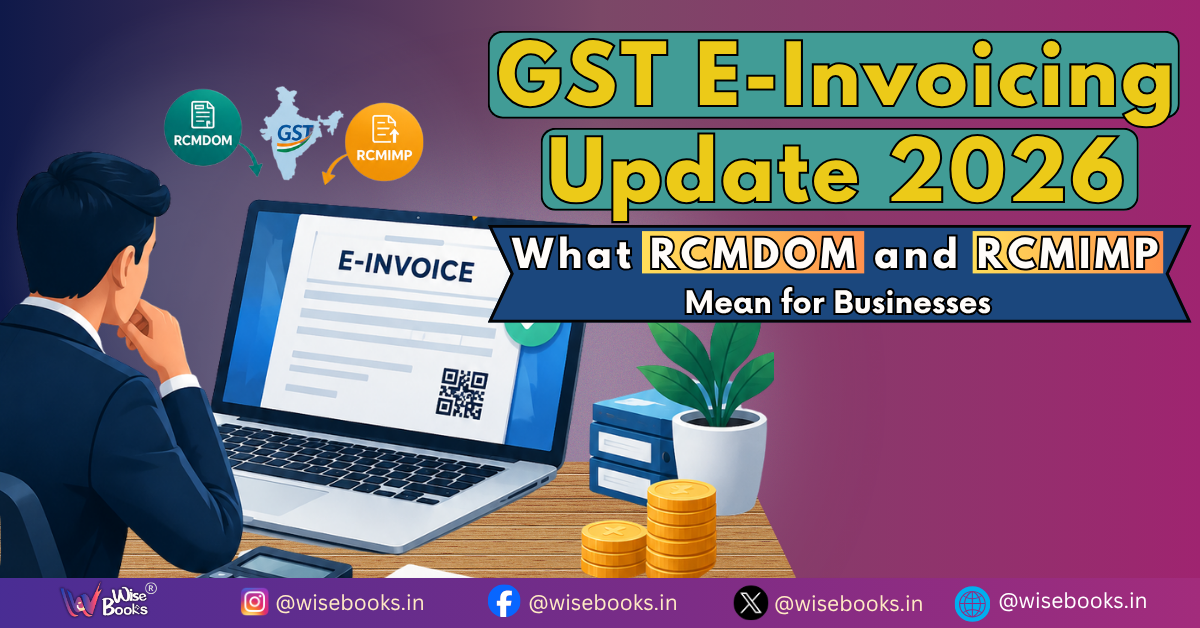
GST E-Invoicing Update 2026: What RCMDOM and RCMIMP Mean for Businesses
India’s GST compliance system continues to evolve as authorities expand the use of technology in invoice reporting and tax administration. A recent GSTN enhancement introduces two new supply-type categories, RCMDOM and RCMIMP, to facilitate the reporting of certain recipient-generated self-invoices under the Reverse Charge Mechanism (RCM).
The development is particularly relevant for businesses that purchase specified goods or services from unregistered suppliers or import services from overseas vendors. For eligible businesses, understanding these new categories can help improve invoice management, accounting accuracy and GST compliance readiness.
What Are RCMDOM and RCMIMP?
The new categories are designed to support the reporting of specified self-invoices through the Invoice Registration Portal (IRP).
RCMDOM — Domestic Reverse Charge Transactions
RCMDOM is intended for recipient-generated self-invoices relating to specified domestic supplies received from unregistered suppliers where the registered recipient is liable to pay GST under the Reverse Charge Mechanism.
RCMIMP — Reverse Charge on Imported Services
RCMIMP is intended for recipient-generated self-invoices relating to imports of services from suppliers located outside India, where the registered recipient is liable to pay GST under RCM.
These categories extend the e-invoicing reporting framework to certain transactions in which the recipient, rather than the supplier, generates the self-invoice.
What Is the Reverse Charge Mechanism Under GST?
Under the Reverse Charge Mechanism, the responsibility to pay GST shifts from the supplier to the recipient for transactions covered by the applicable provisions.
Businesses may encounter RCM in specified domestic transactions and imports of services. The recipient must determine whether the transaction attracts reverse charge, comply with the applicable invoicing requirements and pay tax according to the relevant rules.
For example, a business importing a taxable service from a foreign vendor may need to assess its GST liability under RCM. Where the law requires a self-invoice, the business must ensure that the invoice and related accounting records are properly maintained.
The applicable tax treatment depends on the nature of the supply, the parties involved and the relevant statutory provisions.
Which Businesses Should Pay Attention to This Update?
The GSTN announcement identifies registered taxpayers with aggregate annual turnover of ₹5 crore or more as the intended category for the new functionality, subject to applicable statutory provisions and notifications.
Businesses should assess their exposure if they:
i. Receive specified domestic supplies from unregistered vendors.
ii. Import services from overseas suppliers.
iii. Are liable to pay GST under RCM.
iv. Generate self-invoices as part of their accounting process.
v. Use ERP or accounting software integrated with e-invoicing systems.
The turnover threshold alone should not be treated as a complete determination of legal applicability. Businesses should verify the relevant notification, eligibility conditions and implementation instructions.
How Could the Update Affect GST Compliance?
The new supply types are intended to make reporting of eligible recipient-generated self-invoices possible through the IRP framework. This can have practical implications for accounting and tax teams.
1. Invoice reporting and documentation
Businesses should review whether their existing processes correctly identify transactions requiring self-invoicing and whether the relevant invoice information can be reported using the applicable supply type.
2. Accounting software readiness
Finance teams should coordinate with their ERP vendors, GST Suvidha Providers or other technology partners to assess whether their systems can accommodate the new categories and associated validations.
3. Reconciliation and audit trails
Self-invoices, purchase records, tax-payment entries and supporting documents should be maintained consistently. Clear records can help businesses explain transactions during internal reviews, audits or departmental enquiries.
4. Input tax credit review
Businesses should not assume that generating an Invoice Reference Number automatically establishes eligibility for input tax credit. ITC entitlement continues to depend on the applicable statutory conditions, including the requirements relevant to reverse-charge transactions.
Does This Update Change Existing GST Liability?
No. The introduction of new supply-type categories is a reporting and technology enhancement. It does not, by itself, change the underlying conditions for the levy of GST under RCM, the obligation to issue self-invoices, the time of supply, tax-payment requirements or eligibility to claim ITC.
Businesses must continue to apply the relevant provisions of the CGST Act, CGST Rules and applicable notifications. They should also distinguish between a GSTN technical enhancement, a GST Council recommendation and a legally effective notification.
The production rollout date and commencement of the associated reporting requirements had not been announced in the announcement reviewed for this update. Businesses should therefore monitor subsequent official instructions before treating the new functionality as a live mandatory requirement.
What Should Businesses Do Now?
Businesses can use this development as an opportunity to review their reverse-charge compliance processes.
Start by identifying transactions that may attract RCM, reviewing the self-invoicing process, checking the accuracy of accounting records and discussing system readiness with the relevant technology provider. Finance teams should also monitor official GSTN advisories and notifications for implementation dates and detailed reporting requirements.
Taking these steps early can help reduce avoidable reconciliation issues and support a more organised compliance process.
Conclusion
The introduction of RCMDOM and RCMIMP reflects the continued digitisation of India's GST compliance framework. For businesses dealing with specified domestic reverse-charge supplies or imported services, the key priority is to understand the scope of the new reporting functionality and prepare their accounting systems accordingly.
Staying updated on GST notifications, invoice requirements and input tax credit rules can help businesses maintain accurate records and respond more effectively to changing compliance expectations.
Need support with GST registration, accounting, GST returns or tax compliance? A structured compliance process can help businesses manage their financial records and regulatory responsibilities with greater confidence.
Source: GSTN official advisory on the introduction of RCMDOM and RCMIMP supply types for recipient-generated self-invoices under RCM.
Disclaimer: This article is for general informational purposes and is not a substitute for professional tax or legal advice. Verify applicable notifications, effective dates and transaction-specific requirements before taking action.
FAQs: GST E-Invoicing Update 2026
Q1. What are RCMDOM and RCMIMP under GST?
RCMDOM and RCMIMP are new supply-type categories introduced to facilitate reporting of certain recipient-generated self-invoices under the Reverse Charge Mechanism (RCM). RCMDOM relates to specified domestic transactions, while RCMIMP relates to specified imports of services.
Q2. What is the Reverse Charge Mechanism (RCM) under GST?
Under RCM, the recipient of specified goods or services is responsible for paying GST instead of the supplier, subject to applicable GST provisions.
Q3. Which businesses should pay attention to the new GST e-invoicing categories?
Businesses undertaking eligible reverse-charge transactions, including specified purchases from unregistered domestic suppliers and imports of services, should review the new categories and the applicable eligibility requirements.
Q4. Do RCMDOM and RCMIMP change GST liability?
No. The new categories are intended to facilitate invoice reporting. They do not independently change the existing provisions governing GST liability, tax payment or input tax credit.
Q5. What is a self-invoice under GST?
A self-invoice is an invoice issued by a registered recipient in circumstances where the GST law requires the recipient to issue one, including certain purchases from unregistered suppliers liable to reverse charge.
Q6. What is the Invoice Registration Portal (IRP)?
The IRP is the system through which eligible e-invoices are reported for authentication and generation of an Invoice Reference Number (IRN), along with a digitally signed QR code where applicable.
Q7. Does generating an IRN automatically make a business eligible for input tax credit?
No. Generating an IRN does not automatically establish ITC eligibility. Businesses must satisfy the applicable statutory conditions for claiming input tax credit.
Q8. How can businesses prepare for the GST e-invoicing update?
Businesses should review their reverse-charge transactions, self-invoicing procedures, accounting software, tax-payment records and reconciliation processes. They should also monitor official GSTN advisories for implementation instructions.
Q9. Is the new RCMDOM and RCMIMP functionality mandatory for all GST-registered businesses?
Not necessarily. Businesses should verify the applicable turnover threshold, transaction eligibility, relevant notifications and official implementation dates before determining whether the functionality applies to them.
Q10. Where can businesses find official GST e-invoicing updates?
Businesses can check the GST Portal and the official GST Council website for relevant advisories, notifications and announcements.


Comments
No comments yet. Be the first to comment!