


GST collections have once again become the centre of attention not because collections have fallen, but because there is now a debate over how GST growth should be calculated.
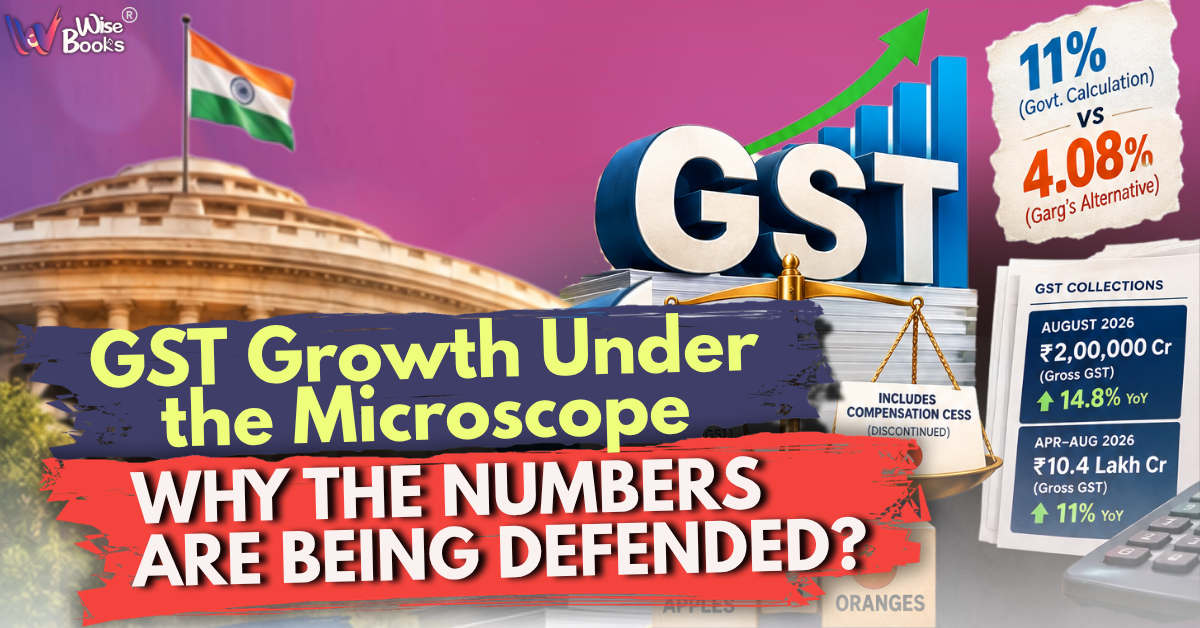
India's gross GST collections rose 14.8% year-on-year to nearly ₹2 lakh crore in August 2026. For April to August 2026, collections increased by 11% to around ₹10.4 lakh crore. After refunds, GST revenue stood at about ₹1.68 lakh crore in August, up 8.3% year-on-year, while April–August net revenue rose 9% to ₹8.89 lakh crore.
These numbers suggest strong revenue growth. But former Finance Secretary Subhash Chandra Garg has questioned whether the headline growth rate gives the complete picture.
That has led the Central Board of Indirect Taxes and Customs (CBIC) to defend the government's method of calculating GST growth.
What Started the GST Data Debate?
The controversy centres on one particular component of GST revenue: compensation cess.
Garg argued that the reported 11% GST growth for April–August did not include compensation cess in the comparison. According to the calculation cited in his criticism, including cess would bring five-month gross GST growth down to 4.08%, while net growth would be around 1.30%. He questioned whether excluding cess presented a more favourable picture of GST revenue performance.
The CBIC rejected this interpretation.
According to the board, the issue is not about hiding or manipulating revenue figures. It is about using the correct and comparable tax base when calculating growth.
Why Does Compensation Cess Matter?
To understand the argument, we first need to look at what happened to compensation cess.
The GST Council discontinued compensation cess from September 22, 2025, for all items except tobacco and related products. The cess on tobacco and related products was subsequently removed from February 1, 2026.
As a result, compensation cess is no longer being collected under the current GST structure.
This change is important when comparing GST collections from one year to another.
If a particular levy existed during the earlier period but no longer exists during the current period, should it continue to be included in the growth calculation?
The CBIC says no.
CBIC's Explanation: Compare Like with Like
The CBIC says GST revenue growth should be calculated using a comparable tax base.
Since compensation cess has ceased to exist as a current levy, the board argues that retaining it in the current growth base would not provide a meaningful comparison.
Since November 2025, the government has been showing compensation cess separately in its published GST revenue figures. The year-on-year growth calculation has been based on the relevant CGST, SGST and IGST tax base.
The principle is straightforward:
If the tax structure changes, the comparison must account for that change. Otherwise, the growth percentage could reflect differences in the tax structure rather than actual changes in the underlying GST tax base.
The "Apples and Oranges" Problem
The CBIC has described the issue as a "like-for-like" comparison.
Consider a simple example.
Suppose last year's revenue included three different taxes, but one of those taxes was completely discontinued this year.
If we compare this year's revenue with last year's revenue while continuing to count the discontinued tax in the comparison, the resulting growth percentage may not accurately represent the performance of the taxes that are currently being collected.
That is essentially the CBIC's argument.
The board says comparing different tax bases is like comparing apples and oranges. Its position is that a growth number is useful only when both sides of the comparison represent the same set of applicable levies.
So, Is GST Growth Really 11% or 4.08%?
This is where the debate can become confusing. The 11% figure refers to the government's calculation of April–August GST growth using the current comparable tax base.
The 4.08% figure comes from Garg's alternative calculation that includes compensation cess in the comparison. These numbers therefore arise from different approaches to defining the comparison base.
The disagreement is not simply about whether GST collections increased. It is about which components should be included when measuring that increase. The CBIC maintains that the government's calculation is appropriate because compensation cess is no longer part of the current tax structure.
What Do the Latest GST Numbers Show?
Despite the debate over methodology, the reported collection figures remain significant.
August 2026
- Gross GST collection: Nearly ₹2 lakh crore
- Year-on-year growth: 14.8%
- GST revenue after refunds: ₹1.68 lakh crore
- Net revenue growth: 8.3%
April–August 2026
- Gross GST collection: Around ₹10.4 lakh crore
- Year-on-year growth: 11%
- Net GST revenue: Around ₹8.89 lakh crore
- Net revenue growth: 9%
These numbers show that GST remains a major source of government revenue and an important indicator of economic and compliance activity.
Why GST Collections Matter to Businesses
GST collections are not just government revenue figures.
They can also provide insights into the broader business environment.
Strong GST collections can be influenced by factors such as:
- Higher consumption
- Increased business activity
- Better tax compliance
- Expansion of the formal economy
- Changes in tax rates
- Improved tax administration
For businesses, these trends matter because GST policy and revenue performance can influence future decisions around compliance, tax administration and reforms.
However, businesses should avoid interpreting one headline number without understanding the factors behind it.
What Does This Mean for Taxpayers?
For taxpayers and businesses, the current controversy does not change their regular GST compliance requirements.
Businesses still need to ensure:
- GST returns are filed accurately and on time.
- Input Tax Credit is properly reconciled.
- Sales and purchase records are maintained correctly.
- GST invoices contain accurate information.
- Tax payments are made within the applicable timelines.
- Books of accounts and GST records remain consistent.
The debate does, however, highlight an important financial lesson:
Always understand the calculation behind a number before drawing conclusions from it.
The Bigger Lesson Behind the GST Debate
The current disagreement between Garg's interpretation and the CBIC's response highlights something broader than GST.
Whenever governments, businesses or analysts report growth, the comparison base matters.
A growth percentage can change significantly depending on:
- Which components are included
- Which taxes or levies have changed
- Whether refunds are considered
- Whether the comparison is based on gross or net revenue
- Whether the same tax structure existed in both periods
That is why financial data needs context.
The headline "GST collections up 11%" may grab attention, but understanding why the number is 11% is equally important.
What Should Businesses Watch Next?
As India's GST framework continues to evolve, businesses should keep an eye on changes in:
i. GST rates and exemptions
ii. Input Tax Credit rules
iii. Compliance requirements
iv. Tax assessments and notices
v. GST Council decisions
vi. Changes in levies and cess
The upcoming GST Council discussions will also be closely watched for possible changes affecting businesses and taxpayers.
Final Takeaway
The GST data controversy is ultimately a debate about how growth should be measured after the compensation cess was discontinued.
Former Finance Secretary Subhash Chandra Garg questioned the exclusion of cess from the growth comparison, while the CBIC has defended the approach by saying that a discontinued levy should not remain part of the current comparison base.
For businesses, the takeaway is simple:
Don't just look at the percentage. Look at the base behind the percentage.
Because when the tax structure changes, the way we measure growth has to change too.


Comments
No comments yet. Be the first to comment!