


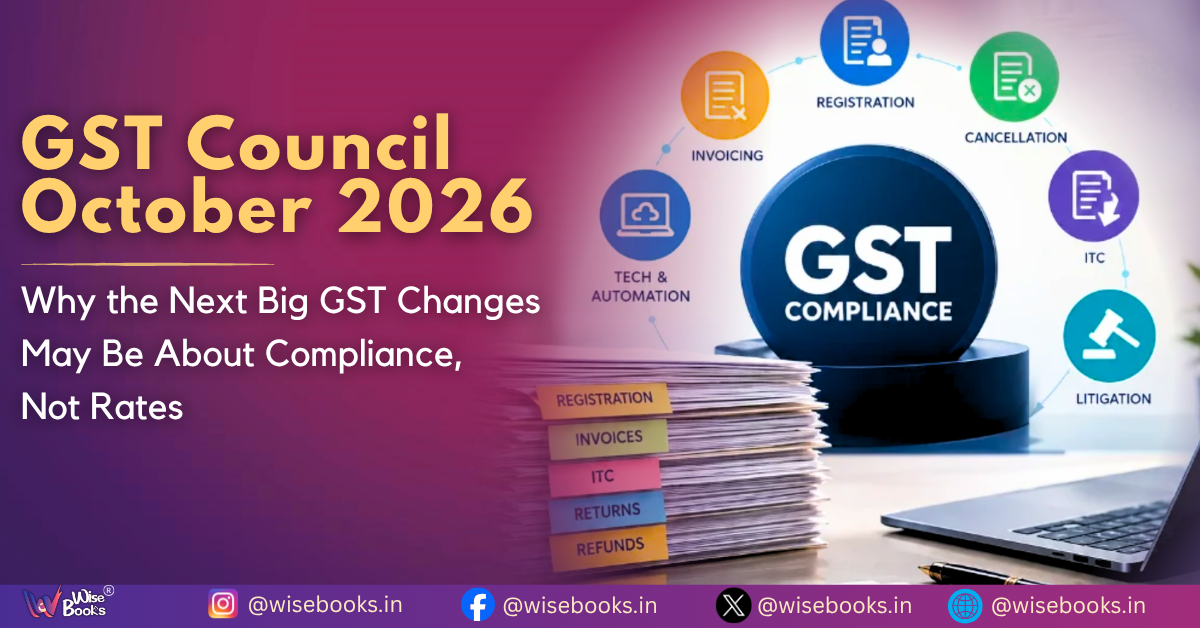
After major GST rate rationalisation, the focus is now shifting from “How much GST should businesses pay?” to “How easily should businesses be able to comply?”
The upcoming 57th GST Council meeting, scheduled for October 7, 2026, is expected to focus on process-oriented reforms rather than another round of GST rate changes. Finance Minister Nirmala Sitharaman said on September 16 that the process-reform agenda, which was deferred earlier, would be taken up at the October meeting.
For businesses, this could be just as important as a rate change. GST compliance involves registration, invoicing, input tax credit, refunds, litigation and several technology-driven processes. Simplifying these areas could directly affect how businesses manage their day-to-day tax compliance.
What Will the October GST Council Meeting Focus On?
The upcoming meeting is expected to concentrate on GST process reforms. One area already identified for discussion is the simplification and standardisation of GST registration procedures, particularly for businesses passing on significant amounts of input tax credit. Current procedures can vary between central and state GST formations, creating uncertainty for taxpayers.
Another important area is GST registration cancellation. Automation and procedural changes are expected to be considered to make the process more efficient and consistent. For businesses, smoother registration and cancellation procedures could reduce unnecessary administrative work and uncertainty.
What About Input Tax Credit?
Input Tax Credit (ITC) is another area businesses will be watching closely.
ITC directly affects working capital and the effective tax cost of a business. Issues around reconciliation, eligibility and procedural requirements can create disputes between taxpayers and the GST authorities.
Recent reporting on the October agenda has also highlighted possible ITC simplification as part of the wider process-reform discussion.
For businesses, the important takeaway is that GST compliance may increasingly move towards a system where technology, data matching and automated processes play a larger role.
Could GST Litigation Also See Changes?
GST disputes have remained a major compliance concern for businesses.
The upcoming process-reform agenda is also expected to look at ways of reducing procedural difficulties and unnecessary litigation. This matters because a tax dispute can involve more than the disputed tax itself businesses may also face interest, penalties, professional costs and blocked working capital.
A more streamlined process could therefore have an impact beyond simply reducing paperwork.
What Does This Mean for Businesses?
The October GST Council meeting is important because the focus appears to be moving towards the next stage of GST implementation.
Businesses should not wait for the Council's final decisions before reviewing their internal GST processes. Registration details, GST master data, invoices, ITC records, reconciliations and compliance documentation should already be in order.
At the same time, businesses should distinguish between proposals or issues expected to be discussed and decisions that have actually been approved by the GST Council. Until the Council formally makes recommendations and the relevant notifications or rules are issued, businesses should not treat proposed reforms as implemented law.
The Bigger Picture
GST reform is no longer only about changing tax rates. The next phase is increasingly about making the system simpler, more consistent and easier to comply with.
With the 57th GST Council meeting scheduled for October 7, 2026, businesses will be watching closely for changes around registration, cancellation, ITC, e-invoicing, litigation and other compliance processes.
For taxpayers, the real question is no longer just “What GST rate applies to me?” It is also “How efficiently can I manage my GST compliance?”
Frequently Asked Questions
1. When is the 57th GST Council meeting scheduled?
The 57th GST Council meeting is scheduled for October 7, 2026.
2. What is the main focus of the upcoming GST Council meeting?
The meeting is expected to focus primarily on GST process reforms, rather than another round of GST rate changes.
3. Will GST rates be changed in the October 2026 meeting?
The current focus announced for the meeting is on process reforms. Any GST rate changes would depend on the Council's formal recommendations.
4. What are GST process reforms?
GST process reforms aim to make areas such as registration, compliance, input tax credit and other taxpayer procedures simpler and more consistent.
5. Why are GST registration reforms important for businesses?
Simpler and more standardised registration procedures could reduce administrative difficulties and make compliance easier for businesses.
6. Could input tax credit (ITC) be part of the reforms?
ITC-related issues are among the areas being discussed in the broader process-reform agenda. However, businesses should wait for official decisions before treating any proposed change as implemented.
7. Will the reforms affect GST compliance?
Potentially, yes. Process reforms could influence how businesses handle GST registration, documentation, reconciliation and other compliance activities.
8. What should businesses do before the GST Council meeting?
Businesses should review their GST registrations, invoices, ITC records, reconciliations and pending compliance issues so they are prepared for any officially notified changes.
9. When will GST Council decisions become applicable?
A GST Council recommendation does not automatically mean a rule has immediately changed. Businesses should check the official notifications, circulars or amendments issued after the Council's recommendations.


Comments
No comments yet. Be the first to comment!