


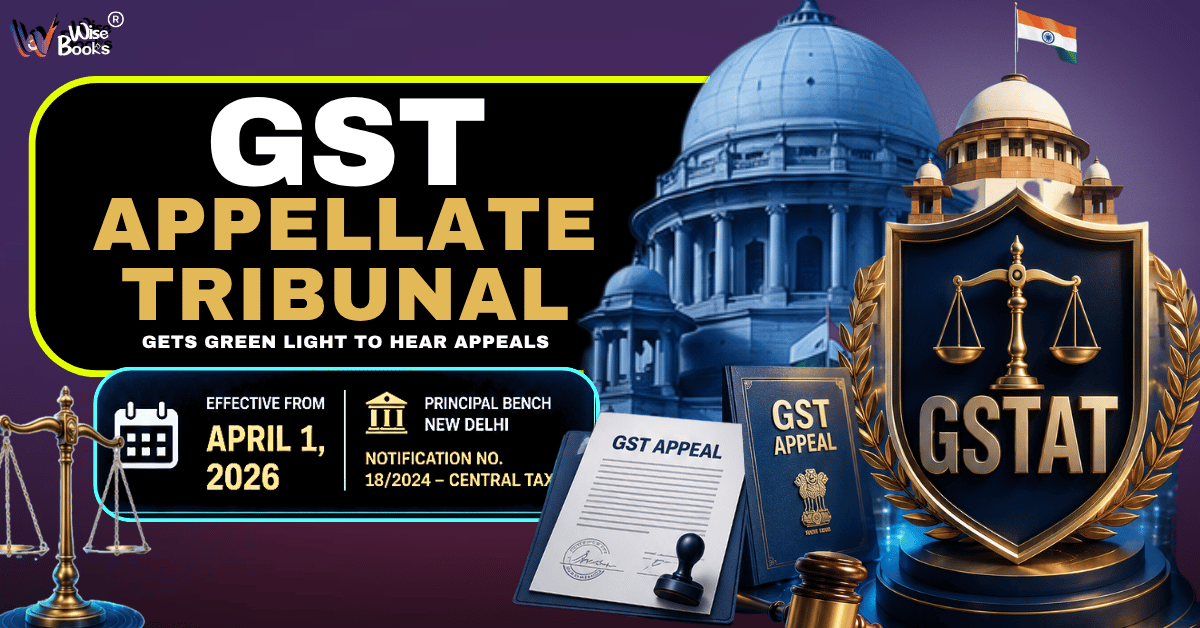
The Government of India has finally taken a landmark step in strengthening the Goods and Services Tax (GST) dispute resolution system by empowering the Principal Bench of the GST Appellate Tribunal (GSTAT) in New Delhi to start hearing appeals under the Central Goods and Services Tax (CGST) Act, 2017.
This development marks one of the most significant reforms in India’s GST ecosystem since the introduction of GST in July 2017. For years, taxpayers, businesses, professionals, and legal experts had been demanding a functional GST appellate mechanism to handle disputes efficiently. The absence of a dedicated tribunal forced taxpayers to approach High Courts directly, resulting in expensive litigation, delays, and judicial burden.
Now, with the Ministry of Finance officially authorising the GSTAT Principal Bench through Notification No. 18/2024 – Central Tax dated May 7, taxpayers finally have access to a specialised appellate authority for GST disputes.
Background: Why GSTAT Was Needed
When GST was introduced in 2017, the law envisioned a structured dispute resolution mechanism comprising:
1. Adjudicating Authority
2. Appellate Authority
3. GST Appellate Tribunal (GSTAT)
4. High Court
5. Supreme Court
However, although the GST law provided for the creation of the GST Appellate Tribunal under Sections 109 and 110 of the CGST Act, the tribunal remained non-functional for several years due to administrative, legal, and constitutional challenges.
As a result:
i. Taxpayers could not file second appeals.
ii. Thousands of GST disputes remained unresolved.
iii. High Courts were flooded with writ petitions.
iv. Businesses faced uncertainty regarding tax liabilities.
v. Working capital remained blocked due to pending tax demands.
The lack of a functioning tribunal became one of the biggest weaknesses of India’s GST framework.
Ministry of Finance Notification: What Has Changed?
The Department of Revenue issued Notification No. 18/2024 – Central Tax on May 7, officially empowering the Principal Bench of the GST Appellate Tribunal located in New Delhi.
The notification authorises the Principal Bench to hear appeals under the CGST Act, 2017.
Most importantly:
The authorisation has been made effective retrospectively from April 1, 2026.
This means:
- Appeals filed after April 1, 2026 can now be entertained.
- Taxpayers who were waiting for the tribunal can finally proceed with litigation.
- Pending matters may now move toward resolution.
This notification effectively operationalises the appellate structure under GST.
What is GST Appellate Tribunal (GSTAT)?
The GST Appellate Tribunal is a quasi-judicial body established to hear appeals against orders passed by:
i. Appellate Authorities
ii. Revisional Authorities
iii. Certain orders under GST law
It acts as the second appellate level under the GST framework before matters reach High Courts.
The tribunal consists of:
- Judicial Members
- Technical Members
- Principal Bench
- State Benches
The Principal Bench is located in New Delhi and deals with specific categories of cases including national-level disputes and anti-profiteering matters.
Powers of the GSTAT Principal Bench
The Principal Bench of GSTAT has been empowered to hear appeals related to:
1. Appeals Against Appellate Authority Orders
Taxpayers dissatisfied with orders passed by first appellate authorities can now approach GSTAT.
This is crucial because many businesses currently face:
- Wrong tax demands
- ITC disallowances
- Interest and penalty disputes
- Registration cancellations
- Refund rejections
Now these matters can be reviewed by a specialised tribunal.
2. Appeals Against Revisional Authority Orders
The Principal Bench can also hear appeals against revision orders passed under GST law.
Revisional authorities generally review orders issued by subordinate officers. Businesses affected by such revisions now have a dedicated forum for challenge.
3. Anti-Profiteering Cases
The Principal Bench is also authorised to hear matters related to anti-profiteering provisions under Section 171 of the CGST Act.
These cases involve situations where businesses allegedly fail to pass on:
- GST rate reduction benefits
- Input tax credit benefits to consumers.
Anti-profiteering disputes often involve large financial implications and complex calculations.
4. Appeals Under Section 101B
The Principal Bench can hear appeals relating to orders of the National Appellate Authority for Advance Ruling (NAAAR).
This is important for:
- Multi-state businesses
- Complex GST classification disputes
- Place of supply disputes
- Conflicting advance rulings
Why This Development Is Important
The operationalisation of GSTAT is being viewed as a major relief for taxpayers and the business community.
1. Faster Resolution of GST Disputes
High Courts are already burdened with:
- Civil cases
- Criminal matters
- Constitutional disputes
- Tax litigations
The GSTAT will now reduce dependency on High Courts and speed up tax dispute resolution.
2. Lower Litigation Costs
Approaching High Courts involves:
- Higher legal fees
- Senior advocates
- Extensive documentation
- Long waiting periods
GSTAT provides a more affordable and specialised litigation platform for businesses.
This especially benefits:
- MSMEs
- Startups
- Small traders
- Mid-sized companies
3. Specialized Tax Expertise
Unlike general courts, GSTAT consists of judicial and technical members with tax expertise.
This improves:
- Consistency in decisions
- Technical understanding
- Interpretation of GST provisions
- Practical resolution of tax disputes
4. Reduction in Pending Cases
Since 2017, thousands of GST cases remained pending due to the absence of the tribunal.
Many taxpayers had:
- No effective appellate remedy
- Stayed demands
- Pending writ petitions
The GSTAT is expected to significantly reduce backlog and improve compliance efficiency.
Impact on Businesses
The activation of GSTAT will directly impact businesses across sectors.
Businesses Will Benefit Through:
Faster Refund Resolutions
Many refund disputes involving:
- Exporters
- Inverted duty structure
- Accumulated ITC
can now move faster.
Better ITC Protection
Input Tax Credit disputes are among the largest GST litigation categories.
Businesses can now challenge:
- ITC mismatches
- Fake invoice allegations
- Supplier non-compliance issues
- Rule 86A blockages
before the tribunal.
Relief in Penalty Matters
The tribunal can review excessive penalties and improper demand orders issued by GST officers.
Improved Legal Certainty
A functional appellate mechanism creates predictability in tax administration.
This improves:
- Investor confidence
- Ease of doing business
- Taxpayer trust
Challenges Ahead
Although the activation of GSTAT is a major positive step, several challenges remain.
1. Infrastructure Readiness
The government must ensure:
- Adequate staffing
- Digital systems
- Proper case management
- Timely appointment of members
2. Huge Case Backlog
Since disputes accumulated over many years, GSTAT may initially face heavy pressure.
3. Need for State Benches
Businesses across India require easy access to tribunals in their respective states.
The government must operationalise:
- State Benches
- Regional Benches
at the earliest.
4. Interpretation Consistency
Uniform interpretation of GST provisions across benches will be important to avoid conflicting rulings.
What Taxpayers Should Do Now
Businesses and taxpayers should immediately:
- Review pending GST disputes
- Consult tax professionals
- Prepare appeal documentation
- Track limitation periods
- Analyse litigation strategy
Companies that were waiting for GSTAT activation should now begin evaluating pending appellate matters.
Conclusion
The operationalisation of the GST Appellate Tribunal Principal Bench is a historic and much-needed reform in India’s GST regime.
For nearly nine years, taxpayers struggled without a proper appellate mechanism, resulting in delayed justice, rising litigation costs, and uncertainty in tax administration. The activation of GSTAT now fills a major institutional gap in the GST framework.
By providing a dedicated and specialised forum for GST disputes, the tribunal is expected to:
- Reduce burden on High Courts
- Improve dispute resolution efficiency
- Strengthen taxpayer confidence
- Promote ease of doing business
- Enhance GST compliance ecosystem
As India’s GST system continues to evolve, the GSTAT will play a crucial role in shaping future GST jurisprudence and ensuring balanced tax administration between the government and taxpayers.


Comments
WkwMzN
sLIoOL