

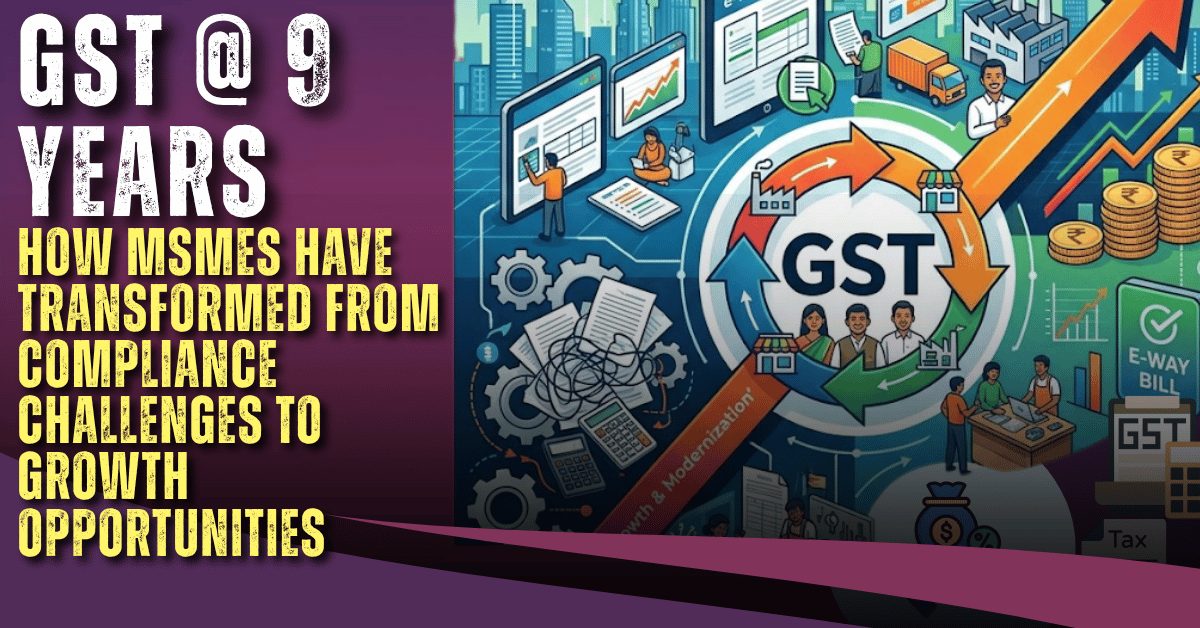
Nine Years of GST: Why MSMEs Are Now Stronger Than Ever
When the Goods and Services Tax (GST) was introduced on 1 July 2017, it marked one of India's biggest tax reforms. The primary objective was simple to replace multiple indirect taxes with a single, unified taxation system that would make doing business easier across the country.
For large corporations, the transition was relatively manageable. However, for Micro, Small and Medium Enterprises (MSMEs), the initial years were filled with uncertainty. Business owners had to adapt to new return filing systems, digital invoicing, online tax payments, reconciliations, e-Way Bills, and changing compliance requirements.
Today, as GST completes nine years, the picture has changed significantly. MSMEs have become more digitally enabled, financially disciplined, and better integrated into India's formal economy. While compliance challenges still exist, businesses have largely adapted to the GST ecosystem and are now leveraging it for growth rather than merely treating it as a tax obligation.
What Are MSMEs?
MSMEs (Micro, Small and Medium Enterprises) form the backbone of the Indian economy. They include manufacturers, traders, service providers, startups, retailers, wholesalers, transport businesses, and numerous local enterprises.
MSMEs contribute significantly by:
- Generating employment opportunities across India.
- Supporting large industries through supply chains.
- Promoting exports and manufacturing.
- Encouraging entrepreneurship.
- Driving regional and rural economic development.
- Contributing substantially to India's GDP.
Because of their scale, MSMEs often operate with limited financial and human resources, making regulatory compliance especially important.
The Initial Challenges After GST Implementation
The introduction of GST brought several operational changes that many small businesses were not prepared for.
1. Shift from Manual to Digital Compliance
Earlier, many businesses relied on paper-based accounting and manual tax filing.
After GST:
- Returns had to be filed online.
- Invoices needed to follow prescribed formats.
- Tax payments became digital.
- Monthly compliance became mandatory.
For many MSMEs, this required investing in accounting software and learning entirely new processes.
2. Increased Return Filing Requirements
Unlike the previous tax regime, GST introduced frequent return filing.
Businesses had to:
- Upload invoices regularly.
- File monthly or quarterly GST returns.
- Reconcile purchase and sales data.
- Monitor Input Tax Credit (ITC).
Missing deadlines often resulted in penalties and blocked tax credits.
3. Frequent Rule Changes
During the early years of GST, businesses experienced continuous updates relating to:
- Return filing procedures.
- E-Way Bill requirements.
- Invoice formats.
- Reverse Charge Mechanism (RCM).
- Input Tax Credit rules.
- GST portal improvements.
Keeping track of these changes became a major challenge for small businesses.
4. Cash Flow Pressure
GST required businesses to pay tax before receiving payments from customers in many situations.
This created working capital pressure, particularly for:
- Manufacturers
- Traders
- Exporters
- Service providers
Many MSMEs struggled to manage liquidity during the transition period.
How MSMEs Have Adapted Over the Last Nine Years
Despite initial difficulties, MSMEs gradually embraced the new tax system.
1. Increased Digital Adoption
One of GST's biggest achievements has been encouraging digital transformation.
Today, most MSMEs use:
- GST accounting software
- Digital invoicing
- Online banking
- Cloud accounting
- Automated GST reconciliation
- Digital record management
Digital adoption has significantly reduced manual errors.
2. Better Financial Discipline
GST requires businesses to maintain accurate financial records.
As a result, many MSMEs now regularly:
- Record every transaction.
- Maintain proper purchase registers.
- Track sales systematically.
- Monitor tax liabilities.
- Reconcile accounts monthly.
This has improved financial transparency.
3. Easier Access to Business Loans
Formal accounting records generated under GST have made it easier for MSMEs to obtain:
- Bank loans
- Working capital finance
- Business expansion funding
- Government-backed MSME schemes
Lenders now have greater confidence in businesses with transparent GST and financial records.
4. Improved Supply Chain Integration
Large companies increasingly prefer suppliers who maintain proper GST compliance.
GST-compliant MSMEs benefit from:
- Better business opportunities.
- Faster vendor approvals.
- Stronger credibility.
- Long-term contracts with larger organizations.
Compliance has become a competitive advantage.
Benefits MSMEs Are Experiencing Today
Improved Transparency
Businesses now maintain organised accounting records, making audits and financial reviews much easier.
Better Tax Credit Utilisation
With proper invoice matching and reconciliation, eligible businesses can claim Input Tax Credit efficiently, reducing overall tax costs.
Faster Business Expansion
GST has enabled businesses to sell products and services across multiple states under a unified tax structure, eliminating the need to deal with numerous state-level taxes.
Stronger Business Credibility
A GST-compliant business is often viewed as more reliable by customers, vendors, financial institutions, and investors.
Better Decision-Making Through Accounting
Because GST requires accurate financial reporting, business owners now have better visibility into:
- Revenue
- Expenses
- Profitability
- Cash flow
- Tax liabilities
This enables smarter business decisions.
Challenges That Still Remain
Although significant progress has been made, certain challenges continue.
Complex Compliance
Businesses still need to manage:
- Multiple GST returns.
- Invoice matching.
- Reconciliation.
- E-Way Bills.
- E-Invoicing (where applicable).
Frequent Regulatory Updates
GST rules continue to evolve.
Businesses must regularly stay informed about:
- New notifications.
- Circulars.
- Compliance deadlines.
- System upgrades.
Working Capital Management
Delayed customer payments continue to affect cash flow, especially when GST must be paid before collections are received.
Need for Professional Guidance
Many MSMEs still rely on tax consultants and accounting professionals for:
- GST filing
- Annual returns
- Notices
- Assessments
- Litigation support
- Financial planning
Professional expertise remains essential for ensuring accurate compliance.
The Role of Technology in Modern GST Compliance
Technology has become one of the biggest reasons behind improved GST compliance.
Modern businesses now use:
- Cloud accounting software
- AI-powered bookkeeping
- Automated GST reconciliation
- Digital document management
- Real-time financial reporting
- Compliance dashboards
Automation has reduced errors while saving considerable time and effort.
What MSMEs Should Focus on Going Forward
To remain competitive, MSMEs should prioritize:
Maintain Accurate Books of Accounts
Updated financial records simplify GST filing and improve decision-making.
File Returns on Time
Timely compliance helps avoid penalties and preserves Input Tax Credit eligibility.
Reconcile GST Data Regularly
Monthly reconciliation minimizes errors and prevents future notices.
Embrace Digital Accounting
Investing in accounting technology improves operational efficiency and financial control.
Seek Professional Advice
Working with experienced accounting and GST professionals helps businesses remain compliant while focusing on growth.
How WiseBooks Helps MSMEs Stay GST Compliant
Managing GST compliance can be time-consuming, especially for growing businesses. WiseBooks simplifies the process by offering end-to-end financial and compliance support.
Our services include:
- GST Registration
- GST Return Filing
- Input Tax Credit Reconciliation
- Professional Bookkeeping
- Accounting Services
- Income Tax Filing
- Audit Support
- Financial Reporting
- Business Compliance Management
- Litigation Assistance
With the right systems and expert guidance, businesses can spend less time worrying about compliance and more time focusing on growth.
Conclusion
Nine years after its implementation, GST has become more than just a tax reform—it has transformed the way MSMEs operate. Businesses that once viewed GST as a compliance burden are now leveraging it to improve transparency, strengthen financial discipline, access formal credit, and expand into new markets.
While compliance continues to evolve, the future belongs to MSMEs that embrace digital accounting, maintain accurate financial records, and stay updated with changing regulations. With expert support and the right technology, GST can be a powerful enabler of sustainable business growth rather than just another statutory obligation.
At WiseBooks, we believe that smart accounting and proactive GST compliance are not just about meeting deadlines, they are about building stronger, more resilient businesses for the future.


Comments
No comments yet. Be the first to comment!