


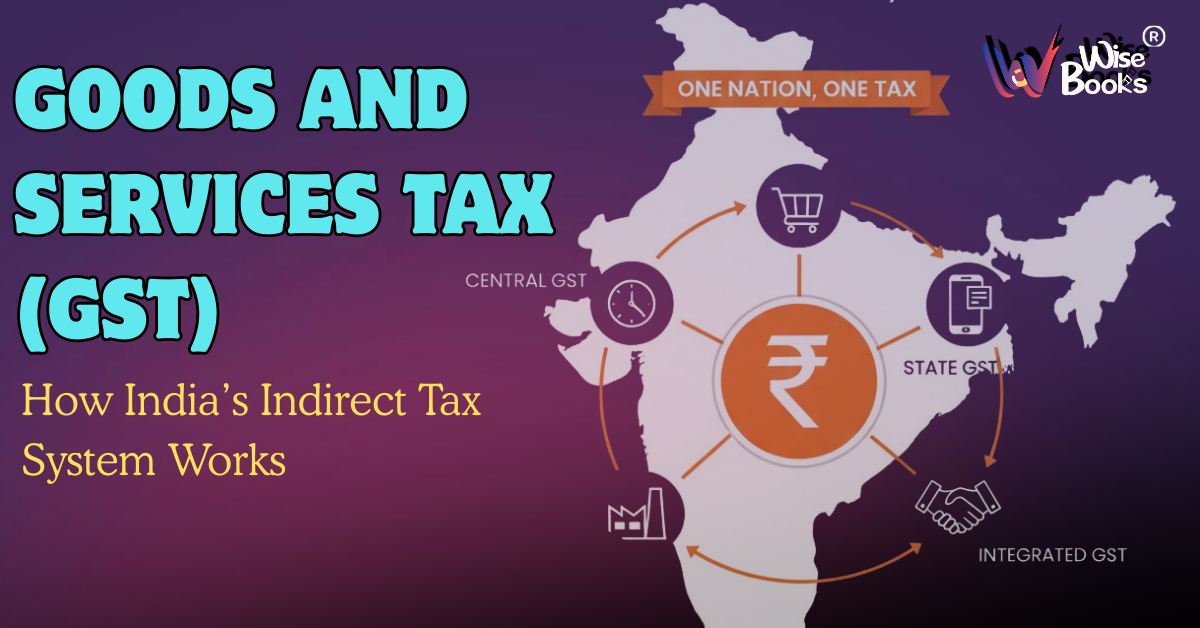
GST stands for Goods and Services Tax. It is an indirect tax that has replaced multiple indirect taxes previously levied in India, such as Excise Duty, Value Added Tax (VAT), Service Tax, and others. The Goods and Services Tax Act was passed by Parliament on 29 March 2017 and came into force on 1 July 2017.
In simple terms, GST is a tax levied on the supply of goods and services. The GST law in India is designed as a comprehensive, multi-stage, and destination-based tax system, which is imposed on every stage of value addition. At each step in the supply chain, tax is collected only on the value added, ensuring transparency and efficiency.
By subsuming most existing indirect taxes into a single unified framework, GST has created a common indirect tax law applicable across the country. This has simplified tax compliance, reduced cascading effects of taxation, and streamlined the overall tax structure in India.
Before the implementation of GST, indirect taxes on goods were levied through a fragmented structure, with different taxes imposed at various stages by both the Central and State Governments.
Under the GST regime, tax is levied at every point of sale. For intra-state transactions, both Central GST (CGST) and State GST (SGST) are applicable. For inter-state transactions, tax is levied in the form of Integrated GST (IGST).
Now, let us examine the definition and key components of the Goods and Services Tax in greater detail
Multi-Stage Supply Chain under GST
A product under the GST regime would pass through a number of stages, with a change in ownership, before reaching the final consumer. At every step in the supply chain, tax is payable on the value addition: starting from production and progressing to consumption.
The steps described in general involve:
1. Procuring of Raw Materials
2. Production or Manufacturing Process
3. Finished Goods Storage and Warehousing
4. Sale to Wholesalers
5. Sale by Wholesalers to Retailers
6. Sale to the Ultimate Consumer
GST is levied at each stage, only on the value added during that stage, with the set-off for the tax paid in the previous stages, which gives full transparency to the consumer about taxes being paid and avoids cascading of taxes.
STAGES IN PRODUCT LIFECYCLE
The movement of goods under GST involves multiple stages, with tax levied at each point of supply. The process flows as follows:
1. Buying Raw Materials
The supply chain begins with the purchase of raw materials by the manufacturer.
2. Manufacturing Process
The raw materials are then used to manufacture finished goods, adding value at this stage.
3. Sale to Wholesaler / Warehousing
The manufactured goods are sold to wholesalers or moved to warehouses for storage and further distribution.
4. Sale to Retailer
Wholesalers sell the goods to retailers, who prepare them for final sale to customers.
5. Final Sale to Consumer
The product is ultimately sold by the retailer to the end consumer, completing the supply chain.
At each of these stages, GST is levied only on the value added, ensuring transparency and avoiding multiple taxation on the same value.
Value Addition under GST – Step-by-Step Explanation
Step 1: Raw Materials (Flour & Sugar)
The process begins with basic raw materials such as flour and sugar. At this stage, these inputs have a basic value and GST is applicable when they are supplied.
Step 2: Manufacturing (Biscuits)
The raw materials are processed to manufacture biscuits. This transformation adds value through manufacturing activities such as processing, labor, and overhead costs. GST is levied only on the value added at this stage.
Step 3: Branding and Labelling (Label)
The manufactured biscuits are then branded and labelled, which increases their market value. The addition of packaging and branding creates further value, and GST is charged on this incremental value.
Step 4: Final Product (Branded Biscuit)
After branding and packaging, the product becomes a branded biscuit, ready for sale in the market. This final form carries the highest value, and GST is levied on the value added during the branding stage.
At every stage, GST is imposed only on the value added, and businesses can claim Input Tax Credit (ITC) for the tax paid on previous stages, preventing double taxation.
Destination-Based Nature of GST
GST is a destination-based tax; it means taxes are levied only at the place of consumption and not at the place of origin. In other words, if goods are manufactured in Maharashtra and sold to a final consumer in Karnataka, the entire GST revenue is collected by Karnataka, as the goods are consumed there and not by Maharashtra where they were produced.
The Journey of GST in India
The origin of GST in India began in the year 2000 when a committee was formed to design a comprehensive indirect tax framework. It was over the next 17 years that the law was extensively discussed, refined, and policies developed.
In 2017, both the Lok Sabha and the Rajya Sabha successfully passed the GST Bill. Then, the Goods and Services Tax law came into effect on 1 July 2017, which is considered to be the biggest indirect tax reform in India.
| Years | Key milestones |
|---|---|
| 2000 | PM Vajpayee set up a committee to draft GST law |
| 2006 | The then finance minister proposes GST introduction from April 1 2010 |
| 2008 | EC finalises dual GST to have separate levy, legislation |
| 2014 | GST bill reintroduced in parliament by Finance Minister |
| 2016 | GSTIN goes live |
| 2017 | Four supplementary GST bills were passed in both houses |
| 1st July 2017 | GST was launched |
Objectives of GST in India
1. Building a “One Nation, One Tax” System
A primary objective of GST is to create a uniform indirect tax framework across the country. By replacing multiple central and state-level taxes with a single tax system, GST ensures consistency in tax rates on goods and services nationwide. Centralised rate-setting, along with standard compliance tools such as e-way bills and e-invoicing, has simplified tax administration. Reduced filings, common procedures, and improved compliance together contribute to a truly unified indirect tax system for businesses.
2. Consolidating Multiple Consumption Taxes into One Regime
Before GST, India followed a fragmented indirect tax structure consisting of levies like Service Tax, VAT, and Central Excise, administered separately by the Centre and States. This lack of coordination between goods and services taxation increased complexity. GST was introduced to combine all major indirect taxes into a single system, reducing overlap, easing compliance for taxpayers, and streamlining tax administration for authorities.
3. Eliminating the Cascading Effect of Taxes
The earlier tax regime suffered from double taxation, where input tax credits could not be fully adjusted across different tax laws. For example, excise duty paid during manufacturing could not be set off against VAT on sales. GST resolves this issue by taxing only the value added at each stage of the supply chain. The seamless flow of Input Tax Credit (ITC) across goods and services has significantly reduced the cascading tax burden.
4. Curbing Tax Evasion and Fraud
GST operates on a technology-enabled compliance model that restricts opportunities for tax evasion. Input tax credit is permitted only when suppliers upload valid invoices on the GST portal, minimizing the scope for fake billing. The implementation of e-invoicing, supported by centralised monitoring and data analytics, has strengthened enforcement and enabled quicker action against defaulters, leading to a substantial reduction in revenue leakages.
5. Expanding the Taxpayer Base
GST has contributed significantly to broadening India’s taxpayer base. Under the earlier regime, varying registration thresholds allowed many businesses to remain outside the tax system. Since GST applies uniformly to both goods and services, a larger number of businesses have been brought under registration. Additionally, strict ITC rules have encouraged formalisation in previously unorganised sectors such as construction and real estate.
6. Simplifying Compliance through Digital Processes
Earlier, taxpayers had to interact with multiple tax departments, with many procedures conducted offline. GST introduced end-to-end digital compliance, covering registration, return filing, refunds, and e-way bill generation. This shift to a fully online ecosystem has greatly enhanced the ease of doing business. The government is also working towards integrating all indirect tax compliances on a single centralised platform.
7. Improving Logistics and Supply Chain Efficiency
With a unified tax structure, GST has reduced the need for multiple documents during the movement of goods. The removal of interstate checkpoints and the adoption of the e-way bill system have shortened transit times and improved delivery efficiency. These changes have promoted warehouse consolidation, reduced transportation delays, and lowered logistics and warehousing costs across sectors.
8. Promoting Competitive Pricing and Higher Consumption
GST has helped achieve more transparent and competitive pricing by removing hidden taxes embedded in product costs under the previous regime. Earlier, varying VAT rates across states and cascading taxes led to inflated prices. Uniform GST rates have balanced pricing across regions and improved the global competitiveness of Indian products. This has boosted consumption, strengthened demand, and ultimately increased indirect tax revenues.
Advantages of GST
GST will indeed minimize the overall tax burden by removing the earlier system of tax-on-tax, thereby directly lowering the cost of goods and services. Prices become more transparent and uniform across states.
It is a digital-intensive tax administration wherein registration, submission of returns, claims of refund, and response to notices are all executed online, thereby making compliance faster and easier.
Major Benefits of GST:
1. Prevents multiple taxations on one value.
2. Higher registration limit for turnover
3. Simplified composition scheme for small taxpayers
4. Fully digitized and user-friendly process of compliance.
5. Fewer formalities
6. Clearly defined structure of taxation in e-commerce
7. Better movement of goods and improved logistics
8. Encourages formalization of unorganized businesses
Components of GST
1. CGST (Central Goods and Services Tax)
CGST is collected by the Central Government on intra-state supplies (when the sale happens within the same state).
Example:
Sale within Maharashtra → CGST + SGST
2. SGST (State Goods and Services Tax)
SGST is collected by the State Government on intra-state supplies along with CGST.
Example:
Sale within Karnataka → CGST + SGST
3. IGST (Integrated Goods and Services Tax)
IGST is collected by the Central Government on inter-state supplies and imports. The IGST amount is later shared between the Centre and the destination State.
Example:
Goods sold from Gujarat to Tamil Nadu → IGST
(Additional Component)
4. UTGST (Union Territory Goods and Services Tax)
UTGST is applicable in Union Territories without a legislature (e.g., Chandigarh, Andaman & Nicobar Islands) and is charged along with CGST.
Simple Summary Table
|
Type of GST |
Applicable When |
Collected By |
|
CGST |
Intra-state supply |
Central Govt |
|
SGST |
Intra-state supply |
State Govt |
|
IGST |
Inter-state supply / Imports |
Central Govt |
|
UTGST |
Intra-UT supply |
UT Govt |
Illustration of GST Application
Inter-State Supply (IGST):
Assume a dealer in Gujarat sells goods worth ₹50,000 to a dealer in Punjab. The applicable GST rate is 18%, which is charged entirely as IGST.
· IGST @ 18% on ₹50,000 = ₹9,000
· The full tax amount of ₹9,000 is paid to the Central Government.
Intra-State Supply (CGST + SGST):
Now assume the same dealer sells goods worth ₹50,000 to a consumer within Gujarat. The applicable GST rate is 12%, split equally between CGST (6%) and SGST (6%).
· Total GST @ 12% on ₹50,000 = ₹6,000
· CGST @ 6% = ₹3,000 (paid to the Central Government)
· SGST @ 6% = ₹3,000 (paid to the Gujarat Government)
Since the sale takes place within the state, the tax revenue is shared between the Centre and the State.
GST Rates in India
GST rates represent the percentage of tax levied on the supply of goods or services under the CGST, SGST, and IGST laws. Every GST-registered business is required to issue invoices showing the applicable GST charged on the value of supply.
For intra-state transactions, the GST rate is divided equally between CGST and SGST. In the case of inter-state transactions, IGST is charged, which is generally equal to the combined CGST and SGST rates.
Tax Laws Before GST in India
Before the introduction of the Goods and Services Tax (GST) in India on 1st July 2017, the Indian indirect taxation system was fragmented, complex, and multi-layered. Multiple central and state taxes applied to goods and services, leading to cascading taxes (tax on tax), compliance difficulties, and higher costs for businesses and consumers.
1. Central Taxes
Before GST, the Central Government levied several indirect taxes under different laws, such as:
· Central Excise Duty: Charged on the manufacture of goods in India.
· Service Tax: Levied on certain services provided, such as telecom, banking, and insurance.
· Customs Duty: Imposed on imports and exports of goods.
· CVD and SAD (Countervailing and Special Additional Duties): Taxes applied to imported goods to counterbalance excise duties on similar domestic goods.
2. State Taxes
Each state had its own tax regime, which often differed across states:
· VAT (Value Added Tax): Levied on the sale of goods within the state, replacing the earlier Sales Tax system.
· Central Sales Tax (CST): Collected by the origin state on inter-state sales of goods.
· Entry Tax / Octroi: Taxes on goods entering a city or state, adding to compliance burden.
· Luxury Tax: Charged on luxury goods and services in certain states.
· Entertainment Tax: Levied on cinema tickets and entertainment services.
3. Problems with the Pre-GST Tax System
· Cascading Effect: Taxes were levied on top of taxes, increasing the final cost of goods and services.
· Multiple Compliance Requirements: Businesses needed to file separate returns for each tax and maintain different records for each state.
· Inter-state Trade Complications: Inter-state movement of goods involved CST and multiple documentation, slowing down trade.
· Tax Rate Complexity: Different taxes had different rates across states and products, making pricing and accounting cumbersome.
· Revenue Loss: Due to inefficient tracking and complex compliance, tax evasion was widespread.
4. Need for GST
The fragmented system created confusion for businesses and consumers, slowed economic growth, and reduced competitiveness. The GST was introduced to create a unified tax system, eliminate the cascading effect, and simplify compliance by subsuming most central and state taxes into a single tax regime.
How GST Has Helped in Reducing Prices in India
The Goods and Services Tax (GST), implemented on 1st July 2017, replaced multiple indirect taxes levied by the central and state governments. One of its major advantages has been the reduction in the overall cost of goods and services, benefiting consumers. Here’s how:
1. Elimination of the Cascading Effect
Before GST, the pre-GST system charged tax on tax. For example:
· If a manufacturer paid excise duty on production, and the product was sold to a retailer, VAT would be charged on the already taxed price.
· This “tax on tax” inflated the final price.
Under GST:
· It is a single, value-added tax system.
· Input tax credit (ITC) allows businesses to deduct taxes already paid on inputs from the tax payable on output.
· Result: The final consumer price is lower because unnecessary tax layering is eliminated.
2. Reduction in Logistics and Transportation Costs
Before GST:
· Inter-state transport involved multiple taxes, such as CST, entry tax, and octroi, which increased logistics costs.
· Delays at state borders also added to operational costs.
After GST:
· The tax system is uniform across India, removing border checkpoints for tax purposes.
· Easier movement of goods reduces transportation time and cost, which contributes to lower product prices.
3. Simplified Tax Structure
· Pre-GST, different states and central laws had different rates for various products, making compliance costly for businesses.
· GST simplified rates into 5%, 12%, 18%, slabs, making pricing transparent and reducing hidden costs.
4. Encouraging Formalization of Businesses
· GST incentivizes businesses to register officially and maintain proper records to claim input tax credit.
· This reduces tax evasion, ensures fair competition, and gradually decreases prices by reducing unaccounted expenses in the supply chain.
5. Examples of Price Reduction
· Essential goods like food items, electronics, and household products saw price reductions in many cases.
· Services like travel, telecom, and hospitality became slightly cheaper because service tax and state VAT were subsumed into GST.
Key New Compliance Requirements Under GST
The Goods and Services Tax (GST) regime in India is continuously evolving, and businesses are required to adhere to various new compliance requirements to ensure proper tax reporting and avoid penalties. Some of the significant recent compliances include:
1. Mandatory E-Invoicing:
Businesses exceeding a certain turnover threshold must generate e-invoices for B2B transactions. This system ensures real-time reporting to the GST portal and reduces errors in tax credit claims.
2. New GSTR Return Formats (Form GSTR-1, GSTR-3B, GSTR-9C Updates):
The GST Council has introduced simplified and updated return formats to improve reporting accuracy. Businesses must file monthly, quarterly, or annual returns as per their category.
3. QRMP Scheme (Quarterly Return Filing & Monthly Payment):
Small and medium taxpayers can opt for quarterly return filing while paying taxes monthly through the QRMP scheme, simplifying compliance for smaller businesses.
4. TDS and TCS under GST:
Certain entities, like government departments or e-commerce platforms, are now required to deduct TDS (Tax Deducted at Source) or collect TCS (Tax Collected at Source) under GST rules. Timely reporting and payment of these amounts are mandatory.
5. E-Way Bill Compliance:
For the movement of goods above a certain value, businesses must generate e-way bills electronically. Recent updates include new thresholds, validity rules, and improved portal functionalities.
6. New Audit and Reconciliation Requirements:
Businesses exceeding specified turnover limits must now undergo GST audits under GSTR-9C and maintain detailed reconciliation of input tax credit, outward supplies, and returns to ensure compliance.
7. Faceless Assessment & Scrutiny:
The GST authorities have introduced faceless assessment and scrutiny processes, requiring taxpayers to respond digitally to notices and audits. This reduces physical interface and increases transparency.


Comments
No comments yet. Be the first to comment!