


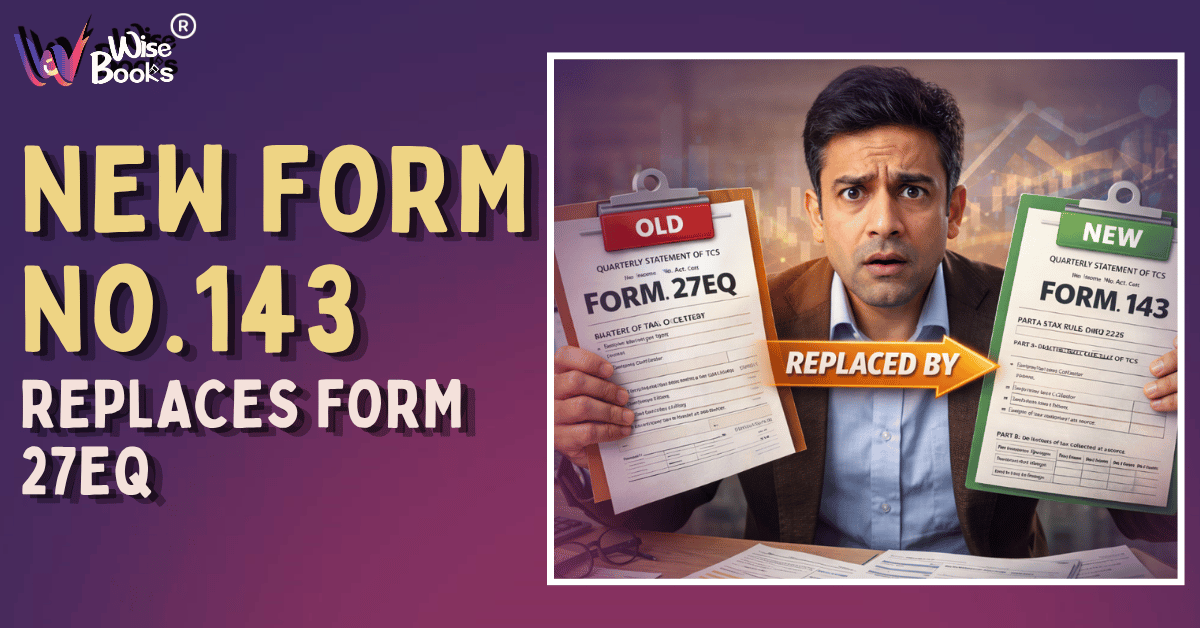
India’s tax compliance landscape is continuously evolving with a strong focus on digitization, transparency, and automation. One of the latest updates under the Income-tax Act, 2025 is the replacement of the long-used Form 27EQ with a new reporting format — Form 143.
This change is not just a procedural update but reflects a structural shift in how Tax Collected at Source (TCS) is reported and monitored by the government.
What is Form 143?
Form 143 is the new quarterly statement of TCS that must be filed by every person responsible for collecting tax at source (collector).
Earlier, businesses used Form 27EQ to report TCS collected on specified transactions such as sale of goods, scrap, foreign remittances, etc. With the introduction of Form 143, the government has modernized the reporting framework to make it more efficient, structured, and technology-driven.
In simple terms, Form 143 performs the same core function as Form 27EQ, but with enhanced reporting capabilities, improved validation systems, and better integration with digital tax infrastructure.
Applicability & Effective Date
The new Form 143 is applicable from 1st April 2026, making it relevant for Financial Year 2026–27 onwards.
This means:
- The first return in Form 143 will be for the quarter April–June 2026
- The last usage of Form 27EQ will be for Jan–March 2026 (Q4 of FY 2025-26)
This transition ensures that businesses get a clear cut-off point to shift from the old system to the new one without confusion.
Who is Required to File Form 143?
Form 143 must be filed by all TCS collectors, i.e., any person or entity responsible for collecting tax at source under the Income-tax provisions.
This includes:
- Businesses engaged in sale of specified goods
- Dealers in scrap, minerals, liquor, or forest produce
- Tour operators and foreign remittance agents
- E-commerce operators and high-value transaction handlers
The requirement applies irrespective of business size, meaning both small businesses and large enterprises must comply if they fall under TCS provisions.
Why Was Form 27EQ Replaced?
The replacement of Form 27EQ with Form 143 is part of a broader initiative by the government to streamline tax compliance and reduce inefficiencies.
Earlier, taxpayers often faced issues like:
- Data mismatches between returns
- Manual entry errors
- Delays in processing
- Limited integration with other tax systems
Form 143 aims to eliminate these issues by introducing a standardized, automated, and digitally aligned reporting system, ensuring that TCS data flows seamlessly across platforms.
Key Features of Form 143
1. Smart & Digital Filing System
Form 143 is designed to work within a technology-driven ecosystem. It supports features like auto-population of data, system-based validation, and integration with accounting and ERP software.
This reduces the dependency on manual inputs and ensures that errors are detected instantly, minimizing the chances of incorrect filings.
2. Simplified Structure
The form is divided into clearly defined sections such as:
- Collector details
- TCS payment details
- Collectee-wise transaction records
This structured approach makes it easier for taxpayers to understand, fill, and verify the return, even when dealing with large volumes of data.
3. Enhanced Reporting & Transparency
Form 143 introduces a more detailed reporting format that captures transaction-level data more effectively.
This helps the tax department in:
- Better tracking of high-value transactions
- Cross-verification with PAN and financial records
- Identifying discrepancies at an early stage
As a result, businesses can expect greater scrutiny but also more clarity in compliance.
Due Dates for Filing Form 143
The due dates for filing Form 143 remain aligned with the earlier TCS return timelines:
- Q1 (Apr–Jun) → 31 July
- Q2 (Jul–Sep) → 31 October
- Q3 (Oct–Dec) → 31 January
- Q4 (Jan–Mar) → 31 May
Timely filing is crucial because delays can lead to interest, penalties, and compliance notices.
Impact on Businesses
The introduction of Form 143 will have both operational and compliance-related impacts on businesses.
Firstly, companies will need to update their accounting systems and software to align with the new format. This may require coordination with software providers or internal IT teams.
Secondly, there will be a higher expectation of accuracy, as the system is designed to automatically detect mismatches and inconsistencies.
Lastly, businesses may experience increased scrutiny from tax authorities, especially in cases where reported data does not align with other filings like GST or income tax returns.
Transition Guidelines
During the transition phase, it is important for businesses to understand that:
- Form 27EQ is no longer valid for FY 2026-27 onwards
- Any attempt to file old forms for new periods may result in rejection of returns
- Proper system upgrades and staff training are essential to ensure smooth compliance
A proactive approach during this phase can help businesses avoid last-minute issues and penalties.
Expert Insight
The introduction of Form 143 is a clear indication that India is moving towards a data-driven tax administration system.
With increasing use of automation and analytics, tax authorities can now track, verify, and analyze transactions in real time. This makes compliance more transparent but also more demanding.
For businesses, this means shifting from a reactive compliance approach to a proactive and accuracy-focused strategy.
Conclusion
The replacement of Form 27EQ with Form 143 is a significant compliance update that every TCS-eligible business must be aware of.
i. The update is official and applicable from April 2026
ii. Form 143 introduces better structure, automation, and transparency
iii. Businesses must upgrade systems and ensure accurate reporting
In today’s compliance environment, staying updated is not enough — implementation is key.


Comments
Great breakdown of the transition to Form 143! Since the article mentions that businesses need to update their ERP and accounting software to align with the new digital infrastructure, I’ve been looking into how different platforms handle these automated TCS validations. I came across some documentation on guiadebetnacionalbrasil.com but I'm having trouble verifying if their integration modules are fully compliant with the 2026 guidelines for scrap and high-value transactions. Does anyone here have experience with their tools, or should we stick to the more mainstream Indian accounting software for this specific transition?
QUQcPC
QUQcPC
QUQcPC
QUQcPC