

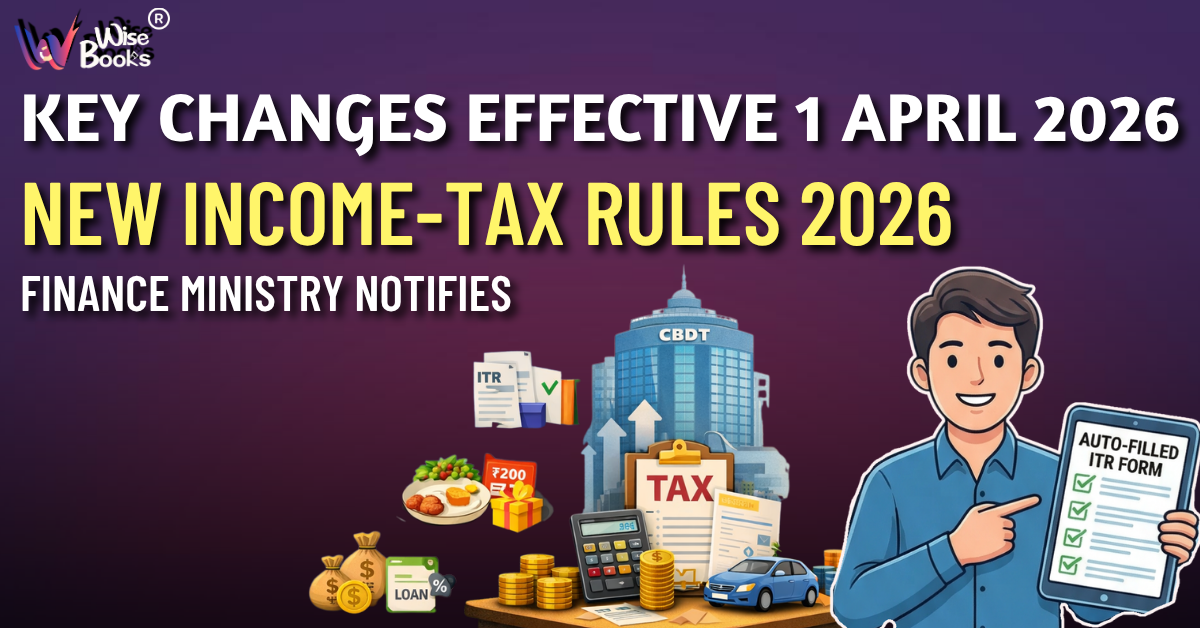
The Government of India has taken a major step toward tax reform with the notification of the Finance Ministry of India Income-Tax Rules, 2026 on 20 March via the e-Gazette.
These rules follow the draft released earlier this year by the Central Board of Direct Taxes (CBDT), which had invited stakeholder feedback. The updated rules will enable the implementation of the Income-Tax Act, 2025, replacing the decades-old framework from 1961, effective 1 April 2026.
Structural Changes in Tax Framework
One of the most significant highlights of the new rules is simplification. The government has reduced the total number of tax rules from 399 to 190, making compliance more streamlined.
Similarly, tax forms have been brought down from 511 to 333, reducing complexity for taxpayers and professionals.
Additionally, all forms will now follow a standardised format, making them easier to understand and use. Features like auto-filled data will further simplify return filing and reduce manual errors.
Updated ITR Deadlines
The government has provided relief to certain taxpayers by extending deadlines:
- ITR-3 and ITR-4 (non-audit cases) due date extended to 31 August
- ITR-1 and ITR-2 due date remains 31 July
- Tax audit deadline continues to be 31 October
Importantly, there is no change in income tax slabs for FY 2026–27.
Key Changes Impacting Taxpayers
Meal Benefits
Under the old tax regime, employer-provided meals (including non-alcoholic beverages) up to ₹200 per meal will now be tax-exempt. This is a substantial increase from the earlier ₹50 limit.
Gift Cards & Coupons
Employees can receive gift vouchers, coupons, or certificates up to ₹15,000 annually without attracting tax, provided they opt for the old tax regime.
Concessional Corporate Loans
Loans given by employers at zero or reduced interest rates will now be taxed based on the difference between the market rate (SBI lending rate) and the actual rate charged.
However, exemptions apply for:
- Loans up to ₹2 lakh
- Loans taken for medical emergencies
Company-Provided Vehicles
For vehicles used for both official and personal purposes:
- ₹8,000/month taxable value for cars up to 1.6L engine
- ₹10,000/month for higher engine capacity
This rule applies under both old and new tax regimes.
HRA (House Rent Allowance) Expansion
The list of metro cities eligible for 50% HRA exemption has been expanded.
New additions include:
i. Ahmedabad
ii. Bengaluru
iii. Hyderabad
iv. Pune
These join existing metro cities like Delhi, Mumbai, Chennai, and Kolkata.
Children’s Education Allowances
There has been a major increase in education-related exemptions under the old tax regime:
- Education allowance increased from ₹100/month to ₹3,000/month per child
- Hostel allowance increased from ₹300/month to ₹9,000/month per child
This provides meaningful tax relief for families.
Transport Sector Allowance
For employees in the transport sector, the exemption limit has been increased to ₹25,000 per month or 70% of the allowance (whichever is lower), up from ₹10,000 earlier.
Capital Market & Investment Changes
Securities Transaction Tax (STT)
STT has been increased for derivatives trading:
- Futures: 0.02% → 0.05%
- Options: 0.1% → 0.15%
This change is expected to impact active traders, especially in F&O segments.
Share Buyback Taxation
From 1 April 2026, income received from share buybacks will now be treated as capital gains.
Additionally:
- Corporate promoters → Effective tax rate ~22%
- Non-corporate promoters → Effective tax rate ~30%
Changes in TCS (Tax Collected at Source)
The government has rationalised TCS rates to simplify compliance and reduce refund issues:
- Alcoholic beverages → Increased from 1% to 2%
- Overseas tour packages (LRS) → Flat 2% rate (earlier 5%–20%)
- Education & medical remittances → Reduced from 5% to 2%
These changes aim to reduce confusion and improve cash flow for taxpayers.
Conclusion
The newly notified Income-Tax Rules, 2026 mark a major shift toward simplification, transparency, and taxpayer convenience.
With fewer rules, simplified forms, and enhanced exemptions, the government is clearly focusing on making compliance easier while maintaining stronger monitoring through digital systems.
For taxpayers and businesses, this is the right time to review tax planning strategies and align with the updated framework before the new regime takes effect on 1 April 2026.
(FAQs)
Q1. What are the new Income-Tax Rules 2026?
The new rules notified by the Finance Ministry of India will implement the Income-Tax Act, 2025 from 1 April 2026. These rules simplify tax compliance by reducing the number of rules and forms, and introducing user-friendly filing systems.
Q2. When will these new rules come into effect?
The new Income-Tax Rules will be applicable from 1 April 2026, i.e., from the financial year 2026–27 onwards.
Q3. Has anything changed in income tax slabs?
No, there is no change in income tax slabs. The existing slab rates will continue for FY 2026–27.
Q4. What are the new ITR filing deadlines?
- ITR-1 & ITR-2 → 31 July
- ITR-3 & ITR-4 (non-audit) → 31 August
- Tax audit → 31 October
Q5. How are the new rules simplifying compliance?
The Central Board of Direct Taxes (CBDT) has reduced:
- Tax rules from 399 to 190
- Tax forms from 511 to 333
Also, forms will now have auto-fill features and simpler formats.
Q6. Is meal allowance now tax-free?
Yes, under the old tax regime:
- Meals up to ₹200 per meal provided by employer are tax-free
- Includes non-alcoholic beverages
Q7. Are gift cards from companies taxable?
Gift cards, coupons, or vouchers up to ₹15,000 per year are tax-free under the old tax regime.
Q8. How will employer-provided loans be taxed?
If an employer provides a loan at low or zero interest, the difference between the market rate (SBI rate) and actual rate will be taxed.
However, no tax applies if:
- Loan is below ₹2 lakh
- Loan is for medical emergency
Q9. What is the tax rule for company cars?
If you use a company car for both personal and official work:
- ₹8,000/month → for cars up to 1.6L engine
- ₹10,000/month → for larger cars
Q10. What changes in HRA exemption?
More cities now qualify as metro for 50% HRA benefit:
- Ahmedabad
- Bengaluru
- Hyderabad
- Pune
Q11. What is the new limit for children’s education allowance?
A. Under old tax regime:
- ₹3,000/month per child (earlier ₹100)
- Hostel allowance → ₹9,000/month per child (earlier ₹300)
Q12. What is the new transport allowance exemption?
A. Transport sector employees can now claim up to ₹25,000/month (or 70% of allowance, whichever is lower).
Q13. Has STT increased?
A. Yes, for derivatives trading:
- Futures → 0.05%
- Options → 0.15%
This may increase trading costs for F&O traders.
Q14. How is share buyback taxed now?
A. From 1 April 2026:
- Buyback income will be taxed as capital gains
- Promoters will pay higher tax (22%–30% depending on category)
Q15. What are the new TCS rates?
A. I. Alcohol → 2%
II. Foreign tour packages → 2% flat
III. Education/medical remittance → 2%
This simplifies earlier complex rates.
Q16. Will filing ITR become easier?
A. Yes, With fewer forms, auto-filled data, and simplified structure, ITR filing is expected to become faster and more user-friendly.
Q17. Should I change my tax planning strategy?
A. Yes, it’s advisable to review your tax planning, especially if you:
i. Use old tax regime benefits
ii. Receive employer perks
iii. Invest in stock markets


Comments
Bahigo Casino Schweiz bietet eine breite Auswahl an Spielautomaten, Tischspielen und Live-Casino-Optionen, wodurch fur jeden Spielertyp etwas dabei ist.
bahigo gutscheincode [url=http://bahigo-suisse.ch/]https://bahigo-suisse.ch/[/url]