
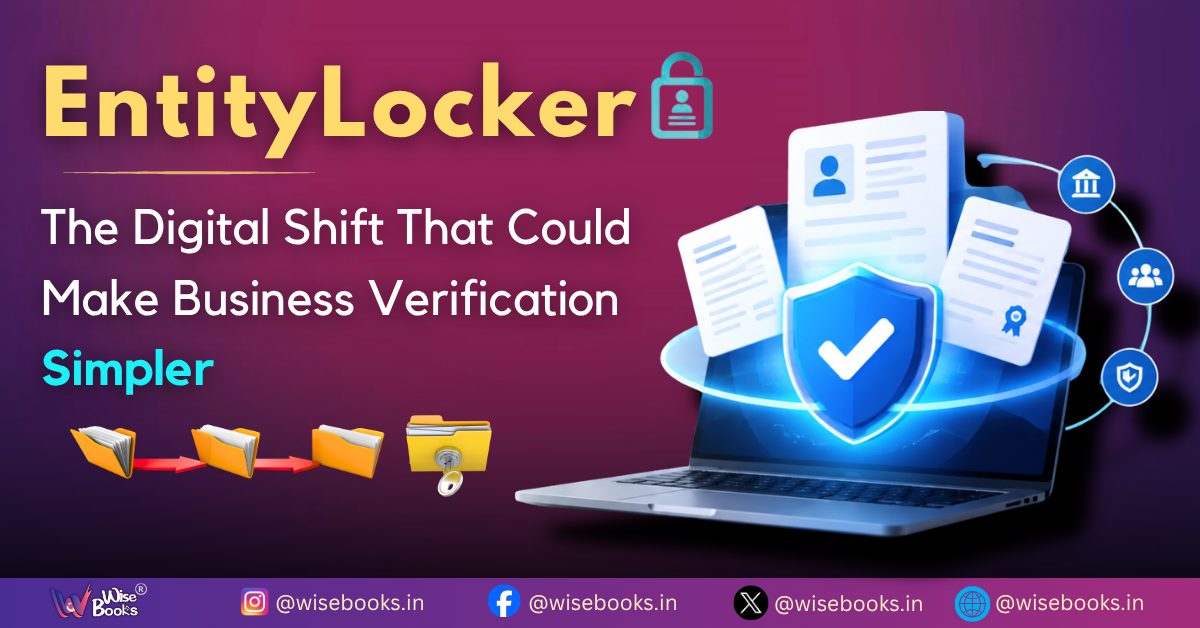
Too many documents. Repeated submissions. Multiple verification requests. For businesses, managing official records can often become as time-consuming as the compliance process itself. EntityLocker is designed to address this problem by bringing business documents, digital access and verification into a more connected ecosystem.
For years, businesses have followed a familiar process: download a certificate, save it in a folder, email it to a bank or vendor, submit it again to another authority and repeat the same exercise whenever verification is required.
India's digital compliance ecosystem is gradually moving in a different direction. Instead of simply storing documents digitally, the focus is increasingly shifting towards authenticated information, controlled sharing and easier verification.
This is where EntityLocker enters the picture.
What Is EntityLocker?
EntityLocker is a digital platform designed for organisations to access, store, manage, share and verify business-related documents.
Developed by the National e-Governance Division (NeGD) under the Ministry of Electronics & Information Technology (MeitY), EntityLocker extends the broader DigiLocker ecosystem to organisations.
Unlike a conventional cloud-storage platform, EntityLocker is designed around a broader question:
“How can an organisation access, manage and share its official information in a way that supports digital verification?”
The platform can connect organisations with authenticated digital records available through participating government and institutional systems. It also provides an Enterprise Vault for managing additional business documents.
Who Can Use EntityLocker?
EntityLocker is designed for organisations and registered entities rather than individuals using it as a personal document locker.
Depending on eligibility and available integrations, it can be relevant to:
1. Companies
2. MSMEs
3. Startups
4. Government organisations
5. Non-profit organisations
6. Trusts and societies
7. Other registered entities
An authorised representative can operate an organisation's EntityLocker account, while personal DigiLocker accounts can be linked with an organisation's account where applicable.
How Does EntityLocker Work?
The process begins with establishing the identity of the organisation and its authorised representative.
For companies, verification can use information such as CIN, PAN and DIN-related data available through MCA systems, while MSME-related verification can be connected with information available through the Udyam registration ecosystem.
Once authentication is completed, relevant digital documents can be accessed and managed through the platform, subject to the applicable integrations.
The objective is not simply to upload PDFs, but to create a structured environment where an organisation's digital identity and official records can be accessed and shared when required.
What Documents Can Businesses Access?
The documents available can depend on the organisation and the systems integrated with the platform.
These may include:
1. Registration certificates
2. Tax-related documents
3. GST-related records
4. Insurance documents
5. Bank-related documents
6. Provident Fund-related records
7. Other documents issued through integrated government or institutional systems
EntityLocker also includes an Enterprise Vault, where organisations can manage additional business documents such as audit reports, board resolutions and meeting minutes.
The Bigger Difference: Digital Verification
This is where EntityLocker becomes more relevant than simply maintaining files in an online folder.
Consider a business applying for a loan. It may need to provide registration documents, tax records, financial information and other supporting documents. Traditionally, these documents may have to be collected, downloaded, renamed, emailed and submitted repeatedly.
EntityLocker is designed to support authorised sharing and verification of organisational documents, including mechanisms such as document locking and digital signatures.
Potential applications can extend across areas such as vendor verification, MSME financing, regulatory documentation and GST/MCA-related verification workflows. However, the actual process will depend on the relevant institution, integration and use case.
Why Should MSMEs and Startups Pay Attention?
For an MSME or startup, documentation can become a surprisingly large part of everyday operations.
The problem isn't always the absence of documents. Often, it is finding the right document at the right time and providing it to the right person. A centralised digital system can potentially reduce this administrative friction.
For startups, the development is particularly relevant as India's startup ecosystem continues moving towards digitally accessible government records and verification processes.
What Does EntityLocker Mean for CAs and Accountants?
The impact of digital document infrastructure is not limited to business owners. It also has implications for CAs, accountants, finance teams and compliance professionals.
These professionals regularly work with tax records, registration documents, GST information, audit reports, financial statements and corporate records. As more official information becomes digitally connected, professionals can potentially spend less time dealing with repetitive document collection and more time on activities requiring professional judgement — checking accuracy, interpreting information, identifying compliance gaps and maintaining proper records.
EntityLocker should therefore be viewed as part of the broader shift towards digital-first compliance and business administration, rather than a replacement for professional compliance services.
Is EntityLocker Just Another Cloud Storage Platform?
Not quite.
A conventional cloud folder can answer:
“Do we have the file?”
A digitally connected verification platform aims to address additional questions:
“Where did the document come from?”
“Can it be authenticated?”
“Can it be shared securely with an authorised party?”
EntityLocker combines document management with elements such as entity verification, access to participating digital records, authorised sharing, digital signatures and an Enterprise Vault.
What Could Be the Benefits for Businesses?
If adopted appropriately, a platform like EntityLocker can support:
Less paperwork: Important records can be managed digitally.
Easier sharing: Relevant documents can be shared with authorised parties.
Better verification: Integrated records can support document authenticity.
Improved document control: Access controls and digital signatures can help manage sensitive records.
Lower administrative friction: Businesses may spend less time repeatedly collecting and submitting the same information.
Better record-keeping: Important organisational documents can remain digitally accessible and organised.
These are intended capabilities of the platform; they do not mean that every business process will immediately become paperless.
The Bigger Picture: From Documents to Digital Business Identity
EntityLocker is part of a much larger transformation taking place across India's business ecosystem.
GST information, MCA records, Udyam registrations, startup recognition and other regulatory data are increasingly becoming part of digital workflows.
The direction is significant:
Paper → PDFs → Digital Records → Digitally Connected & Verifiable Information
EntityLocker fits into this transition by bringing the organisation itself into the digital document ecosystem.
What Should Businesses Do Now?
Businesses do not necessarily need to change their entire documentation process overnight.
Instead, they can start by identifying which documents are repeatedly requested, where important records are stored, which documents originate from government or institutional systems, and who should be authorised to access or share sensitive information.
This can help businesses prepare for a compliance environment where digital accessibility and verification become increasingly important.
Final Takeaway
EntityLocker represents a shift in how organisations can think about business documentation.
It is not simply about replacing a physical file with a digital file. It is about creating a more connected environment where business identity, official records, document management, authorised sharing and verification can work together.
For MSMEs, startups, finance teams and compliance professionals, EntityLocker is worth keeping on the radar as India's digital business infrastructure continues to evolve.
The future of business compliance may not be defined only by having the right documents. It may increasingly depend on having those documents digitally accessible, properly managed, authentic and ready to share when required.


Comments
No comments yet. Be the first to comment!