


Every year, millions of taxpayers across India file their Income Tax Returns (ITR) to comply with tax laws and maintain financial transparency. Filing an Income Tax Return is not merely a legal obligation; it serves as an important financial document that reflects an individual's income, tax payments, investments, and overall financial standing.
According to recent income tax statistics, India witnesses more than 8 crore ITR filings annually, and this number continues to grow as digital compliance becomes easier and financial transactions become more transparent. With the increasing use of Artificial Intelligence, Annual Information Statements (AIS), and data analytics by the Income Tax Department, taxpayers are now expected to provide accurate and complete information while filing their returns.
One of the primary reasons for delays, incorrect filings, tax notices, and refund rejections is the lack of proper documentation. Maintaining accurate records not only simplifies the filing process but also ensures that taxpayers claim all eligible deductions and exemptions while remaining compliant with tax regulations.
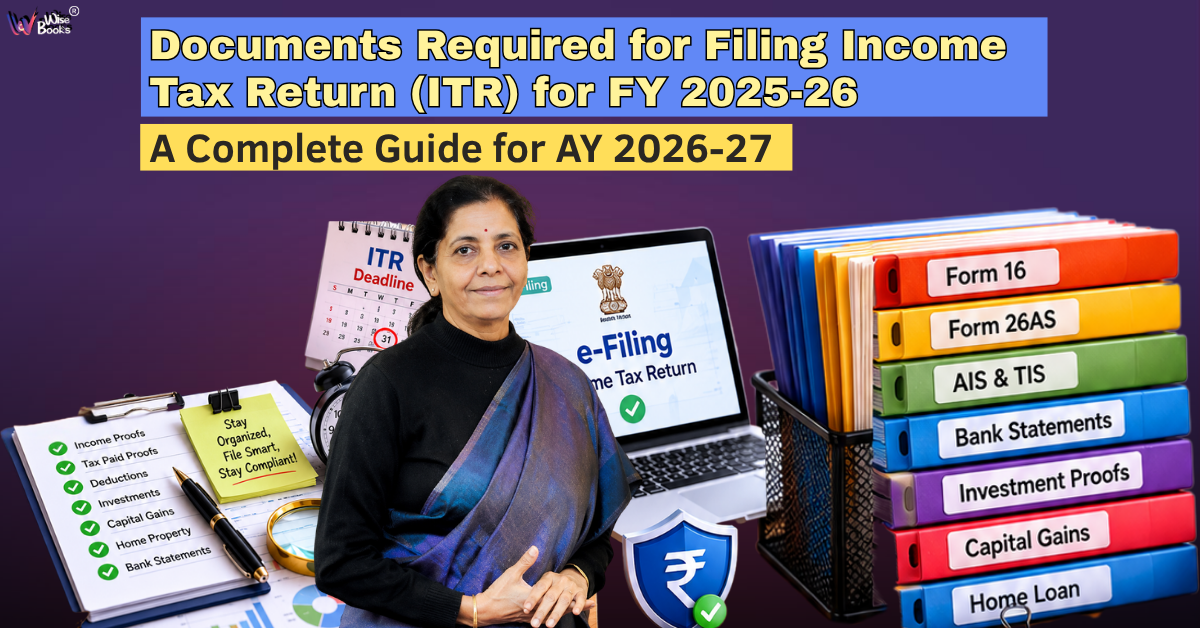
This comprehensive guide explains every document required for ITR filing for FY 2025-26 (AY 2026-27), their importance, applicability, and how they contribute to accurate tax filing.
Why Proper Documentation Matters Before Filing ITR
Many taxpayers believe that filing ITR is simply entering income details into an online form. However, successful tax filing depends on supporting documents that validate income earned, taxes paid, deductions claimed, and exemptions availed.
Proper documentation helps taxpayers:
|
Benefit |
Impact |
|
Accurate Income Reporting |
Reduces filing errors |
|
Faster Processing |
Quicker refund issuance |
|
Tax Saving |
Enables deduction claims |
|
Notice Prevention |
Avoids mismatch notices |
|
Financial Planning |
Better wealth management |
|
Loan Approval Support |
Acts as income proof |
Studies suggest that a significant portion of income tax notices are generated due to mismatches between taxpayer declarations and information already available with the Income Tax Department through AIS, TDS records, banks, mutual funds, and stock exchanges.
ITR Filing Due Dates for FY 2025-26 (AY 2026-27)
Understanding filing deadlines is crucial because delays can result in penalties, interest charges, and loss of certain tax benefits.
|
Taxpayer Category |
Due Date |
|
ITR-1 & ITR-2 |
31 July 2026 |
|
ITR-3 & ITR-4 (Non-Audit Cases) |
31 August 2026 |
|
Tax Audit Cases |
31 October 2026 |
|
Belated Return |
31 December 2026 |
Why Filing Early Is Recommended
Early filing offers several advantages:
- Faster tax refunds
- Better financial record keeping
- Easier loan processing
- Reduced last-minute errors
- More time to rectify discrepancies
Tax experts generally recommend filing at least one month before the deadline.
Essential Documents Required by Every Taxpayer
Regardless of profession or income category, certain documents form the foundation of every tax return.
PAN Card
The Permanent Account Number (PAN) acts as the primary identification for tax purposes. Without PAN, taxpayers cannot file returns efficiently or claim refunds.
Importance
- Links all tax-related transactions
- Tracks financial activities
- Mandatory for high-value transactions
- Required for investment reporting
Aadhaar Card
Aadhaar-PAN linking has become mandatory for most taxpayers.
Benefits
- Enables e-verification
- Simplifies return processing
- Reduces fraud risk
- Facilitates faster refunds
Form 16
Form 16 is issued by employers and acts as the most important document for salaried individuals.
Information Contained in Form 16
|
Component |
Details |
|
Part A |
Employer and Employee Details |
|
Part A |
TDS Deducted |
|
Part B |
Salary Breakup |
|
Part B |
Exemptions Claimed |
|
Part B |
Taxable Income |
Why It Matters
Form 16 provides a complete summary of salary income and taxes deducted during the financial year.
Form 26AS: Your Tax Credit Statement
Form 26AS acts as a consolidated tax passbook.
It contains:
- TDS deducted by employers
- TDS deducted by banks
- Advance tax payments
- Self-assessment tax
- High-value transactions
Analysis
Many taxpayers assume TDS deducted by employers automatically reflects in tax records. However, errors can occur if employers fail to deposit TDS properly.
Therefore, Form 26AS must always be matched with Form 16 before filing.
Understanding AIS (Annual Information Statement)
The Annual Information Statement is one of the most powerful tools introduced by the Income Tax Department.
AIS captures information from multiple reporting entities.
AIS Covers
|
Financial Activity |
Reported in AIS |
|
Salary Income |
Yes |
|
Savings Interest |
Yes |
|
FD Interest |
Yes |
|
Mutual Fund Investments |
Yes |
|
Stock Transactions |
Yes |
|
Property Purchases |
Yes |
|
Foreign Remittances |
Yes |
Why AIS Is Important
AIS provides the government with a complete financial picture of taxpayers.
If any income shown in AIS is not reported in the ITR, taxpayers may receive notices seeking clarification.
Taxpayer Information Summary (TIS)
TIS is a simplified version of AIS.
It presents:
- Processed information
- Categorized income
- Taxpayer feedback adjustments
Advantages
- Easier interpretation
- Faster return preparation
- Reduced reporting errors
Documents Required for Salaried Employees
Salaried individuals account for a significant share of ITR filers.
Required Documents
- Form 16
- Salary Slips
- Bank Statements
- HRA Documents
- Investment Proofs
- Leave Travel Allowance Proofs
Additional Analysis
Salary structures today often include:
- Basic Pay
- HRA
- Special Allowance
- Performance Bonus
- Provident Fund
Each component has different tax implications, making documentation essential.
Documents Required for Business Owners & Freelancers
India's freelance economy is expanding rapidly.
Industry estimates indicate that India has over 15 million freelancers, making it one of the largest freelance markets globally.
Important Documents
- GST Returns
- Sales Invoices
- Purchase Bills
- Bank Statements
- Profit & Loss Statements
- Balance Sheets
- Advance Tax Challans
Key Challenge
Many freelancers mix personal and business expenses, leading to tax reporting complications.
Maintaining separate business accounts is highly recommended.
Capital Gains Documentation
With increasing participation in stock markets and real estate, capital gains reporting has become one of the most scrutinized sections by tax authorities.
Asset Categories
|
Asset Type |
Documentation Required |
|
Equity Shares |
Broker Statement |
|
Mutual Funds |
CAMS/KFin Reports |
|
Property |
Sale & Purchase Deeds |
|
Gold |
Purchase Bills |
|
Bonds |
Transaction Records |
Market Insight
India now has over 20 crore demat accounts, making capital gains reporting increasingly important.
House Property and Rental Income
Property owners earning rental income must maintain:
- Rent Agreements
- Tenant PAN Details
- Municipal Tax Receipts
- Home Loan Interest Certificates
Why It Matters
The Income Tax Department can cross-verify rental transactions through tenant declarations and banking records.
Tax Saving Documents
Tax planning remains one of the most effective methods of reducing tax liability.
Popular Deduction Sections
|
Section |
Maximum Benefit |
|
80C |
₹1.5 Lakh |
|
80D |
₹25,000 to ₹1,00,000 |
|
80E |
Full Interest Deduction |
|
80CCD(1B) |
Additional ₹50,000 |
|
80G |
Eligible Donation Deduction |
Tax Planning Insight
A taxpayer utilizing all major deductions can potentially reduce taxable income by more than ₹2 lakh annually under the old tax regime.
New Tax Regime vs Old Tax Regime: Documentation Impact
|
Factor |
Old Regime |
New Regime |
|
Investment Proofs |
Required |
Not Required |
|
HRA Proof |
Required |
Not Applicable |
|
80C Benefits |
Available |
Not Available |
|
80D Benefits |
Available |
Not Available |
|
Simplicity |
Moderate |
High |
Strategic Analysis
The Old Tax Regime generally benefits:
- Home loan borrowers
- Investors
- Salaried employees with deductions
The New Tax Regime generally benefits:
- Young professionals
- Individuals with minimal investments
- Taxpayers preferring simplicity
Common Mistakes Taxpayers Should Avoid
1. Ignoring AIS information.
2. Reporting incorrect bank accounts.
3. Missing interest income.
4. Not reporting capital gains.
5. Claiming unsupported deductions.
6. Using incorrect ITR forms.
7. Filing at the last moment.
8. Not verifying the return.
Conclusion
The Income Tax Return filing process for FY 2025-26 has become significantly more data-driven and technology-oriented. The Income Tax Department now receives information from employers, banks, stock exchanges, mutual fund houses, property registrars, and other reporting entities. Therefore, maintaining proper documentation is no longer optional—it is a necessity.
Taxpayers who organize their financial records throughout the year experience smoother filing, faster refunds, better tax planning, and reduced compliance risks. Whether you are a salaried employee, business owner, freelancer, investor, or NRI, maintaining the right documents can transform ITR filing from a stressful obligation into a well-managed financial exercise.
A well-documented tax return not only ensures compliance but also strengthens your overall financial credibility, making it an essential component of responsible financial management.


Comments
No comments yet. Be the first to comment!