

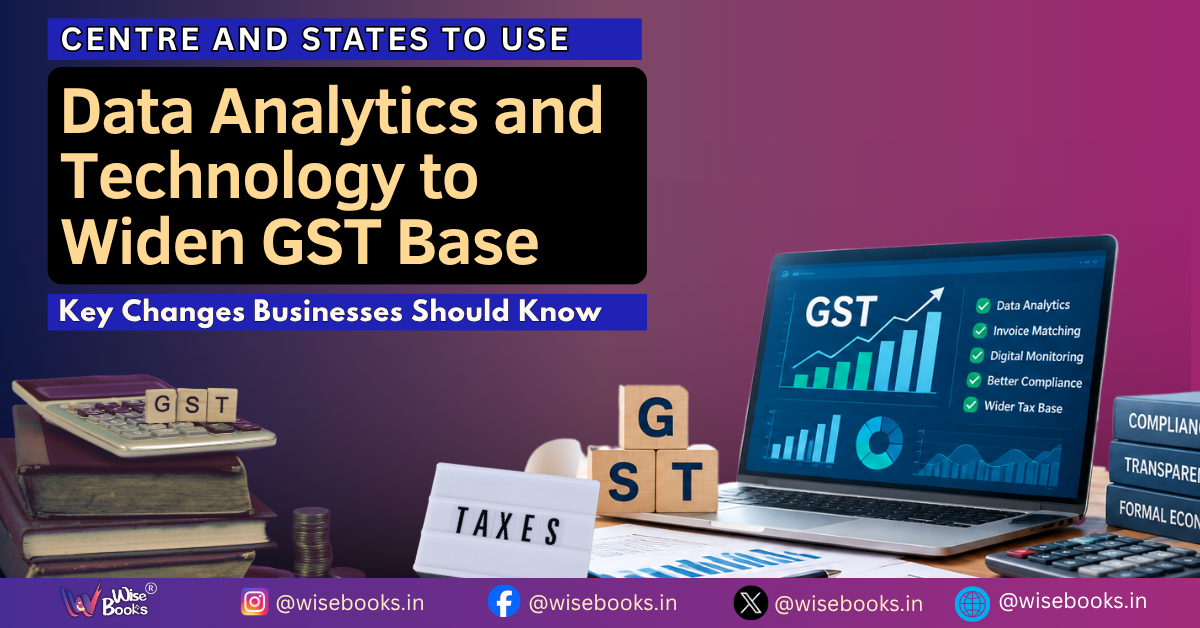
India’s Goods and Services Tax (GST) compliance system is moving towards a more technology-driven approach, with the Centre and state tax authorities being asked to use data analytics, invoice matching and digital monitoring to identify tax anomalies and expand the GST taxpayer base. The focus is shifting towards identifying potential non-compliance through financial data and transaction patterns rather than relying primarily on physical inspections and enforcement-led actions.
According to a report published by The Indian Express on 12 October 2026, these directions follow the 57th GST Council meeting, where several process reforms were discussed. The proposed approach includes examining unusual input tax credit (ITC) claims, identifying inconsistencies between business transactions and GST returns, improving invoice matching through the Invoice Management System (IMS), and limiting the random interception of goods vehicles. For businesses, these developments highlight the growing importance of accurate reporting, transparent records and timely reconciliation.
Why Is the Government Focusing on GST Data Analytics?
The government’s objective is to strengthen GST compliance by identifying potential tax leakage, improving reporting accuracy and bringing more eligible businesses into the formal tax system. Although GST has created a common indirect tax framework across India, differences between declared turnover, reported invoices, tax liabilities and credit claims can still create compliance gaps.
Under the proposed technology-led approach, tax authorities are expected to analyse transaction-level information to identify unusual patterns. For example, a business may report substantial sales but consistently discharge its entire tax liability through input tax credit, without making any cash payment. Such a pattern may warrant further examination, depending on the nature of the business, its purchase structure and the eligibility of the credits claimed.
Similarly, authorities may examine cases where retail transactions appear to have been reported as business-to-business (B2B) supplies to support ITC claims that may not be legitimate. Data analysis can help identify these inconsistencies and direct attention towards cases that require clarification.
However, an unusual pattern is not automatically proof of tax evasion. Businesses may legitimately use accumulated ITC to discharge their tax liability, and a business with no cash payment may still be fully compliant. Any assessment must consider the underlying transactions, supporting documents and applicable GST provisions.
GST Invoice Matching and the Role of the Invoice Management System
One of the important areas highlighted in the report is the use of the Invoice Management System (IMS) to improve invoice matching between suppliers and buyers. The objective is to reduce discrepancies between the invoices reported by suppliers and the purchase details used by recipients when claiming ITC.
Under GST, a supplier reports outward supplies through the applicable return process, while the recipient uses eligible purchase information and supporting records to determine whether ITC can be claimed. Differences in invoice values, GSTINs, tax amounts, amendments or reporting periods can create reconciliation problems and may lead to additional compliance work.
The IMS provides a mechanism through which recipients can review invoices made available to them and take actions such as accepting, rejecting or keeping an invoice pending, subject to the applicable system rules. These actions help improve visibility over purchase invoices and support better coordination between buyers and suppliers.
The report also refers to a proposed additional layer intended to reduce mismatch-related notices. Under the approach described, buyers would be able to accept, reject or hold invoices as they appear in the system. The exact operation, implementation timeline and legal consequences of any new layer should be confirmed through official GSTN guidance and notifications.
For businesses, the practical lesson is clear: invoice reconciliation should not be postponed until the end of the month or quarter. Purchase invoices should be reviewed regularly, and discrepancies should be resolved with suppliers before they affect ITC reporting.
Why Input Tax Credit Is Receiving Greater Attention
Input Tax Credit is a central feature of the GST system because it allows eligible businesses to offset GST paid on qualifying business purchases against their output tax liability, subject to the law. However, incorrect or unsupported credit claims can create revenue risks and compliance disputes.
Technology-based scrutiny is expected to help authorities identify potential mismatches by comparing invoice data, return disclosures, tax payments and related records. For example, differences between a supplier’s reported invoice and a buyer’s purchase records may indicate an amendment, a timing difference, a data-entry error or a more serious compliance issue.
Businesses should ensure that their ITC claims satisfy the applicable eligibility requirements under the CGST Act, including Section 16, and that relevant documentation and reporting conditions are met. They should also review supplier invoices, verify GSTIN details, reconcile purchase registers with GSTR-2B and investigate material discrepancies.
Importantly, a mismatch should not automatically be treated as fraud. Businesses should maintain a documented reconciliation process, obtain corrections where necessary and preserve evidence supporting eligible credit claims.
E-Invoicing May Expand to B2C Transactions From April 2027
Another significant development mentioned in the report is the proposed introduction of electronic invoicing for business-to-consumer (B2C) transactions from 1 April 2027. The report indicates that this would form part of a broader effort to strengthen invoice matching and improve transaction visibility.
Under the existing GST e-invoice framework, covered businesses report eligible B2B invoices to an authorised Invoice Registration Portal (IRP). The system validates the invoice and generates an Invoice Reference Number (IRN) and a digitally signed QR code in accordance with the applicable rules.
A possible extension to B2C transactions could increase the availability of transaction-level information and help authorities compare reported sales with other business records. It may also improve the ability to identify inconsistencies between actual retail activity and declared turnover.
However, businesses should distinguish between the existing e-invoicing requirements and the proposed B2C expansion described in the report. The latter should not be treated as a universal requirement already applicable to all businesses. The final scope, turnover thresholds, exemptions, technical requirements and implementation rules must be confirmed through official notifications.
Businesses can prepare by reviewing their billing software, invoice-generation processes, sales records and ability to maintain consistent digital data.
GST Authorities May Move Towards More Targeted Enforcement
The report also indicates that tax authorities have been instructed to focus more on data-driven compliance and less on intrusive enforcement measures. Rather than relying solely on physical inspections, authorities may use analytical tools to identify cases that require verification or clarification.
This approach is intended to make enforcement more targeted by identifying specific inconsistencies before taking further action. It could also reduce unnecessary compliance pressure on businesses whose records are accurate and whose transactions are properly documented.
At the same time, technology-led monitoring means that inconsistencies in GST returns, invoice reporting and tax payments may become easier to identify. Businesses should therefore treat return filing and reconciliation as ongoing processes rather than activities to be completed only when a deadline approaches.
The report also refers to a proposed ₹10,000 threshold for issuing show-cause notices under GST. Businesses should wait for the relevant legal provisions and official clarification before interpreting the threshold, including its scope, exceptions and effective date.
E-Way Bill Checks: A Move Away From Random Interception
Another important measure discussed at the GST Council meeting concerns the interception of vehicles transporting goods. According to the report, the proposed change would permit interception only by authorised tax officers from the state of the supplier or recipient, and only on the basis of specific intelligence and due authorisation.
The stated objective is to reduce random checks by officers from unrelated transit states and make the movement of goods smoother across state borders. For businesses that transport goods over long distances, unnecessary stoppages can lead to delivery delays, higher logistics costs and disruption to supply chains.
For example, if goods move from Delhi to Punjab through Haryana, the proposed framework would limit the circumstances in which authorities in the transit state could stop the vehicle. The precise legal effect would depend on the final applicable provisions and implementation instructions.
Businesses should continue to maintain valid e-way bills where required, accurate invoices, transport documents and other records prescribed under GST law. The reported proposal should not be interpreted as eliminating lawful inspections or removing existing e-way bill obligations.
How Businesses Can Prepare for the New GST Compliance Approach
With increasing emphasis on transaction data and digital reporting, businesses can reduce avoidable errors by strengthening their internal compliance processes.
1. Reconcile GST returns regularly. Compare sales registers, purchase registers, GSTR-1, GSTR-3B and GSTR-2B, as relevant, to identify discrepancies early.
2. Review ITC eligibility. Verify supporting invoices, supplier information and statutory conditions before claiming credit. Investigate differences rather than assuming every system-generated entry is eligible.
3. Coordinate with suppliers and customers. Resolve invoice amendments, missing invoices, incorrect GSTINs and tax-value differences promptly.
4. Maintain accurate digital records. Ensure accounting software, billing systems and GST return data are consistent and supported by source documents.
5. Monitor cash and credit tax payments. Review the balance between cash payments and ITC utilisation in the context of the business’s purchases, sales and applicable rules. Low or zero cash payment alone does not establish non-compliance.
6. Review e-invoice and e-way bill procedures. Check the requirements applicable to the business and ensure invoices, transport details and supporting documents remain accurate.
7. Document explanations for unusual transactions. Maintain reconciliation statements, supplier communications, credit notes and other evidence that can explain legitimate differences if questions arise.
What Do These Developments Mean for Accountants and Tax Professionals?
For accountants, chartered accountants and GST practitioners, the increased use of analytics makes accurate bookkeeping and regular reconciliation even more important. Compliance work is likely to require closer coordination between accounting records, GST returns, invoice systems and tax-payment information.
Professionals can help businesses identify discrepancies before filing, review ITC claims, assess notices, maintain supporting documentation and develop internal controls that improve the reliability of financial reporting. Automated reconciliation tools can also help identify recurring errors and reduce manual work.
The role of an accountant therefore extends beyond filing returns. It includes helping businesses understand their tax positions, maintain consistent records and respond appropriately when a transaction is flagged for review.
Conclusion
India’s GST compliance framework is moving towards greater use of data analytics, digital invoice matching and targeted enforcement. The measures described following the 57th GST Council meeting aim to improve tax-base coverage, strengthen ITC verification and make goods movement more predictable for businesses.
For businesses, the most practical response is to maintain accurate books, reconcile invoices regularly, verify ITC eligibility and keep clear supporting documentation. As the proposed reforms progress towards implementation, companies should follow official GST Council, CBIC and GSTN announcements to understand which measures have been formally notified and when they become applicable.
Staying prepared is not just about avoiding notices; it is about building a more transparent, efficient and reliable compliance process.


Comments
No comments yet. Be the first to comment!