

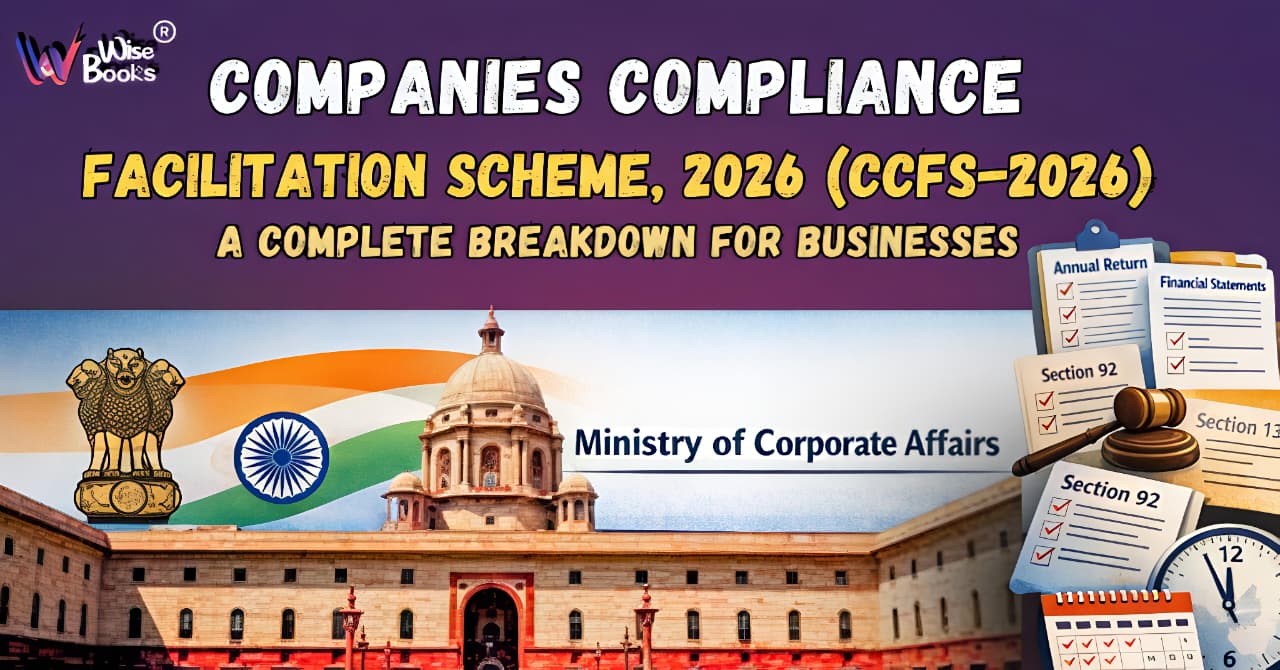
Companies Compliance Facilitation Scheme, 2026 (CCFS-2026): A Complete Breakdown for Businesses
On 24th February 2026, the Ministry of Corporate Affairs issued General Circular No. 01/2026 introducing the Companies Compliance Facilitation Scheme, 2026 (CCFS-2026). This one-time scheme has been notified under the powers of the Central Government pursuant to Sections 460 and 403 of the Companies Act, 2013.
The objective is clear: to provide a compliance reset window to companies that have defaulted in filing Annual Returns and Financial Statements and are burdened with heavy additional fees.
This blog provides a complete page-wise analysis of the 5-page circular, without skipping any provision.
Why Was This Scheme Introduced?
Under the Companies Act, 2013, every company is mandatorily required to file:
- Annual Return (Section 92)
- Financial Statements (Section 137)
The filing fees are governed by Section 403 read with the Companies (Registration Offices and Fees) Rules, 2014.
Since 1st July 2018, an additional fee of ₹100 per day of delay has been applicable for late filing of annual returns and financial statements. Importantly, there is no upper limit on this additional fee.
Over time, this resulted in enormous financial burdens, particularly for MSMEs, private limited companies, OPCs, producer companies, and several new-age startups. The MCA noted that the number of active companies in India has crossed 20 lakh, reflecting the rapid formalization of the economy. However, many of these companies could not complete annual compliances on time, leading to mounting additional fees.
Based on representations received from stakeholders, the Ministry decided to introduce a one-time relief mechanism.
What Is CCFS-2026?
The Companies Compliance Facilitation Scheme, 2026 is a condonation of delay scheme that allows companies to:
1. Complete pending annual filings at significantly reduced additional fees,
2. Apply for dormant status at concessional rates, or
3. Opt for strike-off at reduced filing fees.
The scheme aims to improve compliance levels, update the corporate registry with accurate information, and facilitate closure or dormancy of inactive entities at lower cost.
The scheme will remain in force from 15 April 2026 to 15 July 2026. It is strictly time-bound.
What Filings Are Covered?
The scheme applies to “relevant e-forms” that were due for filing under both the Companies Act, 2013 and the earlier Companies Act, 1956.
Forms under the Companies Act, 2013 include:
- MGT-7 / MGT-7A
- AOC-4 (including CFS, NBFC, XBRL variants)
- ADT-1
- FC-3 and FC-4
Forms under the Companies Act, 1956 include:
- Form 20B
- Form 21A
- Form 23AC / 23ACA (including XBRL versions)
- Form 66
- Form 23B
This ensures that even long-pending legacy filings can be regularised.
Three Major Options Available Under the Scheme
1. Filing Pending Annual Returns & Financial Statements
Companies can complete pending filings by paying:
- Normal filing fee (as prescribed under the Rules), and
- Only 10% of the applicable additional fees.
This is a substantial relief. For companies facing lakhs in additional fees due to daily penalties of ₹100 without cap, the effective burden reduces drastically.
2. Applying for Dormant Status (Section 455)
Inactive companies may choose to file e-Form MSC-1 and obtain dormant company status by paying 50% of the normal filing fee.
A dormant company remains on the register but enjoys minimal compliance requirements. This is ideal for companies temporarily not carrying on business but intending to retain their corporate identity.
3. Applying for Strike-Off (Closure)
Companies wishing to close operations can file e-Form STK-2 during the scheme period by paying only 25% of the applicable filing fees under the Companies (Removal of Name of Companies from the Register of Companies) Rules, 2016.
This provides a cost-effective exit route for defunct entities.
Who Cannot Avail the Scheme?
The scheme specifically excludes:
- Companies against which final notice for strike-off under Section 248 has already been issued.
- Companies that have already filed application for strike-off.
- Companies that applied for dormant status before the scheme commenced.
- Companies dissolved pursuant to amalgamation.
- Vanishing companies.
Thus, the benefit is targeted at defaulting but regularisable companies.
Immunity Provisions – A Critical Feature
One of the most significant aspects of CCFS-2026 is the immunity from penalties in certain situations.
For Sections 92 and 137 (Annual Return & Financial Statements):
No penalty shall be levied if:
- The filing is completed before issuance of notice by the Adjudicating Officer; or
- The filing is completed within 30 days from issuance of such notice.
In these cases, proceedings under Section 454 will be concluded, and no penalty will apply.
However, if:
- 30 days from issuance of notice has already expired; or
- An adjudication order imposing penalty has already been passed,
then filing under the scheme will not alter the liability to pay penalties. The scheme only reduces additional filing fees under Section 403; it does not waive adjudicated penalties.
Immunity for Certain Other Forms
For forms such as ADT-1, FC-3, FC-4 and legacy 1956 Act forms, immunity from prospective penal action is available only if:
- The forms are filed under the scheme; and
- No prosecution has been initiated or show cause notice issued before such filing.
If prosecution or adjudication has already begun, immunity will not apply.
What Happens After 15 July 2026?
The circular clearly states that once the scheme concludes, Registrars of Companies will initiate necessary action under the Act against companies that have not availed the scheme and continue to remain in default.
This means strict enforcement, penalties, and potential strike-off proceedings may follow.
Strategic and Practical Implications for Businesses
For active companies, CCFS-2026 offers an opportunity to clean up compliance history at a fraction of the additional fee burden. It reduces litigation risk and improves corporate credibility.
For MSMEs and startups, this scheme significantly lowers financial stress caused by accumulated daily additional fees.
For inactive or non-operational companies, the scheme provides a structured and economical path to either dormancy or closure.
From a regulatory perspective, this move reflects the government’s continued focus on ease of doing business while maintaining compliance discipline. It is both a relief measure and a compliance enforcement reset.
Conclusion
The Companies Compliance Facilitation Scheme, 2026 is not just a fee reduction window. It is a one-time compliance correction opportunity. Businesses that have pending annual returns or financial statements should carefully evaluate their position and act within the scheme period.
The window is short — 15 April 2026 to 15 July 2026. After that, regular penalties and strict action will resume.
At WiseBooks, we recommend that companies conduct an immediate compliance review and take informed action well before the deadline.
If your company has pending MCA filings, dormant status concerns, or closure plans, now is the right time to regularise.


Comments
No comments yet. Be the first to comment!