


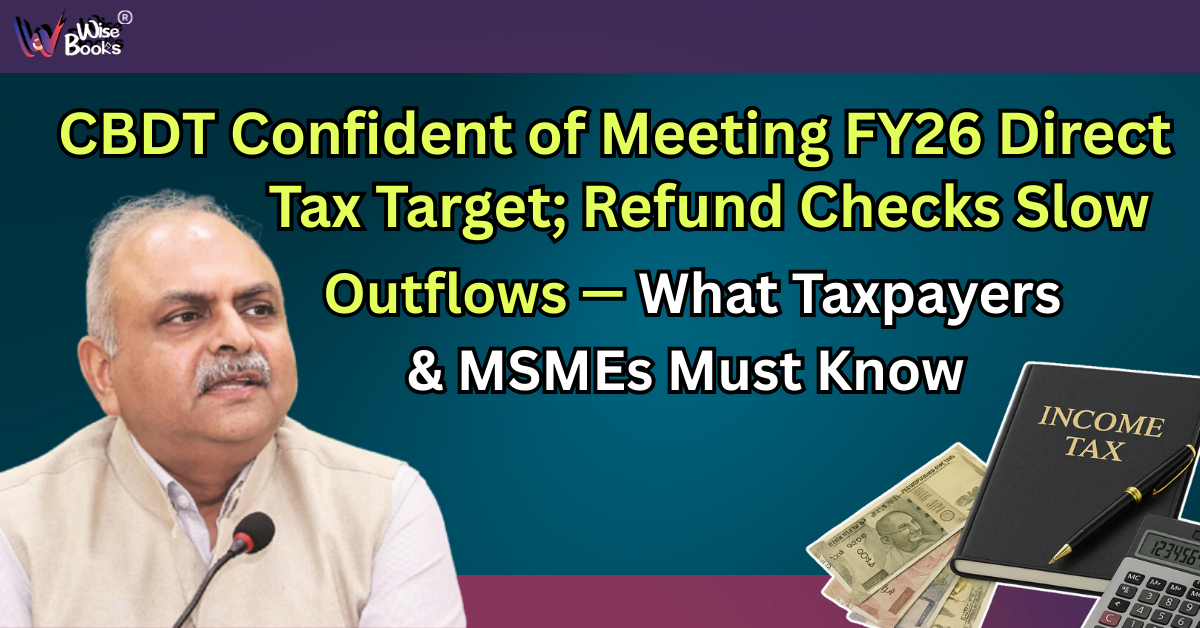
The Central Board of Direct Taxes is confident of achieving the ambitious ₹25.2 trillion direct tax collection target for FY26. CBDT Chairman Ravi Agarwal said on Monday that the department is closely monitoring inflows under personal income tax and STT and the third advance tax instalment due later this month is expected to offer clearer insights on revenue performance.
Meanwhile, the department has increased verification checks on doubtful or wrong refund claims. This is causing a sharp slowdown in refund outflows throughout the country.
The article outlines the latest updates, reasons for refund delays, and top recommendations of Deloitte for MSMEs in the upcoming Union Budget 2026-27.
Direct Tax Collections Grow 7% YoY: CBDT Confident of Meeting ₹25.2 Trillion FY26 Target
Despite uncertainties in the global economic environment, India's direct tax ecosystem continues to show an upward trend. The Central Board of Direct Taxes has reported a 7% year-on-year increase in net direct tax collections of ₹12.92 trillion as of November 10, 2025. With the third advance tax installment due this month, the government is hopeful of meeting the ambitious target of ₹25.2 trillion for FY26.
The Chairman of the CBDT, Ravi Agarwal, said initial trends in personal income tax and STT collections are indeed encouraging, while the government is committed to ensuring accuracy with justice for the taxpayer at the time of the refund.
I. Latest CBDT Update: Direct Tax Collections Improve but Refund Outflows Slow Down
1. Strong Growth in Net Direct Tax Collections
As of November 10, 2025, India’s net direct tax collections have touched ₹12.92 trillion, recording a 7% year-on-year growth. This growth is significant given the global economic slowdown and rising geopolitical uncertainties.
Reasons behind this strong tax growth
- Higher advance tax payments from corporates due to improved profitability
- Increased securities transaction tax (STT) due to market activity
- Better compliance through AIS/TIS data matching
- Growth in withholding tax (TDS) collections due to stricter monitoring
What this signals
- Stable job market and individual income growth
- Strong corporate earnings
- Higher taxpayer participation due to widened tax base
- Improved analytics and automated systems for tax tracking
2. Income Tax Refunds Drop by 17.7%: Verification Drive Slows Payouts — Here’s What Taxpayers Should Know
Despite uncertainties in the global economic environment, India's direct tax ecosystem continues to show an upward trend. The Central Board of Direct Taxes has reported a 7% year-on-year increase in net direct tax collections of ₹12.92 trillion as of November 10, 2025. With the third advance tax installment due this month, the government is hopeful of meeting the ambitious target of ₹25.2 trillion for FY26.
The Chairman of the CBDT, Ravi Agarwal, said initial trends in personal income tax and STT collections are indeed encouraging, while the government is committed to ensuring accuracy with justice for the taxpayer at the time of the refund.
Why Income Tax Refunds Have Slowed Down
CBDT Chairman Ravi Agarwal clarified that the department found multiple discrepancies in refund claims. As a result, a temporary hold has been put on refunds flagged for verification.
Key Reasons for the Delay
1. Detection of incorrect or inflated refund claims
2. Cross-checking mismatches between:
3. ITR and Form 26AS
4. AIS/TIS vs. declared income
5. TDS claims vs. payer filings
6. Cases of suspected misreporting or duplicate claims
Algorithm-based red flags in the I-T system Timeline for Verification The entire verification process is expected to be completed by the CBDT by December-end. Refunds will be released immediately after corrections are made.
3. Impact of Refund Scrutiny on Taxpayers
For salaried taxpayers
- Refunds may be delayed until verification ends
- Any mismatch in AIS/TIS should be corrected immediately
- Notices must be responded to promptly to avoid future penalties
For small businesses and professionals
- Refund delays may affect cash flow
- Increased scrutiny of business expense claims
- Higher chance of receiving e-verification or manual scrutiny notices
For companies
- Refund verifications may target:
- TDS on contractors
- Depreciation claims
- Carry-forward losses
- MAT credit
- Finance teams must prepare reconciliations ahead of time
4. Why CBDT Is Tightening Checks in FY26
(a) Preventing revenue leakage.
Wrong refund claims are one of the major sources of tax leakage. The department is tightening mismatches with higher reliance on analytics.
(b) Preparation for the new Income-tax Act, 2025
The new tax law takes effect from April 2026. Strengthening compliance now will ease the transition.
(c) fiscal discipline maintained.
The government, thus, is cautious on balancing fiscal deficit with multiple tax rate cuts - both income tax and GST.
(d) Greater transparency in record-keeping
The new system is designed to make AIS/TIS matching the central source of income verification.
II. Deloitte’s Top Recommendations for Budget 2026–27 — Big Expectations from MSMEs
Deloitte has released its list of top economic asks ahead of the 2026-27 Union Budget. These insights highlight where the government may focus in the upcoming year.
1. Large-scale Support Package for MSMEs
MSMEs continue to face the biggest challenges.
a) Fluctuating export orders
b) High input costs
c) Delayed payments
d) Expensive credit
e) Complex compliance processes
Deloitte recommends a comprehensive MSME Stabilisation Package including:
a) Expanded export credit and easier access
b) Lower interest/concessional financing for priority sectors
c) Improved credit guarantee schemes to cover more industries.
d) Reduced compliance burden regarding GST, labour laws, and taxation
e) Sector-specific relief for textiles, manufacturing, and logistics
Impact if implemented
a) Stronger business continuity
b) Improved liquidity for manufacturers
c) Improved competitiveness in international markets
d) Lower borrowing costs for small enterprises
2. Clean Energy & Critical Minerals — National Priority
As the world's focus shifts to renewable energy, India is now planning to reinforce its leadership position in the area.
Deloitte suggests key steps:
a) Incentives for solar, green hydrogen, and EV manufacturing
b) Fast-tracking clearances for renewable energy projects
c) Subsidies for firms investing in key minerals like lithium, cobalt, and nickel
d) Policies supporting local mineral processing
e) Push for R&D in climate tech
Why this is important
a) India aims to reduce import dependency.
b) The clean-energy sector can generate millions of jobs.
c) Lower long-term energy costs for industries
3. Manufacturing Revival for Long-Term Growth
Manufacturing has a vital role to play in sustaining high momentum in the Indian economy.
Deloitte's recommendations include:
Simplification of GST classification for manufacturing units:
a) Reducing the regulatory burden across states
b) Incentives for Automation, Robotics, and AI Adoption
c) More industrial clusters with plug-and-play facilities
d) Additional incentives for export-oriented production
e) Simplification of taxation for MSME manufacturers
Expected benefits
a) Lower operating costs
b) Higher production efficiency
c) Increased global competitiveness
d) Creation of jobs in industrial belts
III. What It Means for You — Taxpayers, MSMEs, and Accounting Firms
Recent tax developments affect taxpayers, MSMEs, and accounting firms in several ways. For taxpayers, income tax refunds are slower because the CBDT is verifying mismatches in ITR, AIS/TIS, and TDS data, making accurate reporting and timely responses to notices essential.
MSMEs may face temporary cash flow issues due to delayed refunds, but upcoming Budget recommendations such as easier credit access, reduced compliance burden, and stronger support schemes could benefit them significantly. Meanwhile, accounting firms and tax professionals are seeing higher demand as clients seek help with refund delays, reconciliations, and compliance corrections.
This period also increases the need for automated accounting tools and AI-driven solutions, making technology adoption crucial for firms. Overall, the message is clear: maintain accurate records, stay compliant, and be proactive to avoid delays or scrutiny.
Conclusion
India's direct tax environment is becoming more analytic, more data-driven, and more compliance-oriented than ever. The confidence of the CBDT to meet the target of FY26 tax collections indicates strong fundamentals of the economy, while the slowdown in refunds hints at deeper scrutiny and the usage of high-precision verification tools to deter misuse.
Concurrently, the government is being urged to support MSMEs through extensive budget reforms, clean energy investments, and revival of manufacturing.
The key to staying ahead for taxpayers, businesses, and accounting firms lies in timely compliance, correct documentation, and proactive planning, especially with the new tax law taking effect from April 2026.
FQA
Q1. Why is CBDT confident about meeting the FY26 tax target?
CBDT is confident because direct tax collections have already grown 7% YoY, reaching ₹12.92 trillion by November 10. Strong advance tax trends and higher compliance support the target of ₹25.2 trillion for FY26.
Q2. Why have income tax refunds dropped by 17.7% this year?
Refunds have slowed because CBDT is verifying incorrect or mismatched claims. Refunds flagged for discrepancies are temporarily on hold until checks are completed by December-end.
Q3. How does refund verification impact taxpayers and MSMEs?
Taxpayers may face delay in receiving refunds and must fix AIS/TIS errors quickly. MSMEs may face cash flow pressure due to slower refunds. Businesses must ensure accurate filings to avoid further scrutiny.
Q4. What budget reforms are recommended for MSMEs?
Deloitte suggests an MSME Stabilisation Package, including easier credit, concessional loans, wider credit guarantee cover, and reduced compliance burden.
Q5. What is the government focusing on for clean energy and minerals?
Budget recommendations highlight supporting green energy, EV sector, solar, and critical minerals like lithium to reduce import dependence and boost industrial growth.


Comments
No comments yet. Be the first to comment!