

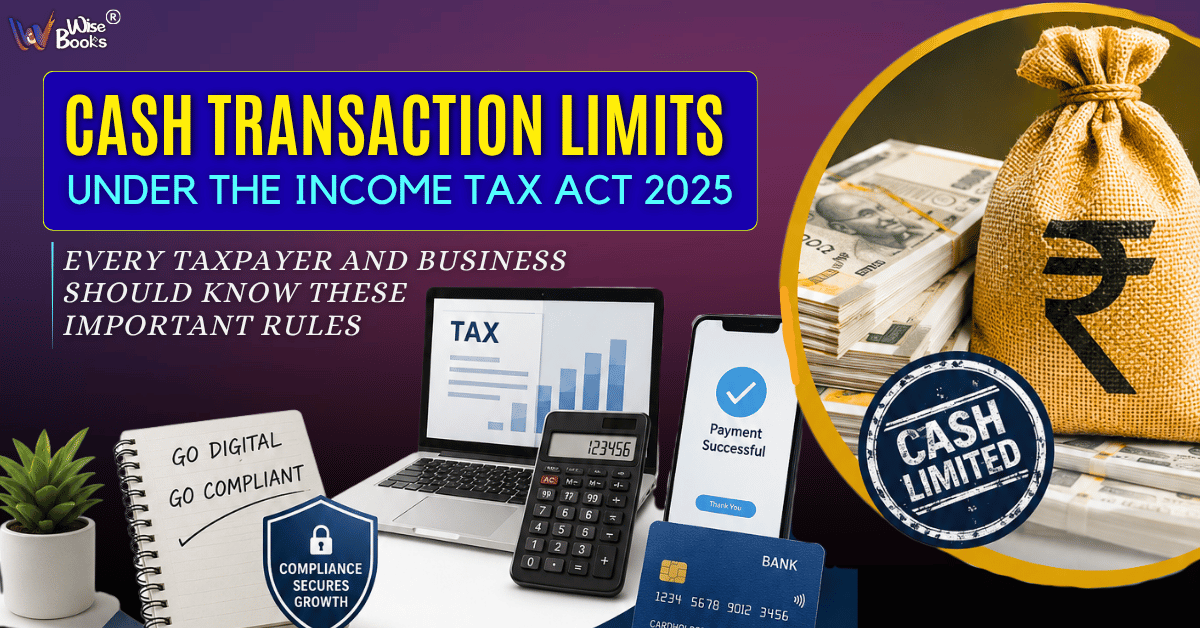
Cash has long been a preferred mode of payment in India. Whether it's paying a supplier, lending money to a friend, purchasing goods, or making donations, cash transactions have traditionally been a part of everyday business and personal life.
However, with India's rapid shift toward a digital economy, the Income Tax Department has introduced strict regulations to discourage large cash transactions. These provisions are aimed at increasing transparency, reducing tax evasion, preventing black money, and ensuring that financial transactions leave a verifiable trail.
Many taxpayers assume that only the ₹2 lakh cash transaction limit applies under the Income Tax Act. In reality, several provisions regulate different types of cash transactions, each carrying its own limits and penalties.
Understanding these rules is essential not only for businesses but also for professionals, entrepreneurs, salaried individuals, traders, property buyers, and anyone dealing with significant amounts of money.
In this article, we'll explain every major cash transaction limit under the Income Tax Act applicable in 2025, along with practical examples, penalties, and compliance tips.
Why Does the Government Restrict Cash Transactions?
The Government of India has consistently encouraged digital payments and banking transactions to create a transparent financial ecosystem.
Large cash transactions often make it difficult for tax authorities to verify the source of income and the movement of funds. By limiting cash dealings, the government aims to:
- Reduce tax evasion and unaccounted income
- Curb the circulation of black money
- Improve financial transparency
- Encourage digital and banking transactions
- Strengthen tax compliance
- Create a clear audit trail for financial activities
Today, high-value financial transactions are increasingly tracked through banking records, PAN reporting, Annual Information Statements (AIS), and other reporting mechanisms. As a result, relying on cash for substantial transactions can expose taxpayers to scrutiny and penalties.
Major Cash Transaction Limits Under the Income Tax Act
Different sections of the Income Tax Act govern different types of cash transactions. Here's a quick overview:
|
Section |
Transaction Covered |
Cash Limit |
Consequence |
|
Section 269ST |
Cash receipts |
₹2,00,000 |
Penalty equal to amount received |
|
Section 269SS |
Acceptance of loans/deposits |
₹20,000 |
Penalty equal to loan amount |
|
Section 269T |
Repayment of loans/deposits |
₹20,000 |
Penalty equal to repayment amount |
|
Section 40A(3) |
Business expenses |
₹10,000 per day per person |
Expense disallowed |
|
Section 80G |
Donations |
₹2,000 |
No deduction allowed |
Let's understand each of these provisions in detail.
Section 269ST: You Cannot Receive ₹2 Lakh or More in Cash
One of the most important restrictions under the Income Tax Act is contained in Section 269ST.
This provision prohibits any person from receiving ₹2 lakh or more in cash under specific situations.
The restriction applies if cash is received:
- From one person in a single day,
- For a single transaction, or
- For transactions relating to one event or occasion.
If any of these conditions are satisfied, receiving ₹2 lakh or more in cash is prohibited.
Example 1: Cash Received in One Day
Suppose a furniture dealer sells products worth ₹2.25 lakh.
The customer pays:
- ₹80,000 in the morning
- ₹70,000 in the afternoon
- ₹75,000 in the evening
Although each payment is below ₹2 lakh, the total cash received from the same customer on the same day is ₹2.25 lakh.
This violates Section 269ST.
Example 2: One Transaction Spread Across Multiple Days
A customer purchases machinery worth ₹3 lakh.
Instead of paying the full amount at once, the customer pays:
- ₹1 lakh on Monday
- ₹1 lakh on Tuesday
- ₹1 lakh on Wednesday
Since all payments relate to a single transaction, accepting the entire amount in cash is still prohibited.
Example 3: Payments for One Event
A wedding planner receives:
- ₹90,000 for catering
- ₹70,000 for decoration
- ₹60,000 for photography
All payments relate to the same wedding event.
The total cash received exceeds ₹2 lakh, making the transaction non-compliant under Section 269ST.
What Is the Penalty?
Violation of Section 269ST attracts a severe penalty under Section 271DA.
The penalty is equal to 100% of the amount received in cash.
Example
Cash received: ₹3,00,000
Penalty imposed: ₹3,00,000
In most cases, the penalty is imposed on the person receiving the cash rather than the person making the payment.
Section 269SS: Cash Loans and Deposits Above ₹20,000 Are Not Allowed
Section 269SS regulates loans and deposits.
A person cannot accept ₹20,000 or more in cash as:
- Loan
- Deposit
- Specified sum relating to transfer of immovable property
- Certain advances
Instead, such amounts must be accepted through:
- Bank transfer
- Account Payee Cheque
- Account Payee Demand Draft
- NEFT
- RTGS
- UPI or other prescribed electronic modes
Example
A businessman borrows ₹75,000 from a friend.
If the amount is received in cash, it violates Section 269SS.
However, if the same amount is transferred through a bank account, the transaction complies with the law.
Penalty for Violating Section 269SS
The penalty under Section 271D is equal to the amount of the loan or deposit accepted.
For example:
Loan accepted in cash = ₹1,50,000
Penalty = ₹1,50,000
This demonstrates how expensive non-compliance can become.
Section 269T: Repayment of Loans in Cash Is Also Restricted
The law not only regulates accepting loans but also their repayment.
If a loan or deposit of ₹20,000 or more is repaid, repayment cannot be made in cash.
Repayment should be through recognized banking channels.
Example
A borrower repays ₹50,000 in cash to the lender.
This violates Section 269T.
The repayment should instead be made electronically or through an account payee instrument.
Penalty Under Section 271E
If Section 269T is violated, the penalty may equal the amount repaid in cash.
This means both accepting and repaying loans in cash can lead to substantial financial consequences.
Section 40A(3): Business Expenses Paid in Cash
Businesses often make daily purchases from suppliers, vendors, and contractors.
However, Section 40A(3) restricts cash payments for business expenses.
If a business pays more than ₹10,000 in cash to a person in a single day, that expenditure generally cannot be claimed as a deductible business expense while calculating taxable income.
For payments made to transporters in specified circumstances, the limit is generally ₹35,000.
Example
A company purchases office equipment worth ₹18,000 and pays the supplier entirely in cash.
Although the purchase is genuine, the company cannot claim the ₹18,000 as an allowable business expense for income tax purposes.
As a result, the taxable income of the business increases.
Section 80G: Cash Donations Above ₹2,000
Taxpayers who donate to eligible charitable institutions can claim deductions under Section 80G.
However, donations exceeding ₹2,000 must be made through banking or digital modes.
If a donation above ₹2,000 is made in cash, no deduction will be available.
Example
Donation Amount: ₹15,000
Paid through UPI or Bank Transfer:
Eligible for deduction (subject to conditions)
Paid in Cash:
Deduction not available
Can You Split Cash Payments to Avoid the Law?
Many taxpayers believe they can avoid the rules by splitting payments into smaller amounts.
Unfortunately, this does not work.
The Income Tax Act specifically considers:
- Aggregate cash received from one person in a day,
- Payments relating to one transaction, and
- Payments relating to one event or occasion.
Simply dividing the payment into smaller installments does not remove the violation.
Are There Any Exceptions?
Yes, Certain transactions are exempt from these restrictions.
Examples include transactions involving:
- Government
- Banking companies
- Post Office Savings Banks
- Cooperative Banks
- Other entities specifically notified by the Government
However, these exceptions are limited, and most taxpayers should assume that the cash restrictions apply to them.
Practical Tips to Stay Compliant
Following a few simple practices can help taxpayers avoid unnecessary penalties:
i. Prefer UPI, NEFT, RTGS, or bank transfers for high-value payments.
ii. Avoid accepting or making large cash payments.
iii. Maintain proper invoices, receipts, and supporting documents.
iv. Use account payee cheques for loans and deposits wherever applicable.
v. Educate employees handling cash about statutory limits.
vi. Review business payment practices regularly to ensure compliance.
vii. Consult a tax professional before entering into large cash transactions.
Final Thoughts
Cash transactions continue to play a role in many businesses and personal dealings, but the Income Tax Act clearly limits their use in high-value transactions. Whether you're receiving payments from customers, borrowing money, repaying loans, claiming business expenses, or making charitable donations, understanding these provisions is essential to avoid costly penalties.
The consequences of violating the cash transaction rules can be severe ranging from disallowance of business expenses to penalties equal to the entire amount of the transaction. These rules are designed not only to improve tax compliance but also to encourage greater financial transparency and promote a digital economy.
By choosing banking and digital payment methods, maintaining proper documentation, and staying informed about the applicable provisions, taxpayers can safeguard themselves against unnecessary disputes and ensure smooth compliance with the Income Tax Act.
For businesses and individuals alike, the message is clear: when dealing with significant amounts, think beyond convenience choose compliance.


Comments
No comments yet. Be the first to comment!