


Introduction
Goods and Services Tax (GST) compliance has become one of the most important responsibilities for businesses operating in India. Timely filing of GST returns not only helps taxpayers avoid penalties but also ensures uninterrupted business operations. However, recent reports and expert opinions have raised concerns regarding GST registration suspensions being initiated in certain cases even when returns are delayed by only a few days.
This issue has generated significant discussion among chartered accountants, tax professionals, and business owners, especially after some GST-registered persons reportedly faced suspension notices despite filing delays of only five to ten days. The situation has become even more concerning because many taxpayers experienced technical difficulties on the GST portal during recent filing periods.
The controversy raises an important question: Can GST registration legally be suspended for a short delay in return filing, and what does the law actually say?
Understanding GST Registration Suspension
GST registration serves as the legal identity of a business under the GST framework. Without an active GST registration, businesses may face serious operational difficulties, including:
- Inability to issue GST-compliant tax invoices
- Restrictions on collecting GST from customers
- Difficulty claiming Input Tax Credit (ITC)
- Challenges in conducting interstate business transactions
- Increased compliance risks and legal complications
Therefore, suspension of GST registration can significantly impact a business's day-to-day operations and cash flow.
What Does Rule 21A(2) Say?
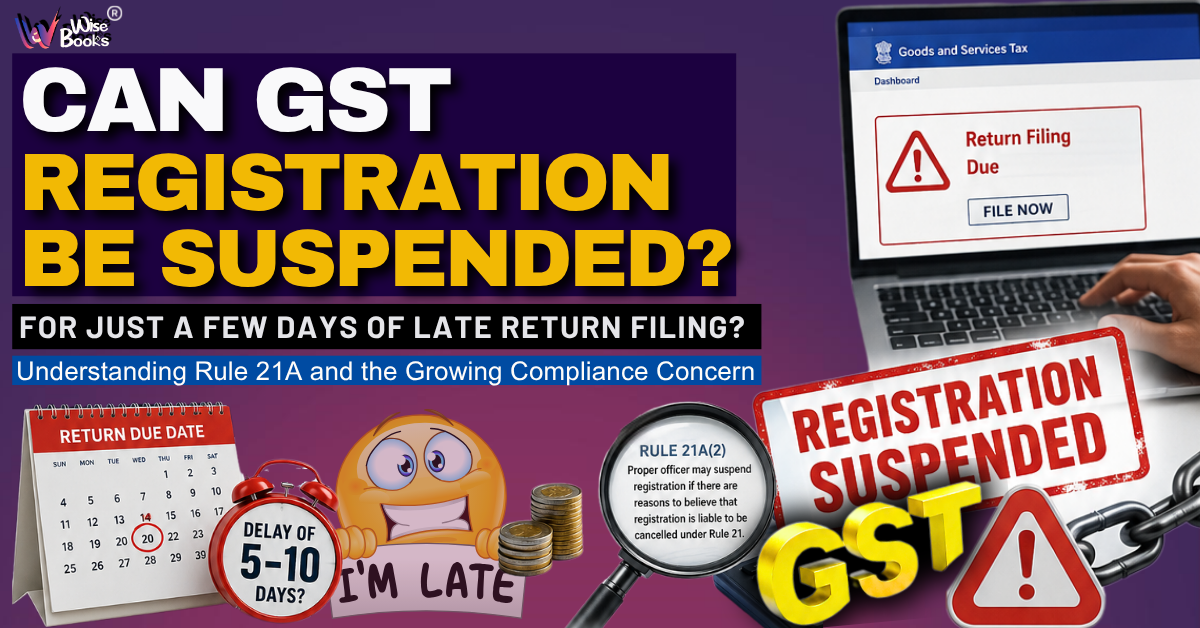
According to Rule 21A(2) of the Central Goods and Services Tax (CGST) Rules, 2017, a proper officer may suspend a GST registration if there are sufficient reasons to believe that the registration is liable to be cancelled under Rule 21.
The key phrase here is "liable to be cancelled."
This means suspension is generally intended as an interim measure when authorities believe that circumstances exist that may eventually lead to cancellation of registration. The purpose is not merely to penalize taxpayers for minor delays but to address cases where serious compliance concerns exist.
Tax experts argue that the law requires proper justification before suspension is initiated. A brief delay in filing returns does not automatically indicate that a taxpayer's registration warrants cancellation.
What Does Rule 21 Cover?
Rule 21 outlines situations where GST registration may be cancelled. These circumstances generally include:
- Failure to conduct business from the declared place of business
- Issuing invoices without actual supply of goods or services
- Violations of GST provisions
- Non-filing of returns for a prescribed continuous period
- Fraudulent activities or misrepresentation
The intention behind these provisions is to prevent misuse of the GST system and ensure tax compliance.
However, experts point out that isolated or short-term delays in return filing may not necessarily indicate any fraudulent intent or serious non-compliance.
The Recent Concern Among Tax Professionals
Several chartered accountants and GST practitioners have observed instances where GST registrations were suspended shortly after taxpayers missed filing deadlines.
In some reported cases, returns were delayed by only five to ten days.
This has led to concerns regarding:
- Overly strict implementation of compliance provisions
- Lack of adequate consideration for genuine hardships
- Technical glitches on the GST portal affecting taxpayers
- Increased compliance burden on MSMEs and small businesses
- Uncertainty regarding interpretation of suspension rules
Professionals argue that while compliance enforcement is essential, authorities should also consider practical business challenges before taking drastic actions such as registration suspension.
Impact on MSMEs and Small Businesses
Micro, Small and Medium Enterprises (MSMEs) are particularly vulnerable to GST registration suspensions.
Unlike large corporations with dedicated compliance teams, many small businesses depend on limited accounting resources. A temporary disruption can lead to:
Cash Flow Problems
Customers may hesitate to deal with businesses whose GST registration status is suspended.
Input Tax Credit Issues
Suppliers and customers may face difficulties in claiming tax credits associated with transactions.
Business Reputation Risks
Suspension notices can create concerns among clients, vendors, and financial institutions.
Additional Compliance Costs
Businesses often need professional assistance to restore registration and respond to notices.
For many MSMEs, even a temporary suspension can create significant operational challenges.
The Role of GST Portal Technical Issues
Recent filing periods witnessed technical difficulties on the GST portal, prompting authorities to extend filing deadlines in certain cases.
Despite these extensions, some taxpayers reportedly continued to experience:
- Login difficulties
- Slow portal performance
- Payment processing delays
- Return submission errors
- System-generated compliance alerts
Tax professionals argue that genuine technical challenges should be taken into account before initiating suspension proceedings.
The objective of tax administration should be to improve compliance rather than penalize taxpayers facing circumstances beyond their control.
Legal and Practical Considerations
Experts emphasize that GST registration suspension should not be treated as an automatic consequence of every delayed return.
Instead, authorities should evaluate:
- Duration of delay
- Taxpayer's compliance history
- Presence of fraudulent intent
- Previous filing behavior
- Existence of technical difficulties
- Business circumstances
A balanced approach helps maintain both compliance discipline and taxpayer confidence.
What Businesses Should Do
To avoid compliance risks, businesses should adopt proactive GST management practices:
File Returns Before Due Dates
Avoid waiting until the final day to submit returns.
Maintain Compliance Calendars
Track all GST deadlines and filing obligations.
Monitor GST Portal Notifications
Regularly review notices, alerts, and communication from GST authorities.
Keep Documentation Ready
Maintain records of portal issues, payment receipts, and filing attempts.
Seek Professional Assistance
Consult GST professionals immediately upon receiving any notice or suspension communication.
Conduct Periodic Compliance Reviews
Regular compliance audits can identify potential risks before they become serious issues.
Future Outlook
As GST compliance systems become increasingly technology-driven, authorities are expected to strengthen monitoring and enforcement mechanisms. While this may improve tax administration efficiency, businesses must remain vigilant regarding compliance requirements.
At the same time, industry bodies and tax professionals continue to advocate for a more practical and taxpayer-friendly approach, particularly in cases involving minor delays or genuine technical challenges.
The balance between strict enforcement and reasonable flexibility will remain an important discussion in India's evolving GST landscape.
Conclusion
The recent concerns regarding GST registration suspensions for short filing delays have sparked an important debate within the tax community. While GST laws provide authorities with powers to suspend registrations under specific circumstances, experts argue that such actions should be supported by valid reasons and proper legal justification.
Businesses should view these developments as a reminder of the growing importance of timely GST compliance. Proactive return filing, proper record maintenance, and continuous monitoring of GST obligations can help organizations avoid unnecessary compliance risks.
As GST regulations continue to evolve, taxpayers must stay informed, remain compliant, and seek professional guidance whenever compliance challenges arise. A well-managed GST compliance framework is no longer just a legal requirement, it is an essential component of sustainable business operations.


Comments
GrVsBE