

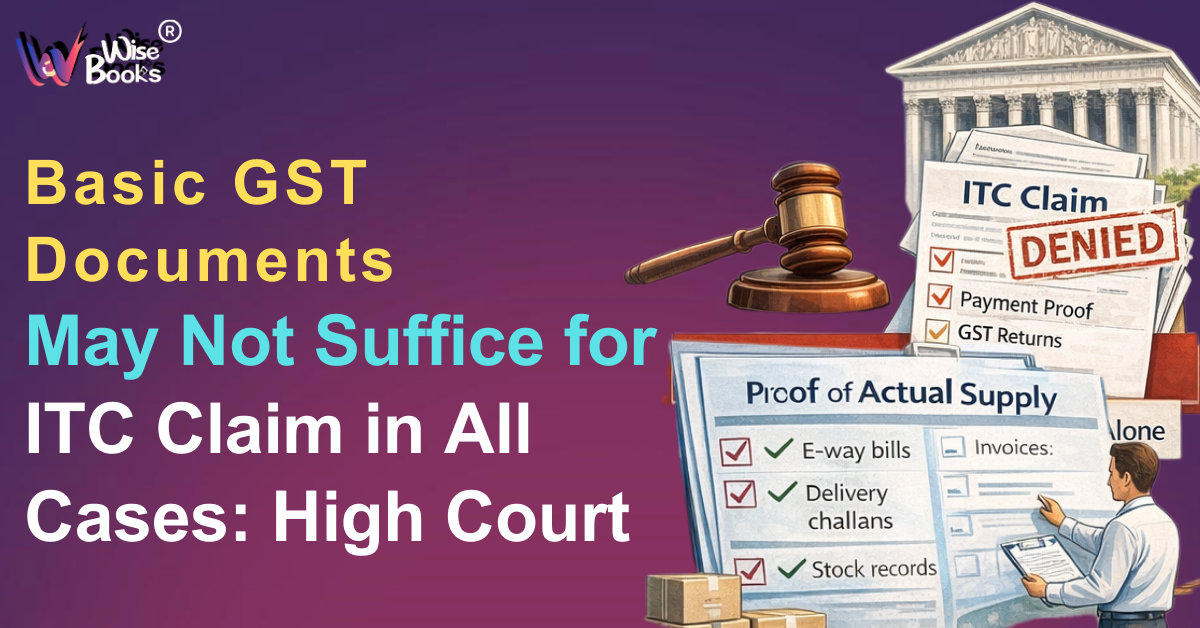
Input Tax Credit (ITC) is one of the most important features of the Goods and Services Tax (GST) system. It allows businesses to claim credit for the tax paid on purchases and reduce their overall tax liability. However, several judicial decisions have clarified that simply having basic GST documents like invoices and payment records may not always be sufficient to claim ITC.
Recently, High Courts have observed that the genuineness of the transaction and actual supply of goods or services are equally important for claiming ITC. If authorities find that the transaction lacks commercial substance or appears suspicious, the ITC claim may be denied even when proper documents exist.
This interpretation has significant implications for taxpayers, as it places greater emphasis on substance over documentation in GST compliance.
Legal Framework Governing ITC under GST
Section 16 of the CGST Act – Conditions for Availing ITC
Section 16 of the Central Goods and Services Tax (CGST) Act, 2017 lays down the fundamental conditions for claiming Input Tax Credit. According to this provision, a registered person can claim ITC only if certain mandatory conditions are satisfied.
The taxpayer must possess a valid tax invoice or debit note issued by a registered supplier. The goods or services must have been actually received by the recipient. Additionally, the supplier must have paid the tax to the government and the recipient must file the prescribed GST returns.
These conditions clearly indicate that ITC is not an automatic right, but a benefit available only when all statutory requirements are fulfilled.
Documentary Evidence vs Actual Supply
Many taxpayers assume that if they have a tax invoice and proof of payment through banking channels, their ITC claim cannot be questioned. However, courts have clarified that documents alone do not prove the authenticity of a transaction.
Tax authorities are allowed to examine whether the goods were actually supplied, transported, and received. If evidence suggests that the transaction was merely on paper or the supplier was non-existent, the ITC claim can be disallowed.
This approach aims to prevent fake invoicing and fraudulent ITC claims, which have been a major concern under the GST regime.
High Court Observations on ITC Claims
ITC Cannot Be Claimed Solely on the Basis of Invoices
High Courts in several cases have held that mere possession of invoices, GST returns, and bank payment records does not automatically establish a valid ITC claim.
Courts have emphasized that the transaction must reflect genuine business activity and actual supply of goods or services. If authorities find discrepancies in the supply chain or discover that the supplier was not operational, the ITC claim may be rejected.
Authorities Can Verify the Entire Transaction
Courts have also recognized the authority of tax officials to verify the authenticity of transactions. During investigations, authorities may examine whether the supplier had adequate infrastructure, stock, or business operations to carry out the transaction.
If the supplier is found to be a shell entity or part of a fake invoicing network, the ITC claimed by the recipient may be denied even if the recipient has basic documentation.
Investigation Parameters Used by GST Authorities
Supplier Verification
Tax authorities often verify the GST registration status, filing history, and place of business of the supplier. If the supplier is found to be inactive, untraceable, or engaged in suspicious activities, the transaction may be considered doubtful.
This verification helps authorities identify fake billing networks used to generate fraudulent ITC.
Movement of Goods
Authorities may also check whether goods actually moved from the supplier to the recipient. This verification may include reviewing e-way bills, transport documents, logistics records, and delivery challans.
If no evidence of goods movement exists, the transaction may be treated as fictitious.
Stock and Accounting Records
Businesses claiming ITC may also be asked to produce stock registers, purchase orders, goods receipt notes, and warehouse records. These documents help confirm whether the purchased goods were actually received and recorded in the books of accounts.
Proper accounting documentation strengthens the credibility of the ITC claim.
Impact of Fake Invoicing on the GST System
Rising Cases of Fraudulent ITC Claims
Since the implementation of GST, authorities have detected numerous cases involving fake invoices issued without actual supply of goods or services. Such invoices are used to claim ITC fraudulently and reduce tax liability.
These fraudulent activities have caused significant revenue losses to the government.
Government Measures to Curb ITC Fraud
To prevent misuse of ITC, the government has introduced several compliance mechanisms. These include matching of invoices through GSTR-2B, mandatory e-invoicing for specified taxpayers, and strict monitoring of GST registrations.
Authorities are also conducting data analytics and risk-based investigations to identify suspicious transactions and fake ITC claims.
Compliance Strategies for Businesses
Conduct Proper Supplier Due Diligence
Businesses should verify the GST registration status, compliance history, and credibility of suppliers before entering into transactions. Dealing with unreliable suppliers increases the risk of ITC disputes.
Supplier verification has become an essential part of GST compliance.
Maintain Comprehensive Documentation
Apart from tax invoices, businesses should maintain additional records such as purchase orders, delivery challans, goods receipt notes, transport documents, and payment proofs.
These documents collectively demonstrate that the transaction is genuine and that goods or services were actually received.
Regular Reconciliation of GST Returns
Taxpayers should regularly reconcile GSTR-1, GSTR-3B, and GSTR-2B data to ensure that the ITC claimed matches the invoices reported by suppliers.
Timely reconciliation helps identify discrepancies early and reduces the risk of compliance issues during audits or investigations.
Implement Strong Internal Controls
Businesses should establish internal systems to monitor GST compliance. This may include automated reconciliation tools, supplier risk checks, and periodic GST audits.
Such measures help prevent errors and protect businesses from disputes related to ITC claims.
Judicial Trend and Future Outlook
The recent High Court observations highlight a growing judicial trend that ITC claims must be supported by genuine commercial transactions, not just documentation. Courts are increasingly focusing on the substance of transactions to ensure that the GST system is not misused.
As tax authorities continue to strengthen compliance mechanisms and technology-based monitoring, businesses must adopt a more transparent and well-documented approach to GST compliance.
Conclusion
The High Court’s observations serve as a crucial reminder that basic GST documents alone may not be sufficient to claim Input Tax Credit in all situations. While invoices and payment proofs are essential, they must be supported by evidence of genuine supply, movement of goods, and proper accounting records.
Businesses should therefore focus on strong documentation practices, supplier verification, and regular reconciliation of GST data. By maintaining a transparent audit trail and ensuring compliance with legal requirements, taxpayers can safeguard their ITC claims and avoid potential disputes with tax authorities.


Comments
No comments yet. Be the first to comment!