


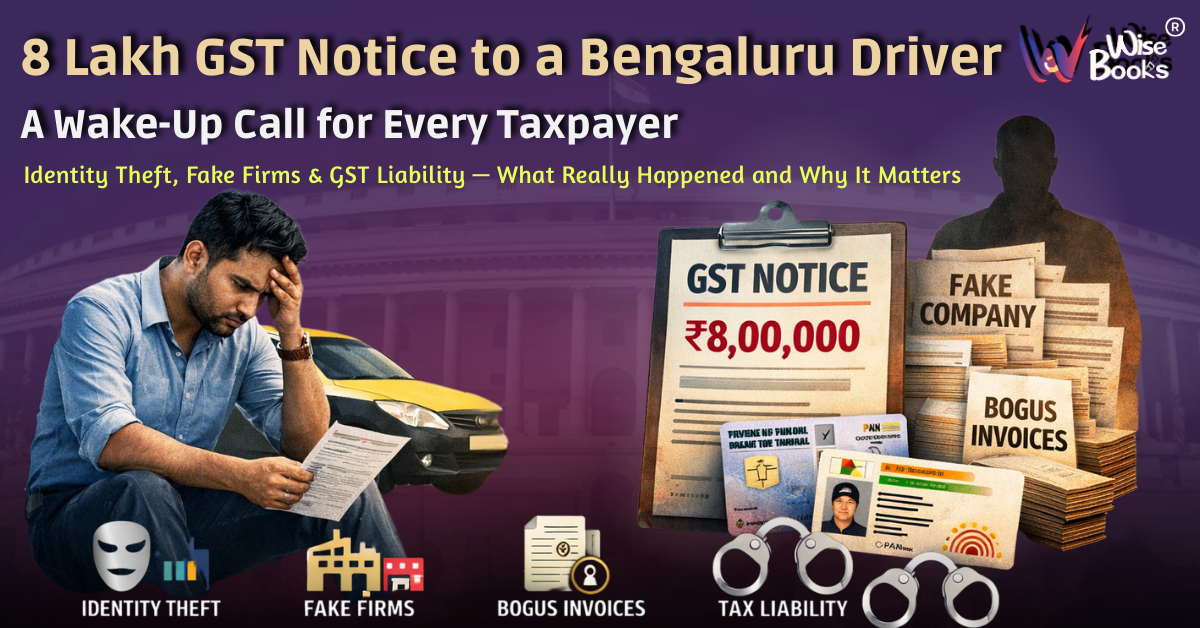
₹8 Lakh GST Notice to a Bengaluru Driver: A Wake-Up Call for Every Taxpayer
Identity Theft, Fake Firms & GST Liability — What Really Happened and Why It Matters
In a deeply disturbing incident reported from Bengaluru, a 26-year-old cab driver working with a regional ride-hailing service found himself entangled in a serious tax dispute after receiving a GST demand notice amounting to nearly ₹8 lakh. What makes the case particularly alarming is the fact that the young driver had never owned or operated a business, had never applied for GST registration, and had no involvement in any taxable commercial activity whatsoever.
The notice came as a complete shock, leaving the driver confused and distressed. Like many individuals earning a modest livelihood, he had limited understanding of GST laws and had never imagined that he could be held accountable for such a massive tax liability. The demand was not the result of any genuine business transaction, but allegedly stemmed from the misuse of his personal identity documents, including PAN and Aadhaar, to create fake business entities without his consent.
This incident has once again highlighted a growing and deeply concerning trend across India: the fraudulent use of personal identification details to obtain GST registrations, issue bogus invoices, and carry out paper transactions aimed at tax evasion. In many such cases, innocent individuals only become aware of the fraud when official tax notices arrive at their doorstep, by which time the damage has already been done.
The Bengaluru case underscores the vulnerability of ordinary citizens in India’s technology-driven and compliance-heavy tax ecosystem, where automated systems generate notices based on data patterns, often without immediate human verification. While digitisation has undoubtedly improved efficiency and transparency, it has also opened new avenues for identity-based financial fraud, placing unsuspecting individuals at risk of legal and financial consequences.
More importantly, the case serves as a powerful reminder that GST compliance is no longer limited to business owners alone. Any individual whose identity documents are misused can unknowingly be dragged into complex tax proceedings. As GST authorities intensify their crackdown on fake firms and bogus invoicing, such incidents are expected to come to light more frequently.
For taxpayers and citizens alike, this episode is a clear wake-up call highlighting the urgent need for document security, regular monitoring of tax records, and greater public awareness about how personal information can be exploited within the tax system.
What Exactly Happened?
As per reports, unidentified individuals allegedly misused the driver’s PAN, Aadhaar, and personal details to set up fake business entities without his knowledge. Using these documents, they obtained GST registrations fraudulently and issued bogus invoices to show taxable transactions that never actually occurred.
These paper transactions were captured in the GST system, which automatically flagged unpaid tax liabilities. As a result, the GST department issued a tax demand notice of nearly ₹8 lakh to the registered taxpayer, the driver whose identity had been misused.
For someone earning a modest livelihood, receiving such a large tax notice was not only shocking but also emotionally distressing and financially overwhelming, exposing the serious consequences of identity-based GST fraud.
Why This Is a Serious Issue — And Not an Isolated Case
This Bengaluru incident is not an isolated occurrence. Across India, tax authorities are increasingly uncovering cases involving identity-based GST fraud, including:
i. Fake firms created using stolen PAN and Aadhaar details
ii. Bogus GST invoices issued to wrongfully claim Input Tax Credit (ITC)
iii. Shell companies that operate briefly, generate paper transactions, and then disappear
In many such cases, innocent individuals remain unaware of the fraud until they receive an official GST notice demanding tax, interest, or penalties.
The Core Issue
GST compliance is highly technology-driven. Most notices are system-generated, triggered by data analytics and return mismatches, rather than immediate personal verification. While this improves efficiency, it also means that identity misuse can go undetected initially, leaving unsuspecting citizens to deal with the consequences later.
How Can Someone Be Trapped Without Knowing?
Identity misuse often happens quietly, without the victim realizing it until a tax notice arrives. Some of the most common ways this occurs include:
Misuse of PAN and Aadhaar
Personal documents are frequently shared for routine purposes such as:
- SIM card verification
- Job onboarding formalities
- Loan or credit applications
- KYC processes handled by unverified or unauthorized agents
Once these details are copied or stored improperly, they can be misused without the individual’s knowledge.
Fraudulent GST Registration
Using stolen identity documents, fraudsters can:
- Register fake business entities online
- Link dummy email IDs and mobile numbers under their control
- File GST returns and manage compliance without alerting the real individual
Since the entire process is digital, the genuine document holder often remains unaware.
Bogus Invoice Networks
After obtaining GST registration, fake firms are used to:
- Issue bogus invoices
- Pass on fraudulent Input Tax Credit (ITC)
- Evade tax payments
Eventually, when the fraud is detected, the registered “owner” becomes legally liable, even though they had no involvement in the transactions.
Why the GST Department Issues Such Notices
From the perspective of the GST authorities, actions are driven strictly by data available on official records rather than personal intent or background verification. When a GST registration exists in an individual’s name, the law presumes that the registered person is responsible for compliance unless proven otherwise.
Typically, the system identifies the following red flags:
- A GST registration is active under the individual’s PAN
- GST returns reflect turnover, outward supplies, or tax liability
- Corresponding tax payments are not made or are inconsistent with reported figures
GST being a technology-driven tax regime, these mismatches are automatically flagged by analytics tools. As a result, demand notices are system-generated and legally valid, even if the registered person is unaware that their identity was misused. At this stage, the law places the burden of explanation on the taxpayer, not on the system.
Legal and Financial Impact on Victims
For individuals whose identities are misused, the consequences can be severe and long-lasting.
Legal Consequences
Victims may be required to:
- Respond to formal GST demand notices
- Appear before tax authorities
- File written explanations, affidavits, and complaints
- Apply for cancellation of fraudulent GST registrations
Failure to respond in time can result in recovery proceedings, including attachment of bank accounts.
Financial Consequences
Even without wrongdoing, victims often face:
- Interest and penalties added to the tax demand
- Temporary freezing or scrutiny of bank accounts
- Legal and professional fees to resolve the matter
Emotional and Personal Impact
Beyond financial loss, such cases cause:
- Extreme mental stress and anxiety
- Fear of legal action or arrest
- Loss of time and productivity
- Reputational concerns, especially for salaried or informal workers
In many cases, proving innocence is neither quick nor simple. It requires time, strong documentation, coordination with authorities, and professional representation, making identity-based GST fraud a deeply distressing experience for ordinary citizens.
Conclusion: A Critical Lesson for Every Citizen
The Bengaluru driver’s case is more than just an isolated tax dispute, it is a stark warning about the hidden risks of identity misuse in India’s digital tax ecosystem. What began as a routine life for a young individual earning an honest living quickly turned into a legal and financial nightmare, solely because his personal documents fell into the wrong hands.
This incident clearly demonstrates that GST compliance is no longer a concern limited to business owners or registered taxpayers. In an era where tax systems rely heavily on automation and data analytics, any individual can unknowingly become liable if their identity is misused. While digitisation has strengthened enforcement and transparency, it has also created new vulnerabilities that fraudsters continue to exploit.
For policymakers and tax authorities, the case highlights the need for stronger verification mechanisms, faster grievance redressal, and better safeguards for innocent victims of identity-based fraud. For citizens, it reinforces the importance of document security, cautious sharing of personal information, and regular monitoring of tax records.
Ultimately, awareness is the strongest defence. Staying informed, vigilant, and proactive can make the difference between preventing fraud and facing its devastating consequences. The Bengaluru incident serves as a powerful reminder that protecting your identity today is essential to protecting your financial future tomorrow.


Comments
No comments yet. Be the first to comment!