


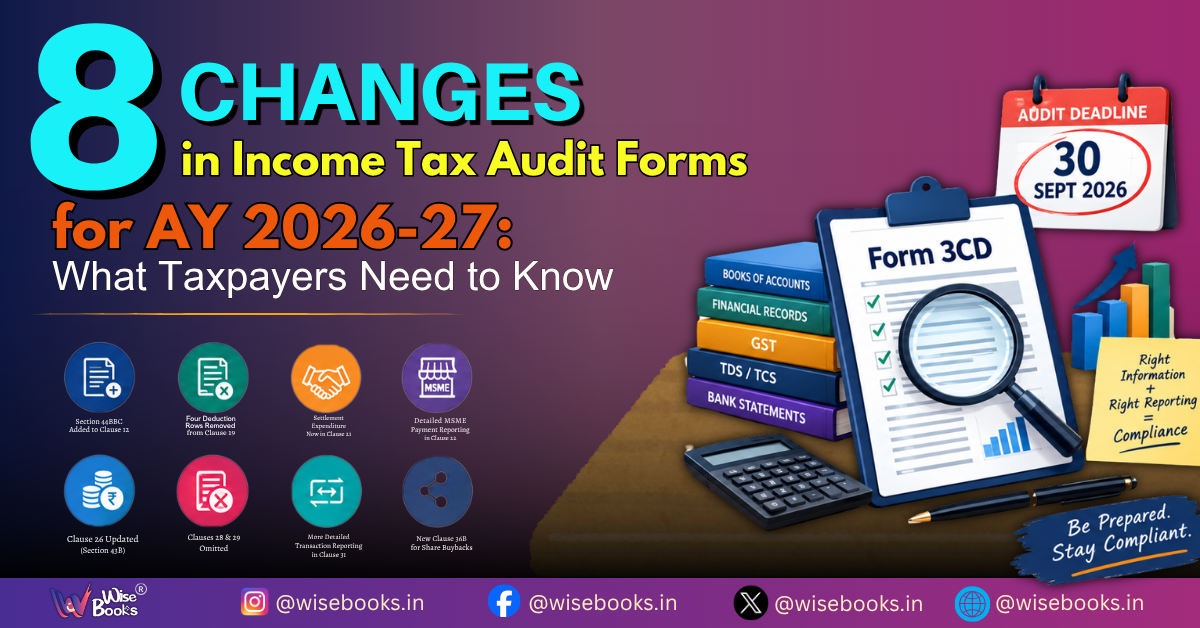
8 Changes in Income Tax Audit Forms AY 2026–27
The Income Tax Audit deadline for AY 2026–27 is September 30, 2026, making it an important compliance date for businesses, professionals and other taxpayers covered under tax audit. A tax audit is required for specified taxpayers to ensure that their books of accounts, income, deductions and other relevant financial information are properly examined and reported. The audit is conducted by a Chartered Accountant, who prepares the prescribed tax-audit report based on the applicable requirements.
For FY 2025–26 / AY 2026–27, taxpayers also need to pay attention to several changes in Form 3CD, which is attached to the tax-audit report. Some reporting requirements have been added, certain disclosures have been removed and existing reporting requirements have been modified.
So, what has changed this year, and what should taxpayers keep in mind before the September 30 deadline?
1. Section 44BBC Added to Clause 12
One of the changes in Form 3CD is the addition of Section 44BBC to Clause 12, which deals with income taxable on a presumptive basis.
Section 44BBC relates to certain non-resident companies providing services or facilities in connection with the prospecting for, or extraction or production of, mineral oils. The inclusion means that the relevant presumptive-taxation information now needs to be considered while preparing the tax-audit report.
For taxpayers covered by this provision, the nature of the business and the applicable tax treatment should be reviewed carefully before the audit report is finalised.
2. Four Deduction Rows Removed from Clause 19
Clause 19 has been streamlined for AY 2026–27, with references to four deduction provisions removed.
The provisions removed from the reporting format relate to Sections 32AC, 32AD, 35AC and 35CCB.
While this reduces certain reporting requirements in Form 3CD, taxpayers should not interpret the change as meaning that all related records or tax computations can be ignored.
The books of accounts and tax computation should still accurately reflect the deductions and other relevant information applicable to the taxpayer.
3. Settlement Expenditure Now Reported Under Clause 21
Another change appears in Clause 21, which now specifically covers expenditure incurred in connection with settling proceedings relating to a contravention under a law notified by the Central Government.
This makes it important for businesses to identify expenses arising from settlements and review their tax treatment before completing the tax-audit report.
In practical terms, businesses should not look at such expenditure only from an accounting perspective. The nature of the expense and the relevant tax provisions should also be considered.
4. Clause 22 Brings Detailed MSME Payment Reporting
For businesses dealing with micro and small enterprises, Clause 22 is particularly important.
The revised Clause 22 requires reporting of information relating to MSME payments, including interest that is inadmissible under Section 23 of the MSMED Act and amounts required to be paid to eligible micro or small enterprises under Section 15. It also requires a breakup of amounts paid within the prescribed period and amounts that were not paid within that period.
This means businesses need to look beyond their closing creditor balance.
They should review vendor classification, payment terms, relevant invoice or acceptance dates and actual payment dates to determine whether the information reported in the audit report is accurate.
For businesses with significant MSME transactions, proper reconciliation before the audit report is finalised can help identify potential reporting and deduction issues.
5. Clause 26 Updated in Relation to Section 43B
Clause 26 has also been revised in line with the current Section 43B framework.
Section 43B covers certain expenses for which deduction is subject to specified payment conditions. The revised reporting structure also distinguishes the MSME-related provision under Section 43B(h) from the other categories covered under Section 43B.
Businesses should therefore review their outstanding liabilities and payment records carefully.
The key point is that the figures reported in the tax-audit report should be properly supported by the books of accounts and relevant documentation.
6. Clauses 28 and 29 Omitted
The revised Form 3CD has also omitted Clauses 28 and 29.
These clauses were previously part of the reporting format, but they no longer appear in the revised Form 3CD applicable for AY 2026–27.
For taxpayers, this means that the corresponding disclosures are no longer required in the same format.
However, businesses should still retain relevant records wherever they are required under other applicable tax, accounting or regulatory requirements.
A reporting requirement being removed from Form 3CD does not automatically mean that the underlying transaction or documentation is irrelevant.
7. Clause 31 Requires More Detailed Transaction Reporting
Clause 31 has been modified to require more detailed information about specified transactions.
The revised reporting includes additional details regarding the nature and mode of certain loans, deposits, specified advances and their repayments, along with applicable transaction codes.
This makes transaction-level record keeping even more important.
Businesses should ensure that their books, bank statements and supporting documents contain sufficient information to identify the nature of these transactions accurately.
Waiting until the final stage of the audit to collect this information can make reconciliation more difficult. Maintaining proper records throughout the year can make the reporting process considerably smoother.
8. New Clause 36B Introduced for Share Buybacks
One of the notable additions to Form 3CD is Clause 36B, which introduces reporting requirements relating to certain share buyback receipts.
Where an assessee receives an amount from a buyback of shares covered under Section 2(22)(f), the relevant amount needs to be reported under the new clause. The reporting is focused on the amount received and the related information prescribed under the form.
This is particularly relevant for taxpayers who have received buyback consideration during the relevant financial year.
Businesses and shareholders covered by the provision should therefore ensure that the necessary transaction documents and tax records are available before the tax-audit report is prepared.
Why Do These Changes Matter?
At first glance, changes to Form 3CD may appear to be technical updates mainly relevant to Chartered Accountants. But they can have a direct impact on the information businesses need to maintain, reconcile and provide during the tax-audit process.
A tax audit is not simply about checking whether the final profit figure is correct. The tax auditor also needs to report various prescribed particulars based on the taxpayer's books and supporting records.
That is why businesses should avoid treating the tax audit as a last-minute exercise.
For AY 2026–27, several areas require closer attention, particularly MSME payments, Section 43B, specified financial transactions, settlement expenditure and share buybacks.
What Should Taxpayers Check Before September 30?
With the tax-audit deadline approaching, businesses should review their records and ensure that the information required by their tax auditor is complete and properly reconciled.
Some important areas to review include:
- Books of accounts and financial statements
- Payments to eligible micro and small enterprises
- Section 43B-related liabilities
- Settlement-related expenditure
- Specified loans, deposits and advances
- Share buyback transactions, wherever applicable
- GST turnover and books reconciliation
- TDS and TCS records
- Bank statements and supporting documents
- Information required for Form 3CD disclosures
Businesses should also check whether information reported across their accounting records, GST records, TDS/TCS statements and other financial documents is consistent.
The Income Tax Department provides the prescribed tax-audit forms and related e-filing utilities, and the applicable form depends on the nature of the taxpayer's audit requirements.
The Bigger Picture: Tax Audit Is Becoming More Data-Driven
Tax audit is increasingly becoming more than a year-end accounting exercise. It is becoming a data-reconciliation and reporting exercise, where information from different financial and compliance records needs to come together accurately.
For AY 2026–27, businesses should therefore ask more than:
“Is our tax audit report ready?”
A more useful question is:
“Can every important figure and disclosure in our tax-audit report be traced back to our books and supporting documents?”
With September 30, 2026 approaching, businesses should complete their reconciliations, review the relevant Form 3CD requirements and provide the necessary information to their tax auditors well before the deadline.
Because in tax audit, getting the numbers right is only one part of compliance. Getting the reporting right matters too.


Comments
No comments yet. Be the first to comment!