


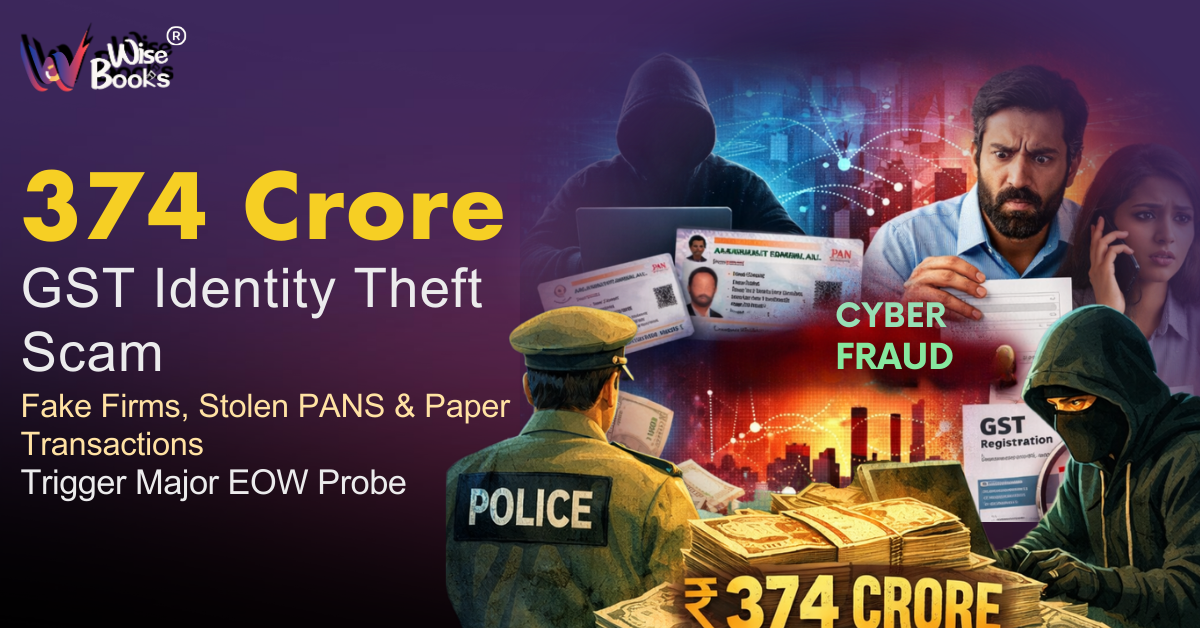
₹374 Crore GST Identity Theft Scam: How Fake Firms, Stolen PANs and Paper Transactions Triggered a Major EOW Probe
The Economic Offences Wing (EOW) of the Delhi Police has launched a large-scale investigation into an alleged GST fraud amounting to nearly ₹374 crore, uncovering a disturbing pattern of identity theft, fake registrations, and paper-only transactions. The probe was initiated after seven separate complaints were registered during November and December, all pointing to a common modus operandi, misuse of personal identity documents without the knowledge of the victims.
This case highlights a growing vulnerability in India’s tax ecosystem, where unsuspecting individuals are being turned into “dummy taxpayers”, only discovering the fraud when tax notices arrive years later.
How the Fraud Came to Light
According to police officials, the fraudsters allegedly collected PAN cards, Aadhaar details, and other personal credentials of individuals under seemingly legitimate pretexts such as job offers, salary account opening, financial assistance, or GST compliance services. These documents were then used to obtain GST registrations without the consent or awareness of the victims.
Once registered, these entities showed extremely high-value transactions on paper, even though no real goods or services were exchanged. Investigators believe most of these transactions were purely fictitious, designed to inflate turnover figures, facilitate tax evasion, or enable fraudulent input tax credit (ITC) claims.
Businessman Discovers ₹194.7 Crore Fraud During ITR Filing
One of the most alarming revelations in the ongoing GST identity-theft investigation emerged on December 11, 2025, when a businessman residing in Inderpuri, West Delhi, uncovered a massive financial fraud completely unknown to him until that moment. The discovery occurred during a routine income tax return (ITR) filing exercise, a process the businessman had undertaken as part of his regular statutory compliance.
While reviewing the financial data, the businessman’s chartered accountant noticed serious irregularities linked to the PAN of the taxpayer. These discrepancies were entirely inconsistent with the individual’s actual income, business profile, and financial history. What initially appeared to be a data mismatch soon revealed a far more serious issue.
A deeper probe showed that a GST registration had been fraudulently obtained using the businessman’s PAN, without his consent or knowledge. Shockingly, the fake entity registered under his identity had allegedly reported transactions worth ₹194.7 crore, despite the businessman never having carried out any such business activity, sales, or purchases.
The individual had never applied for GST registration, never operated the firm reflected in official records, and had no bank accounts or commercial dealings connected to the reported transactions. In effect, his identity had been hijacked and used to run a shell company existing only on paper, while massive turnovers were artificially created in his name.
The fraud might have continued unnoticed for a much longer period had it not been for professional scrutiny during tax compliance. It was only because the chartered accountant carefully reviewed PAN-linked data and compliance records that the issue was detected. This highlights the critical role of audits, ITR filings, and professional reviews in identifying hidden financial crimes.
This case starkly demonstrates how large-scale GST frauds often remain concealed until they surface during assessments, departmental scrutiny, or statutory filings. Many victims remain unaware of such misuse for years, only discovering the problem after receiving tax notices, recovery proceedings, or summons from authorities.
The incident serves as a powerful reminder that regular compliance checks and expert oversight are not merely procedural formalities, but essential safeguards against identity theft, fraudulent registrations, and serious financial exposure for innocent taxpayers.
Dummy Company Created in the Name of a Delhi Couple
In another case registered in November, a Delhi-based couple approached the police after discovering that a dummy company had been created using their identities. The fake entity reportedly showed transactions amounting to ₹69.9 crore, despite the couple never having operated any business or applied for GST registration.
Such cases demonstrate how ordinary citizens with no commercial background can become accidental targets of large-scale financial fraud, exposing them to legal stress, tax notices, and reputational harm.
Job Seekers and Low-Income Workers Among Primary Targets
A particularly alarming complaint was filed on December 24, involving suspected GST fraud of nearly ₹48 crore. The complainant, a former data-entry operator, told police that his PAN and Aadhaar details were collected under the pretext of opening a salary account.
Months later, he began receiving notices from the Income Tax Department in Karnataka and tax authorities in Gurgaon and Siwan, seeking explanations for high-value transactions allegedly conducted in his name. This case highlights how job seekers and low-income workers are especially vulnerable, as they may not regularly monitor tax portals or understand early warning signs.
Additional Cases Under Investigation
Apart from the major fraud cases, the Economic Offences Wing (EOW) of the Delhi Police has confirmed that four more complaints are under active investigation, involving alleged fraudulent GST transactions of:
· ₹9.4 crore
· ₹20 crore
· ₹26.9 crore
· ₹5.3 crore
Although smaller in individual value, these cases follow a similar pattern of identity misuse and fake GST registrations, indicating a systematic and organised fraud operation rather than isolated incidents. Investigators believe these entities were created solely for paper-based transactions, aimed at inflating turnovers and bypassing detection.
Together, these cases strengthen the view that the frauds are part of a coordinated network exploiting gaps in GST compliance systems.
Organised Network and Sophisticated Modus Operandi Suspected
Investigators believe an organised gang may be behind the frauds. According to sources, scammers often:
- Open bank accounts using manipulated or newly created credentials, not linked to victims’ existing accounts
- Use these accounts for shell companies that exist only on paper
- Show fake purchases and sales between multiple dummy entities
- Artificially inflate GST turnovers to support bogus compliance records
By keeping these accounts disconnected from victims’ real financial profiles, fraudsters reduce the risk of immediate detection, allowing the scam to continue until tax scrutiny begins.
Why These Frauds Are Especially Dangerous
Such GST identity theft cases are dangerous because:
- Victims are legally shown as business operators without consent
- Tax notices, recovery proceedings, and even prosecution risks fall on innocent individuals
- Clearing one’s name requires lengthy correspondence, FIRs, and departmental representations
- Government revenue systems suffer due to fake ITC claims and distorted turnover data
In many cases, victims learn about the fraud years after it has occurred, making damage control even more complex.
Public Advisory Issued by Authorities
In light of the investigation, authorities have issued a public advisory urging citizens to remain vigilant.
Taxpayers are advised to regularly verify PAN-GSTIN linkages on the GST portal and immediately report any unauthorised registrations. Individuals should avoid casually sharing copies of PAN, Aadhaar, or bank documents, even for job applications or consultancy services. Old paperwork should be securely destroyed to prevent misuse.
If any unexpected tax notice is received, citizens should act immediately by contacting the tax department, filing a police complaint, and seeking professional assistance.
Conclusion: A Wake-Up Call for Every Taxpayer
The ₹374 crore GST identity theft scam under investigation by the Economic Offences Wing of the Delhi Police exposes a serious and growing threat within India’s tax compliance framework. What emerges clearly from these cases is that identity misuse is no longer limited to cyber or banking fraud, it has evolved into a systematic exploitation of GST and PAN-based systems, capable of causing severe legal and financial consequences for innocent individuals.
From businessmen and salaried couples to job seekers and low-income workers, the victims in this case share one common factor: their personal documents were misused without their knowledge, turning them into “dummy taxpayers” overnight. The fact that most frauds surfaced only during ITR filings, audits, or departmental scrutiny highlights how easily such schemes can remain hidden for years.
This investigation underscores the critical importance of regular compliance reviews, PAN–GST monitoring, and professional oversight. In an increasingly digitised tax ecosystem, vigilance is no longer optional; it is essential. Strengthening verification mechanisms, improving public awareness, and adopting proactive compliance practices are key to preventing such large-scale misuse in the future.
Ultimately, this case serves as a stark reminder that timely scrutiny can protect not only government revenue, but also the rights, reputations, and peace of mind of honest taxpayers.


Comments
No comments yet. Be the first to comment!