


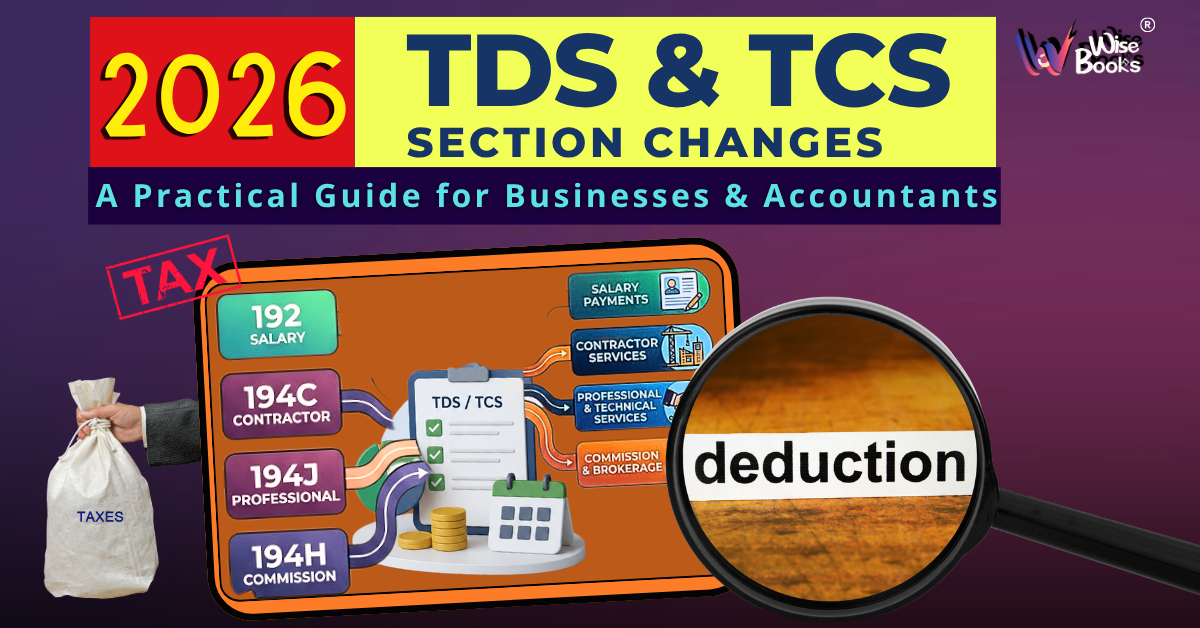
2026 TDS & TCS Section Changes: A Practical Guide for Businesses and Accountants
India's tax compliance landscape is evolving with the implementation of the Income-tax Act, 2025, effective from 1 April 2026. One of the most significant administrative changes is the introduction of a revised reporting framework for Tax Deducted at Source (TDS) and Tax Collected at Source (TCS).
While the tax deduction and collection principles largely remain the same, businesses will notice changes in how these transactions are identified and reported through payroll systems, ERP platforms, accounting software, and tax filing utilities.
This update is aimed at making tax administration more structured, digital, and easier to manage. For finance teams, payroll professionals, accountants, and business owners, understanding these changes is essential to ensure accurate reporting and smooth compliance.
Why Was the TDS & TCS Reporting Framework Updated?
The Income-tax Act has undergone numerous amendments over the years, making its numbering structure increasingly complex. To simplify compliance and improve digital tax administration, the Income-tax Act, 2025 reorganizes TDS and TCS provisions into a more structured framework.
The objectives include:
- Simplifying tax law references.
- Improving consistency in reporting.
- Supporting automated payroll and accounting systems.
- Making future amendments easier to implement.
- Enhancing digital compliance and return processing.
Businesses should note that these changes primarily affect reporting and compliance. The nature of many taxable transactions continues to remain the same unless specifically amended by law.
Major TDS Categories Businesses Should Know
Instead of focusing only on section numbers, businesses should understand the type of payment that attracts TDS and ensure it is reported correctly.
1. Salary Payments
Earlier Provisions: Section 192 and Section 192A
Salary is one of the most common categories under TDS. Employers deduct tax from employee salaries after considering exemptions, deductions, declarations, and the applicable tax regime.
The framework also covers certain employee-related payments, including eligible accumulated balances payable under specified circumstances.
Example:
A company processing monthly payroll deducts TDS before crediting employees' salaries and deposits the tax with the government within the prescribed timelines.
2. Commission and Brokerage
Earlier Provisions: Section 194D and Section 194H
Businesses often pay commission to insurance agents, brokers, marketing representatives, and sales agents. Depending on the nature of the payment and applicable conditions, TDS may need to be deducted before releasing the amount.
Example:
A real estate developer pays brokerage to a property consultant. The finance team reviews the applicable TDS provisions before making the payment.
3. Rent Payments
Earlier Provision: Section 194I
Payments made towards office rent, warehouse rent, factory premises, machinery, or equipment may attract TDS where the prescribed conditions are met.
Maintaining proper lease agreements and payment records helps businesses ensure smooth compliance.
4. Immovable Property Transactions
Earlier Provisions: Section 194-IA and Section 194LA
Certain payments made while purchasing immovable property or compensation paid on compulsory acquisition are covered under TDS provisions. Businesses involved in property transactions should review the applicable requirements before completing the transaction.
5. Investment, Mutual Fund & Business Trust Income
Earlier Provisions: Section 194K, Section 194LBA, Section 194LBB and Section 194LBC
Specified distributions from mutual funds, business trusts, REITs, investment funds, and securitisation trusts may require tax deduction at source. Investors and financial institutions should verify the applicable tax treatment before making or receiving payments.
6. Interest Payments
Earlier Provisions: Section 193 and Section 194A
Interest paid on securities, fixed deposits, corporate deposits, and other eligible financial instruments may attract TDS depending on the nature of the payment and the recipient.
Financial institutions and businesses should ensure that interest payments are correctly classified in their accounting systems.
7. Contractor Payments
Earlier Provision: Section 194C
Payments made to contractors for construction, transportation, maintenance, fabrication, advertising, or similar contractual work may be subject to TDS after considering the applicable provisions and thresholds.
Proper vendor classification and documentation are essential for accurate reporting.
8. Professional & Technical Services
Earlier Provision: Section 194J
Payments to chartered accountants, lawyers, consultants, architects, engineers, doctors, technical experts, and company directors may attract TDS based on the nature of the service provided.
Businesses should maintain invoices, agreements, and payment records to support compliance.
9. Dividends, Insurance & Other Business Payments
Earlier Provisions: Section 194, Section 194DA, Section 194Q, Section 194P, Section 194R, Section 194O and Section 194S
Several business transactions continue to fall within the TDS framework, including:
- Dividend payments
- Eligible life insurance proceeds
- Purchase of goods
- Benefits or perquisites
- E-commerce transactions
- Certain virtual digital asset transactions
Each category has its own compliance requirements, making proper transaction classification important.
10. Special TDS Categories
Certain transactions require special attention due to their unique nature, including:
- Lottery winnings
- Online gaming winnings
- Horse race winnings
- Lottery-related income
- Specified cash withdrawals
- Certain partner remuneration and interest
Businesses operating in these sectors should ensure that tax deductions are made wherever applicable and reported correctly.
Major TCS Categories
Apart from TDS, businesses dealing in specified transactions may also be responsible for collecting tax at source.
Some important TCS categories include:
- Sale of scrap
- Sale of minerals
- Sale of specified goods
- Motor vehicles
- Certain luxury goods
- Overseas tour programme packages
- Liberalised Remittance Scheme (LRS) transactions
- Specified business rights involving mines, tolls, or parking facilities
Businesses operating in these industries should review their invoicing and collection processes to ensure TCS is collected and deposited in accordance with the applicable provisions.
Impact on Payroll, Accounting & ERP Systems
The revised reporting framework requires businesses to review their technology systems carefully.
Key areas that may require updates include:
- Payroll software
- ERP systems
- Accounting software
- Vendor master records
- Employee tax profiles
- TDS/TCS configurations
- Return filing utilities
Organizations using automated accounting solutions should confirm with their software providers that the latest compliance updates have been implemented.
Compliance Checklist
Before filing future TDS and TCS returns, businesses should:
- Review existing TDS and TCS processes.
- Update payroll and accounting software.
- Verify vendor and employee master data.
- Test ERP tax configurations.
- Train finance and payroll teams.
- Maintain proper supporting documents.
- Monitor official notifications and compliance updates.
Why This Matters for Businesses
Although these updates are largely administrative, they have a direct impact on day-to-day compliance. Incorrect transaction classification, outdated software configurations, or inaccurate reporting can result in filing errors, reconciliation issues, and additional compliance efforts.
Businesses that prepare in advance by updating systems, reviewing internal processes, and training their teams will be better positioned to manage the transition smoothly.
Conclusion
The revised TDS and TCS reporting framework under the Income-tax Act, 2025 marks another step toward a modern, technology-driven tax administration system. While the core principles of tax deduction and collection remain familiar, businesses must adapt their reporting systems and compliance processes to align with the updated framework.


Comments
No comments yet. Be the first to comment!