


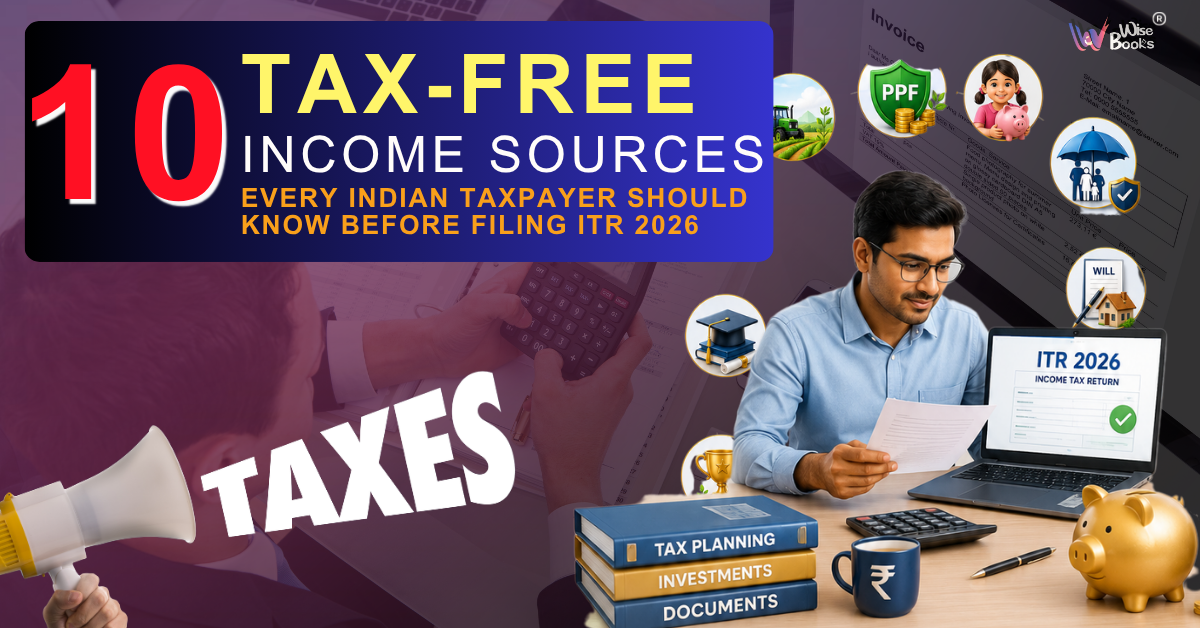
Legally Reduce Your Tax Burden by Understanding Income That Doesn't Attract Income Tax
Every year, millions of Indians focus only on taxable income while filing their Income Tax Return (ITR). Salaries, business profits, rental income, and capital gains often receive the most attention. However, what many taxpayers overlook is that the Income Tax Act also provides several types of income that are completely tax-free or exempt under specific conditions.
Knowing these exemptions is more than just saving taxes, it helps you file your ITR accurately, avoid unnecessary tax payments, and make smarter financial decisions. Whether you're a salaried employee, investor, freelancer, retiree, or business owner, understanding tax-free income can significantly improve your tax planning.
As the ITR filing season for FY 2025-26 (AY 2026-27) approaches, here are 10 important tax-free income sources every Indian taxpayer should know.
1. Agricultural Income
Why is it Tax-Free?
Agricultural income earned from agricultural land situated in India is exempt from income tax under Section 10(1) of the Income Tax Act.
This includes income from:
i. Sale of agricultural produce
ii. Cultivation of crops
iii. Rent received from agricultural land
iv. Income from certain farming activities
Important Points
i. Fully exempt under normal circumstances.
ii. Large agricultural income may still be considered for calculating tax rates if your non-agricultural income exceeds the prescribed limit.
iii. Proper records of agricultural activities should be maintained.
Example:
If a farmer earns ₹6 lakh annually from farming activities, that income is generally not taxable.
2. Interest Earned on Public Provident Fund (PPF)
One of India's Best Tax-Free Investments
The Public Provident Fund (PPF) follows the popular EEE (Exempt-Exempt-Exempt) taxation model.
This means:
- Investment qualifies for deduction (subject to applicable rules).
- Interest earned is tax-free.
- Maturity amount is also tax-free.
Why Investors Love PPF
- Completely safe government-backed investment.
- Long-term wealth creation.
- No tax on yearly interest.
- Ideal for retirement planning.
3. Interest Earned on Sukanya Samriddhi Yojana (SSY)
Parents investing for their daughter's future enjoy tax-free benefits under the Sukanya Samriddhi Yojana.
Tax Benefits
- Interest earned is exempt.
- Maturity amount is exempt.
- Investment qualifies for tax deduction under eligible provisions.
Best For
- Girl child education
- Marriage planning
- Long-term disciplined savings
4. Life Insurance Policy Maturity Amount
A Major Tax-Free Benefit
The maturity proceeds received from a life insurance policy are generally exempt under prescribed conditions.
This may include:
- Sum assured
- Bonus received
- Final maturity amount
Keep in Mind
The exemption depends on factors such as:
- Date of policy issuance
- Premium amount relative to the sum assured
- Compliance with applicable provisions
High-value policies may be subject to specific taxation rules introduced in recent years.
5. Gifts Received from Relatives
Many taxpayers assume every gift is taxable.
That's not true.
Certain gifts received from specified relatives are fully tax-free regardless of the amount.
Specified Relatives Include
- Parents
- Spouse
- Brother or sister
- Grandparents
- Children
- Lineal ascendants and descendants
- Certain in-laws as defined under tax law
Example
If your parents gift you ₹15 lakh for purchasing a house, the amount is generally tax-free.
6. Amount Received Through Inheritance or Will
Receiving property, cash, jewellery, or investments through inheritance is generally not taxable.
Examples Include
- Property inherited from parents
- Cash received through a Will
- Jewellery inherited from grandparents
- Family investments transferred after death
However
Although inheritance itself is tax-free, any income earned later from the inherited asset (such as rent, interest, or capital gains on sale) may be taxable.
7. Scholarships Granted for Education
Scholarships received to meet educational expenses are exempt from income tax.
This Includes
- Government scholarships
- University scholarships
- Merit scholarships
- Research fellowships
- International education grants
Who Benefits?
- School students
- College students
- Research scholars
- PhD candidates
The exemption helps reduce the financial burden of education.
8. Interest Earned on Tax-Free Bonds
Certain government-backed tax-free bonds provide interest that is exempt from income tax.
These bonds have been issued by entities such as:
- Infrastructure financing companies
- Government-backed public sector undertakings
Benefits
- Fixed returns
- Tax-free interest
- Suitable for conservative investors
- Lower investment risk
9. Gratuity Received by Employees (Within Prescribed Limits)
Gratuity is a retirement benefit paid by employers to employees after completing eligible years of service.
Tax Treatment
Gratuity may be fully or partially exempt depending on:
- Type of employment
- Employer category
- Applicable exemption limits
- Relevant tax provisions
Why It Matters
For many employees, gratuity forms an important part of retirement savings.
10. Leave Encashment at Retirement (Subject to Applicable Rules)
Many employees accumulate unused earned leave during their service.
At retirement or resignation, employers may compensate employees for this unused leave.
Tax Benefits
Leave encashment may qualify for exemption based on:
- Government or non-government employment
- Applicable exemption limits
- Conditions under the Income Tax Act
Proper reporting while filing ITR is essential.
Bonus Tax-Free Income You Should Also Know
Apart from the above, taxpayers should also be aware of several other exempt income sources:
EPF Withdrawal
Eligible withdrawals from the Employees' Provident Fund are generally tax-free when prescribed conditions are fulfilled.
Interest on Certain Savings Accounts
Interest may enjoy deductions under applicable sections, especially for senior citizens and eligible taxpayers.
Certain Government Compensation
Some government compensation and relief payments notified under law may also be exempt.
Common Mistakes Taxpayers Make
Many taxpayers lose tax benefits simply because they are unaware of exemption rules.
Avoid these common mistakes:
- Assuming every receipt is taxable.
- Not reporting exempt income where disclosure is required.
- Ignoring conditions attached to exemptions.
- Mixing taxable and exempt investment returns.
- Not maintaining supporting documents.
- Choosing the wrong tax regime without evaluating benefits.
Proper documentation and understanding of the law can help prevent errors during ITR filing.
How Tax-Free Income Helps You
Understanding exempt income is not just about saving tax, it also improves your overall financial planning.
Benefits Include
i. Lower tax liability
ii. Better investment planning
iii. Accurate ITR filing
iv. Reduced chances of receiving tax notices
v. Improved long-term wealth creation
vi. Smarter retirement planning
Important Things to Remember Before Filing ITR 2026
Before submitting your Income Tax Return, ensure that you:
- Identify all taxable and exempt income separately.
- Keep records supporting exempt income claims.
- Verify applicable conditions under the Income Tax Act.
- Report exempt income where required in the ITR form.
- Cross-check bank interest, investment income, and salary details.
- Choose the tax regime that best suits your financial situation.
Taking a little extra time before filing can help you avoid mistakes and make full use of the tax benefits available to you.
Final Thoughts
Tax planning is not about avoiding taxes; it is about understanding the provisions of the Income Tax Act and making informed financial decisions. Many taxpayers unknowingly pay more tax than required simply because they are unaware of legitimate exemptions available to them.
By knowing these 10 tax-free income sources, you can file your ITR for AY 2026–27 with greater confidence, improve your tax efficiency, and ensure that you claim every benefit you are legally entitled to.
Whether you are a salaried employee, investor, retiree, or entrepreneur, staying informed about tax-free income is an essential part of responsible financial planning.
Disclaimer: Tax laws and exemption conditions may change through amendments, Finance Acts, or government notifications. Taxability also depends on individual circumstances and the tax regime chosen. Always refer to the latest Income Tax provisions or consult a qualified tax professional before making financial or tax-related decisions.


Comments
No comments yet. Be the first to comment!